

Last Updated on October 20, 2026 by Umar Farooq
Pavers settling after installation is normal only in two small ways: the pavers are meant to compact down slightly during installation, and some joint sand drops in the first months. A dip, a rocking paver, a corner that cracks or a gap that keeps growing is not normal, and it points to the base. Pavers are not supposed to keep sinking.
I looked for a published number for how much a new patio may settle after the crew leaves. I did not find one. What I did find are limits that apply while it is built, and warning signs that apply afterwards.
Settling you plan for happens before you walk on it
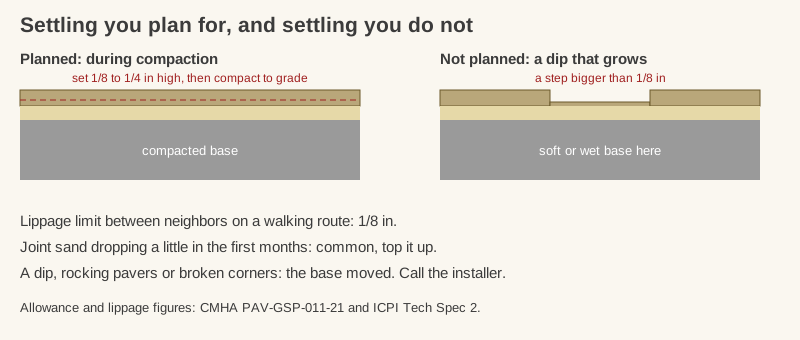
CMHA's guide specification lets pavers sit 1/8 to 1/4 inch above final grade before the plate compactor goes over them, because the compaction seats them into the bedding sand (CMHA PAV-GSP-011-21). That is the allowance built into good work, and it happens on day one. After that, a patio on a properly compacted base should have very little left to give.
The bedding sand is also part of it. ICPI's spec asks for a nominal 1 inch of screeded, uncompacted sand (ICPI Tech Spec 2). Two inches in a low spot squashes more than one inch everywhere else, which is why a patio shows the installer's shortcuts a year later as a shallow dish. For the rule, see screeding sand for pavers.
Pavers settling after installation: what is normal in the first months
A few things count as ordinary:
- Joint sand drops. Alliance Gator's SuperSand G2 data sheet says about 30 to 50 percent of the sand drops after the first compaction. That is a product-specific figure. A newspaper advice column agrees in plainer words: sand "has a tendency to wash out between the cracks," and a new patio needs topping up. See re-sand pavers.
- Surface sand and dust. Loose sand on top after rain is not settling.
Limits you can measure
Settling can only be judged against a standard, and the useful ones are small:
| What | Limit | Source |
|---|---|---|
| Height difference between neighboring pavers on a walking route | max 1/8 inch (lippage) | ICPI Tech Spec 2 |
| Base surface before the sand goes down | within 3/8 inch over a 10 ft straightedge | CMHA PAV-GSP-011-21 |
| Pavers before compaction | 1/8 to 1/4 inch above final grade | CMHA PAV-GSP-011-21 |
| Minimum slope for drainage | 1.5% | ICPI Tech Spec 2 |
Agrio's homeowner guide suggests checking with a 4 foot level or broomstick and points to the same 1/8 inch limit. A step bigger than 1/8 inch between two pavers is a trip hazard, not a style choice.
I could not find a published figure for settling after the work is done. Forum posts offer opinions, not tolerances, and I would not hold an installer to one. What I can say is the mechanism: the base should be dense enough that it does not compress under traffic.
What is not normal
Rochester Concrete Products lists the usual causes of sinking, and the telling thing is that almost all of them are installation or water issues, not defective pavers:
- a subgrade that was not prepared well,
- a base that is too shallow or placed in thick lifts,
- uneven bedding sand,
- missing or loose edge restraint,
- unfilled joints, and
- water from downspouts, grading or irrigation.
Rochester's own words: "In most cases, sunken pavers or uneven pavers are not caused by defective pavers." If your patio is only a few months old and has any of the following, it is not settling in the healthy sense:
- a dip that holds water,
- a paver that rocks or clunks,
- cracked or broken corners,
- joints that open in one patch while the rest are tight, or
- a low spot that gets deeper after each rain.
A one-week test you can do yourself
- Lay a straightedge or long level across the suspect area and measure the gap at the deepest point with a ruler. Write it down with the date.
- Take a photo with the straightedge in frame.
- Check again after a heavy rain and after a month. This is my method, not a published one.
- If the number grows, or water stands in it, ask the installer to look.
A dip that is not growing and is under 1/8 inch relative to its neighbor is probably cosmetic. A dip that is growing is the base telling you something.
Talk to the installer before you fix it yourself
If you hired the job, call the installer, describe the dip with your measurements and ask what base depth and compaction method they used. Our paver warranty guide covers what warranties usually say. Questions worth asking, in this order:
- What base depth did you build, and on what soil?
- How thick were the compaction lifts, and what size plate compactor did you use? (ICPI's 4 to 6 inch lifts assume a 7,000 lbf plate, and thinner lifts for smaller ones, per Tech Spec 2.)
- How thick is the bedding sand, and is it ASTM C33 concrete sand?
- What edge restraint is on every open side, and how is it fixed?
- Is the joint sand polymeric, and has it been topped up since the first compaction?
Their answers tell you where to look. Repairing it yourself first may affect a workmanship warranty, so check the terms and get the installer's answer in writing.
If you built it yourself, a localized dip is fixable. The procedure is in how to fix sunken pavers: lift, rebuild the base under the dip, re-screed and relay. You can do it in an afternoon, and the pavers go back where they came out. Avoid the temptation to shovel more sand under the low spot. Rochester's guide says to "avoid using extra bedding sand to compensate for an improperly prepared base," and the base tolerance in the table above is measured before the sand goes down for a reason.
For general mistakes that cause early sinking, common paver installation mistakes is the checklist.
Normal ends where the dip begins
Small joint-sand loss and a few seated pavers in the first season are ordinary. A measurable dip that grows is a base problem, and the sooner you measure it, the cheaper the fix. If someone tells you "it will settle" about a step you can feel with your foot, believe your foot. It is the only inspector you did not have to hire.
FAQ
How much should new pavers settle?
Pavers are set 1/8 to 1/4 inch high so they compact flush to final grade during installation (CMHA PAV-GSP-011-21). After that, a properly compacted base should show very little further settling, and I found no published tolerance for it.
Is it normal for polymeric sand to drop after installation?
Some of it, yes. Alliance Gator's data sheet says about 30 to 50 percent of the sand drops after the first compaction, and joints may need topping up.
How do I know if my pavers are sinking?
Lay a straightedge across the area and measure. A step over 1/8 inch between neighbors, a dip that holds water, rocking pavers or cracked corners point to a base problem.
Will sunken new pavers fix themselves?
Not if the base is soft or wet. A dip that grows needs the pavers lifted and the base rebuilt.
Who pays if pavers settle after installation?
It depends on the contract and warranty. Photograph and measure the problem, then call the installer before touching it.


