

Last Updated on October 20, 2026 by Umar Farooq
Paving stones or concrete comes down to paying now or paying later. A plain poured concrete patio costs less to build, often around half the price of pavers per square foot. It will almost certainly crack somewhere, though, and a cracked slab can only be patched or cut out and repoured. Paving stones cost more up front, but they're rated stronger, flex with frost, and any section can be lifted, fixed and relaid with the same pavers. Pick concrete for a tight budget, a simple shape or a spot under a roof. Pick pavers where it freezes, where tree roots or pipes run underneath, or where you want to build it yourself over a few weekends. We have a separate page on basalt pavers if you need the specifics. You can read more in the guide to pavers heaving in winter.
I read the pages that rank for this question, and all three come from companies that sell or install pavers. One admits it in its first line, which is more candor than I expected. The numbers below are theirs, the arithmetic is mine, and concrete gets a fair hearing.
Paving stones or concrete, side by side
| Poured concrete patio | Paving stones (concrete pavers) | |
|---|---|---|
| Upfront cost | Lowest; plain gray is the budget option | Higher; roughly double plain concrete |
| Strength of the material | Western Interlock puts poured patio concrete at 2,500 to 3,000 psi | 8,000 psi minimum average (ASTM C936, via CMHA) |
| Cracking | Expected; control joints decide where | Joints between units take the movement |
| Repairs | Patch (visible) or cut out and repour a section | Lift, fix the base, relay the same units |
| Use after building | Wait for the concrete to cure | Walk on it the same day |
| DIY friendliness | One pour, one finishing window, a crew | Can be built in stages by one or two people |
| Upkeep | Sweep, reseal every few years | Sweep, top up joint sand, pull the odd weed |
The strength row needs a caveat. Western Interlock makes pavers, and its 2,500 to 3,000 psi is a typical residential mix, not a ceiling; a stronger one can be ordered. The 8,000 psi for pavers is a standard, not a sales claim. Every ASTM C936 paver has to meet it, plus a 5% average absorption limit that keeps water, and frost damage, out of the unit.
What each one costs to build
The three contractor pages publish ranges that line up well:
- Outback Landscape (Idaho) lists basic poured concrete at about $4 per square foot, stamped, scored or colored concrete at about $12, and concrete pavers at up to $24 installed.
- Eli's Paver Patios gives $4 to $8 for concrete (up to $12 stamped) against $10 to $20 for pavers (up to $30 for high-end).
For a 12 x 16 ft patio (192 sq ft), that's about $770 to $1,540 for plain concrete against roughly $1,900 to $3,840 for pavers at Eli's figures. Our patio pavers price breakdown shows where the paver money goes. Most of it is labor and base, not the pavers themselves.
Stamped concrete is where the gap closes. Once you're paying about $12 a square foot for a slab that imitates stone or brick, real pavers at $10 to $20 are no longer the luxury option. At that point the question isn't cost anymore. It's whether you'd rather own a picture of pavers or pavers.
How a slab cracks, and how pavers move instead
Concrete shrinks as it cures and moves with temperature, so slabs are built to crack in chosen places. Concrete Network's guide to control joints says to space them, in feet, no more than 2 to 3 times the slab thickness in inches. For a standard 4-inch patio slab that means a joint every 8 to 12 feet, cut about a quarter of the slab's depth. A 12 x 16 patio ends up as four panels. When the joints do their job, the crack hides at the bottom of the saw cut.
When they don't (late cuts, soft soil, a tree root lifting one corner), the crack goes wherever it likes, and frost works on it every winter.
A paver patio has a joint every few inches, and the sand in them takes the movement, so each paver can shift a hair without breaking. That suits freeze-thaw climates. It also means pavers settle unevenly over a rushed base. They don't avoid movement. They just survive it.
Repairs: patch the slab or relay the pavers

Here is where I land after the reading: the repair story decides this more often than the price does. A sunken corner on a paver patio is an afternoon's work. You lift about 9 square feet of pavers, add and compact base stone, re-screed, relay the same units, and re-sand. Nobody can find the repair a month later. The same sunken corner on a slab means patching (it will show) or saw-cutting and repouring the whole panel, which on a 4-inch slab with 8-foot joints is about 48 square feet of new concrete in a slightly different gray.
It's the same story when a plumber needs to reach a line under the patio. Pavers come up and go back down. A slab gets a rectangular scar.
The trade-off runs the other way for small, cosmetic cracks. A hairline crack in a slab is just a line and can be left alone. A paver patio needs its joint sand topped up and the odd weed pulled for as long as you own it. How to tell which you're facing on an existing slab: if the two sides of a crack sit at different heights, the ground underneath has moved and a patch won't hold. If they're level, it's shrinkage and can be sealed.
Building it yourself
This is where the two diverge most for a DIYer.
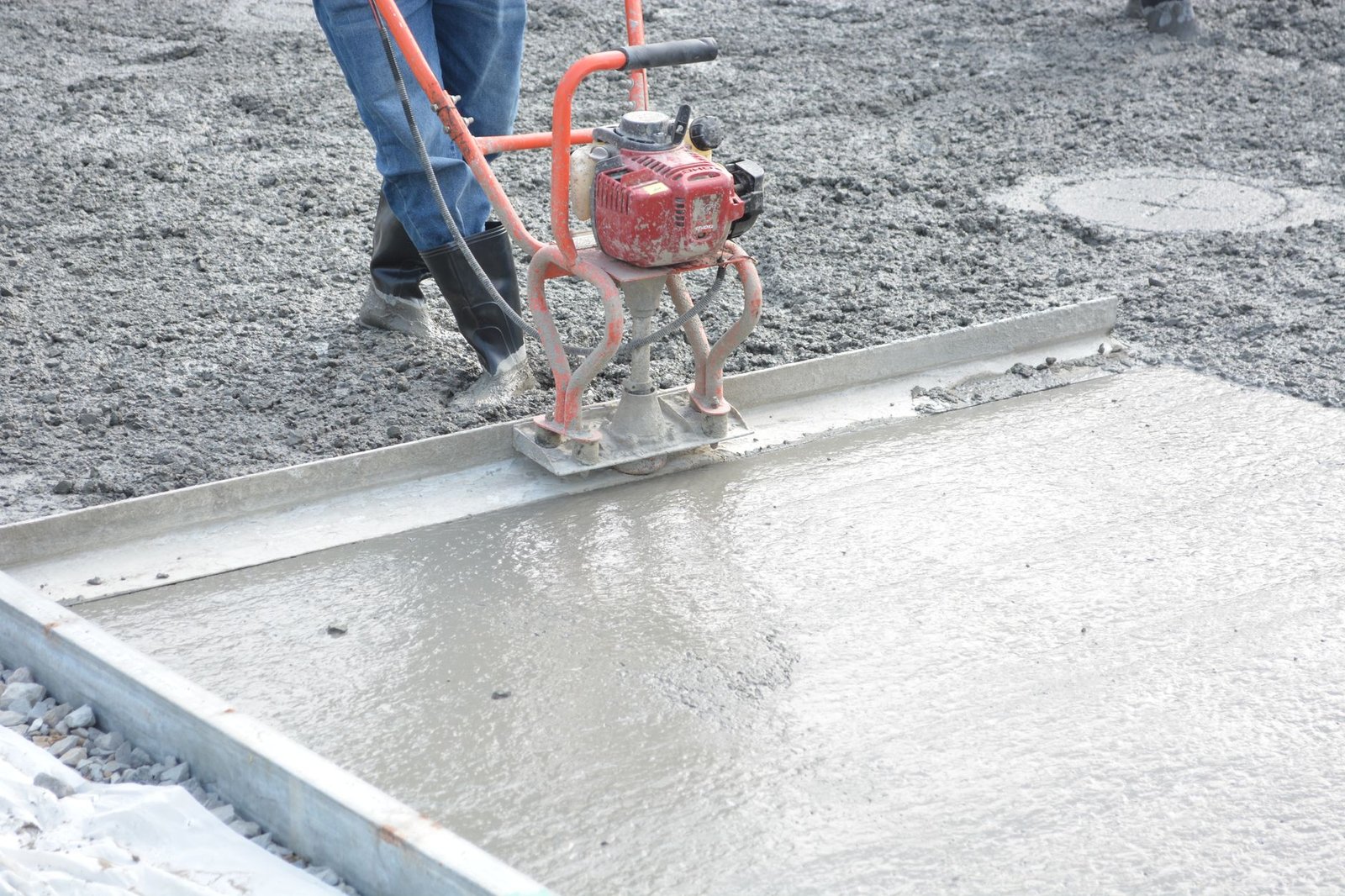
A concrete patio is one continuous event. A 12 x 16 ft slab at 4 inches thick is 64 cubic feet, or about 2.4 cubic yards, all of which has to be placed, screeded, floated, edged and jointed before it sets. That's a ready-mix truck, a few helpers and one chance. The concrete also needs time to cure before you use it, so the patio sits roped off after the pour.
A paver patio can be built at whatever pace your back allows. Dig one weekend, lay the base the next, set pavers when the weather suits you. If a row goes wrong, you pull it up. The one tool worth renting is a plate compactor, for the base and again for the finished pavers. You can walk on the patio the day you finish.
If you've never finished concrete, pavers are the more forgiving DIY job.
When poured concrete is the better call
Concrete is the right answer when:
- The budget is fixed and small. Plain gray at about $4 a square foot is hard to beat, and a well-jointed slab can last a long time.
- The patio sits under a roof or pergola, where it stays dry and frost has less to work with.
- You want a smooth, joint-free surface for a wheelchair, a rolling grill, or furniture that catches on paver edges.
- The ground is stable and it rarely freezes, which removes pavers' biggest advantage.
Pavers win where it freezes hard, where the soil is unreliable, over utilities, next to trees, and anywhere you might want to change the patio later. If you already have a sound slab and want the paver look, you don't have to choose. You can lay pavers over concrete, or add a paver section beside it. Our guide to a concrete patio extension with pavers covers matching the heights and the joint between the two.
Pour concrete to save now, lay pavers to repair later
If the lowest bill today matters most, pour a plain slab with properly spaced control joints and accept that it will crack along them. If you plan to keep the house, live where the ground freezes, or want to build it yourself, spend the extra on paving stones, because every future repair is a lift-and-relay rather than a jackhammer. Either way, the ground underneath decides how long the patio lasts. The paving stones or concrete question only decides how much it costs you when the ground gets a vote.
FAQ
Is it cheaper to pour concrete or lay pavers?
Pouring plain concrete is cheaper up front. Contractor price pages put basic concrete at about $4 to $8 per square foot and pavers at about $10 to $24 installed. Stamped or colored concrete, at about $12, narrows the gap considerably.
Do pavers last longer than concrete?
Concrete pavers are made to a higher standard than a typical patio slab (8,000 psi against a common 2,500 to 3,000 psi), and they can be relaid instead of replaced. A slab can last a long time too, but its cracks are permanent and repairs show.
Which is better in cold climates, pavers or concrete?
Pavers. The joints let each unit move slightly as the ground freezes and thaws, and ASTM C936 pavers must pass freeze-thaw testing. A slab has to absorb the same movement in one piece, which is why it cracks.
Is stamped concrete cheaper than pavers?
Usually a little, but not by much. At about $12 per square foot, stamped concrete overlaps the lower end of installed paver prices. And when it cracks, the crack runs straight through the pattern.
Can you put pavers over an existing concrete patio?
Yes, if the slab is sound, drains, and has room for the added height at doors. Cracked, heaved or sunken slabs should come out first, because the pavers will follow every flaw underneath.


