


Last Updated on October 20, 2026 by Umar Farooq
Plank pavers are long, narrow concrete or porcelain units, usually 3 to 7 1/2 inches wide and 12 to 24 inches or more long, laid in straight lines for a clean, modern look. They install on the same compacted gravel and 1-inch sand bed as any paver, with three extra demands: a flatter base, an offset of about one third instead of one half if the units have any bow, and a firm rule that they stay off the driveway unless the maker rates them for cars. Get those three right and a plank patio looks like a sharp piece of architecture. Miss them and it looks like a wooden floor after a flood. Worth a read next: pavers over irrigation lines.
Plank paver sizes you'll actually find
Every maker sizes planks differently, and several sell them as multi-length systems so the joints don't line up across the field. A few current examples from the product pages I checked:
| Product | Width x length | Thickness | Notes |
|---|---|---|---|
| Nicolock Plank Paver | 6 x 9, 6 x 13, 6 x 17 in | 2 3/4 in | three lengths per pallet, 103 sq ft per pallet |
| Belgard Melville Plank LG | 7 1/2 x 11 7/8, 15 3/4, 19 11/16 in | 2 3/8 in | 3-piece system, not rated for vehicles |
| Belgard Melville Plank Slim | 5 x 11 7/8, 15 3/4, 19 11/16 in | 2 3/8 in | same lengths, narrower |
| Mutual Materials Plank | 3 x 12 in | 2 3/8 in | 4 pieces per sq ft |
The 3-inch-wide units are what people mean by skinny pavers: lots of joints, lots of pieces to lay, and a strong linear pattern. The 6- to 7 1/2-inch widths read calmer and lay faster.
Wood-look concrete planks deserve a closer look before you buy. The grain is molded into the face, so check three things on a sample rather than a photo: whether the texture is deep enough to grip when wet, whether the color runs through the unit or sits only on top (a chipped corner shows the difference), and whether the grain pattern repeats every few pieces. A repeating knot in the same spot on every fifth plank is the hardscape version of a laugh track.
Porcelain planks exist too, often 2 cm thick in wood-look finishes. They are a different product with different rules (thin, rigid and usually set on pedestals, mortar or a very flat bed), and our porcelain pavers guide covers them.
Why plank pavers stay off the driveway
Here's the one opinion in this article, and it's a firm one: plank pavers are patio pavers. The photo of a plank driveway in a catalog shows a thicker, vehicle-rated unit, or it shows a driveway that hasn't met a delivery truck yet.
The reason is leverage. CMHA's Tech Spec 10 judges paver strength under cars by aspect ratio, the length divided by the thickness. At 4:1 or more, the unit shouldn't go where vehicles drive. Between 4:1 and 3:1 it's fine for a home driveway. Now run the planks from the table:
- Nicolock 6 x 17 in at 2 3/4 in: 17 ÷ 2.75 = about 6.2.
- Belgard Melville at 19 11/16 in and 2 3/8 in: about 8.3.
- Mutual Materials 3 x 12 in at 2 3/8 in: about 5.1.
All three are well past 4. A tire landing near the end of a long unit turns it into a lever, and it cracks or rocks the bedding sand out from under itself. Belgard says outright that Melville Plank isn't rated for vehicles. If you want the linear look on a driveway, look for a maker's thicker, vehicle-rated linear unit, or lay a shorter rectangle in a 90-degree herringbone. The paver thickness guide has the full reasoning.
A flatter base for long units
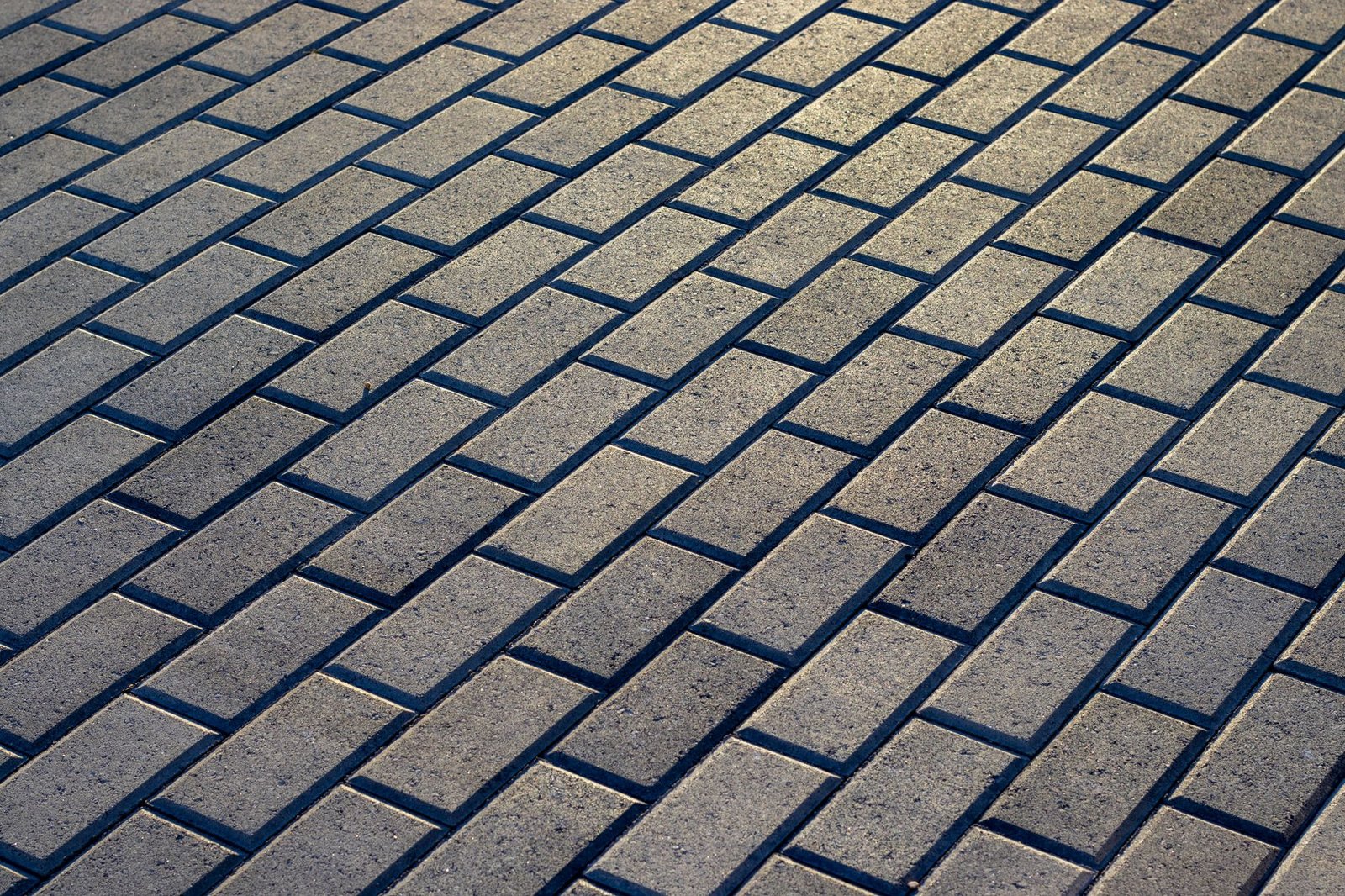
Planks are one of the more demanding paver shapes, but they don't need a thicker base than other pavers. At least 4 inches of compacted crushed stone under a patio on well-drained soil is the usual floor (ICPI Tech Spec 2), with more on clay, wet ground or where it freezes. What they need is a flatter one.
A 4 x 8 inch brick sits happily over a small hump in the base, because it only spans 8 inches of it. A 20-inch plank spans the hump and rocks on it, and every rocking plank lifts one end above its neighbour. So:
- Hold the base tolerance. CMHA's guide spec asks for ±3/8 inch over a 10-foot straightedge. With planks, treat that as the maximum, not the target, and fix any hump in the gravel, not in the sand.
- Keep the sand bed at 1 inch and screed it in one pass between rails. A bed that varies from 3/4 to 1 1/4 inches compacts unevenly under long units.
- Check lippage as you go. ICPI allows at most 1/8 inch of height difference between neighbouring pavers on pedestrian routes. Run a straightedge across the plank ends every few rows; ends are where lippage shows first.
Compact the laid field with a plate compactor fitted with a urethane pad, and check the manufacturer's install sheet: some large-unit systems want a roller or a lighter touch.
Bond patterns that hide a bow
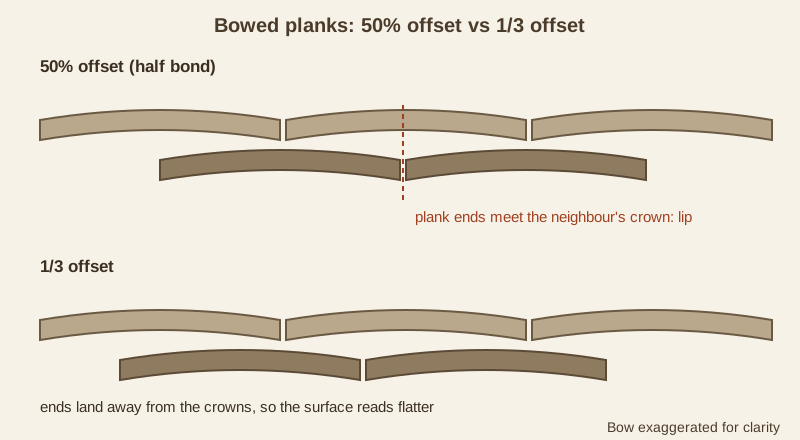
Long concrete and porcelain units can come out of production with a slight bow, a crown in the middle of the long face. In a half-bond (50 percent offset) pattern, the end of every plank lands beside the middle of the plank next to it. Low end meets high middle, and you get a lip at every joint.
NT Pavers' explainer on the 30 percent running bond makes this case for porcelain over 18 inches: shift the offset to about 30 percent and the ends land away from the crowns. The same geometry applies to any long unit with a bow. A one-third offset is the practical rule. Many plank systems solve it for you by mixing three lengths, so the offset changes from row to row.
The patterns that work with planks:
- Offset running bond (one-third or random). The default. Clean and forgiving.
- Stack bond. Very modern, but every end joint lines up, so any bow or length variation shows immediately. Only with truly flat, square units.
- 90-degree herringbone. Strong, and a good use of planks on a large patio. More cuts at the edges.
- Random-length. Two or three lengths mixed, like a hardwood floor. Hides small variations best.
Nicolock's page shows its planks in a 45-degree and a horizontal running bond. For the styling side (colors, joints, mixing materials) see modern pavers.
Which way to run the planks
Plank direction changes how the space feels. Nicolock's product page puts it neatly: lengthened planks "make spaces appear longer and direct the eye outward."
- Along a walkway or a long, narrow patio: the planks lead you through it and make it feel longer.
- Across a narrow side yard or walkway: the space reads wider, and it's easier to keep edge cuts square.
- Parallel to the house wall: the safe default for a patio. It lines up with the building and hides small deviations at the wall.
Whatever you choose, snap a string line for the first row and check it every few rows. A plank field magnifies a wandering line more than any other paver shape, because the long joints are straight enough for the eye to follow all the way to the lawn.
Cutting planks and planning waste
Straight-edged plank patios cut little. Herringbone and diagonal layouts cut a lot, and plank offcuts are often too short to reuse because slivers at the edge work loose. Order more spare units than you would for a brick-sized paver, especially for herringbone, and cut with a wet diamond blade. Long rip cuts along a plank are slow and easy to wander; mark with a straightedge and make them in two or three shallow passes.
Tight joints make planks look crisp, which is part of the appeal. Belgard describes Melville as having tight-fitted joints. Use fine joint sand or a polymeric sand rated for narrow joints, and don't widen the joints to "make it easier": it changes the look and lets the long units shift.
Flat base, one-third offset, feet only
Plank pavers give a patio or walkway long, clean lines, and they install like any other concrete paver with three upgrades: build the base flatter than usual, offset the joints by about a third, and keep them where only feet and furniture go. The planks forgive very little. On the other hand, they also make a very ordinary backyard look like it had an architect, which is a fair trade for an extra pass with the straightedge.
FAQ
What size are plank pavers?
Most are 3 to 7 1/2 inches wide and 12 to 24 inches long, 2 3/8 to 2 3/4 inches thick for concrete. Many are sold as systems of two or three lengths, such as Nicolock's 6 x 9, 6 x 13 and 6 x 17 inch planks.
Can plank pavers be used on a driveway?
Usually not. Long, thin units have an aspect ratio well above 4:1, which CMHA says shouldn't carry vehicles. Use only a plank the manufacturer specifically rates for vehicular traffic, or choose shorter rectangles in herringbone.
What is the best pattern for plank pavers?
An offset running bond at about one third, or a random-length pattern. Both keep plank ends away from the middle of the neighbouring plank, which hides slight bowing. Stack bond looks sharp but shows every flaw.
Do plank pavers need a special base?
The same compacted crushed-stone base and 1-inch sand bed as other pavers, built flatter. Long units rock over humps that small pavers ignore, so hold the base to ±3/8 inch over 10 feet or better.
Are plank pavers harder to install?
A little. They need a flatter base, careful string lines and more attention to lippage at the ends. The laying itself is quick because each unit covers more area.


