


Last Updated on October 20, 2026 by Umar Farooq
Pavers over irrigation lines are possible, but the safest version has no live pipe under the patio at all. Locate the lines first, reroute them around the footprint if you can, and if a line must cross, run it through a larger PVC sleeve with every valve, splice and head outside the pavers. A leak in the lawn is a shovel job. A leak under pavers means lifting the patio, and that is the whole argument in one sentence.
I searched for a dedicated guide to this and found none. The ranking pages are general paver-patio tutorials with a line or two about sprinklers, so this one stitches together what the irrigation side and the paver side each say.
Map the irrigation lines first, because 811 will not
Calling 811 is step one for any dig, and it still will not find your sprinkler pipes. The City of Williamsburg's MISS Utility page says privately owned lines such as sprinkler systems "will not be marked," and that it is your responsibility to locate them or hire someone to do it. Colorado 811 says the same: private utilities are not registered with it, and the locating is the property owner's expense.
So you need another way to map them:
- Look for the installer's plan. Ask the previous owner, the installer or the HOA.
- Run each zone and walk the yard. Mark every head, then trace the likely path between them and the valve box.
- Hire a private locator if the system is old or undocumented.
- Dig the first few inches by hand. Nothing should be trusted until you have seen it.
(Yes, the free number covers the gas line and not the pipe most likely to be cut. The universe does enjoy a loophole.) For layout planning that comes before this step, see how to lay out a paver patio.
Move it, shorten it or sleeve it: pick the cheapest that works
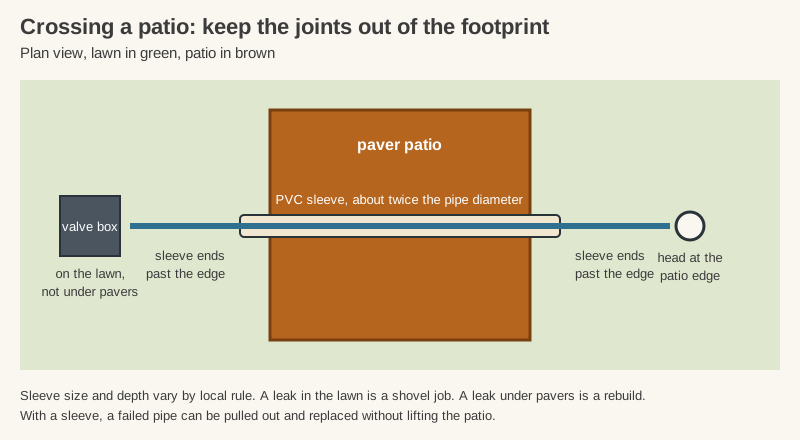
Ranked from cheapest to most work:
- Reroute outside the footprint. Take the line around the patio, or move the head to the patio edge so the pipe never crosses. This is usually the cheapest permanent fix, and it is the only option that leaves nothing buried under the pavers.
- Shift the patio. If the dig lines are flexible, nudge the patio so the pipe falls outside it. A few feet on paper beats a few hours with a trencher.
- Sleeve the crossing. When the pipe must pass under, put it inside a larger PVC sleeve that ends past the patio edge on both sides. The City of Grass Valley's landscape specification says all piping under pavement should go in a Schedule 40 PVC sleeve twice the diameter of the water line (Grass Valley, Section 8). That is one city's rule for public work, not a national standard, so check what your own jurisdiction or irrigation installer requires.
- Use rigid pipe, not drip tubing. Handyman Startup's patio tutorial says to use rigid PVC for any line under the patio and never run black drip line there, because it will get smashed (Handyman Startup).
If the sleeve goes in before the pavers, you can lay it in a trench. If the patio already exists, Sprinkler Warehouse describes a sidewalk sleever, a 2 or 3 inch boring tool that comes in lengths from 10 to 20 feet, for pushing a sleeve under a walk without digging it up. That page is written for concrete sidewalks, and a paver walk is easier: lift a strip and dig normally.
Keep valves, splices and heads out from under the pavers
A sleeve protects a pipe. It does nothing for a fitting. The weak points in any irrigation line are its joints, valves and heads, so none of them should end up under pavers, where reaching them means pulling a patio apart.
- Valve boxes go on the lawn side, beyond the edge, where you can lift the lid.
- Sleeve ends extend beyond the edge, and you mark them on a sketch so you can find them later.
- Heads next to the patio need pavers cut around the riser. Our guide to cutting pavers around pipes covers the template and the compaction around it.
- Test the line under pressure before backfilling, while the trench is still open. That is my advice, not a spec, and it costs ten minutes.
Count the depth before you commit to the pipe
This is the part nobody states. A patio on well-drained soil needs at least 4 inches of compacted base under the pavers (ICPI Tech Spec 2), a nominal 1 inch of bedding sand, and a paver of about 2 3/8 inches. My own arithmetic, not a published figure: that is roughly 7 1/2 inches from the finished surface down to the top of the native soil. A pipe sitting inside that depth cannot stay there, because the base has to be compacted over undisturbed ground.
So a shallow line, one that sits a few inches below grass, has to be lowered or moved out. I could not find a paver-industry rule for how much cover a pipe needs under a base, so I will not invent one. If you have a shallow main and no room to lower it, that is a job for an irrigation contractor, and a reason to move the patio.
Where a pipe does stay below the dig, compact the base around the trench in thin lifts. ICPI's 4 to 6 inch lift figure assumes a 7,000 lbf plate, so use thinner lifts or a hand tamper in the trench line. A trench is the classic place for a soft stripe to show up in the patio a year later.
When the line is already under a finished patio
You will usually find out in one of three ways: a wet patch, a sunken strip of pavers, or a water bill that jumped. My reasoning, not a tested figure: water escaping under a paver base can wash out the stone that carries the load, and the surface drops over the leak.
The repair is the quiet superpower of pavers. Lift the pavers over the line, fix the pipe, rebuild the base in thin lifts, re-screed and relay the same pavers. See how to fix sunken pavers for the rebuild. A poured slab would need a jackhammer. A paver patio needs an afternoon and a bit of patience.
Move the plumbing before the patio goes down
Reroute where you can, sleeve where you must, and keep every valve and fitting out from under the pavers. The patio will be there for decades. The sprinkler line, if you are honest, will be replaced at least once, and the best place for it is somewhere you can reach without a rental saw.
FAQ
Can you put pavers over irrigation lines?
You can, but the safest build has no live pipe under the patio. Reroute the line around it, or run the pipe through a larger PVC sleeve that ends past the edge, with all valves, splices and heads outside the pavers.
Does 811 mark sprinkler lines?
No. 811 marks utility-owned lines. Municipal and state pages say privately owned lines such as sprinkler systems will not be marked, so you must locate them yourself or pay a private locator.
How deep should a sprinkler pipe be under a patio?
It has to sit below the dig, which for a typical patio is about 7 1/2 inches by my own arithmetic (4 inches of base, 1 inch of sand, a 2 3/8 inch paver). Beyond that, depth rules vary by locality, so ask your irrigation installer or building department.
Can you run a sprinkler line under an existing paver patio?
Yes. For a paver walk you can lift a strip of pavers, dig the trench and relay them. A sleever tool pushes a sleeve under a concrete sidewalk without digging it up, as Sprinkler Warehouse describes, but pavers make the dig easy.
Should sprinkler heads be inside a paver patio?
Keep them at the edge. A riser inside the field needs a round or notched cut in several pavers, and the area around it is where sinking starts. A head just past the edge is simpler to cut and simpler to service.


