


Last Updated on October 20, 2026 by Umar Farooq
Plastic pavers mostly means one of two things: open plastic grid pavers, honeycomb or lattice panels made from recycled plastic that are filled with gravel or grass to make a firm, permeable driveway, parking pad or path; or solid plastic patio pavers and snap-together tiles that imitate stone or brick. Grid pavers work well when they sit on a compacted crushed-stone base and their cells are filled to the top. Solid plastic pavers suit light-duty patios, balconies and temporary surfaces, but they don't replace concrete pavers for a long-life patio or driveway. We have a separate page on concrete paver molds if you need the specifics. If this applies to your yard, our guide to paver driveway turnaround goes into more detail.
I read TRUEGRID's installation guides, since it's one of the better-known US makers, and the Wikipedia overview of permeable paving, which is refreshingly blunt about the ways these systems fail. The plastic is the easy part. What goes under it and into it decides whether the driveway lasts.
Types of plastic pavers
| Type | What it is | Typical use | Base |
|---|---|---|---|
| Grid pavers, gravel fill | Open honeycomb or square-cell panels filled with gravel | Driveways, parking pads, RV and boat pads, paths | Compacted crushed stone |
| Grid pavers, grass fill | Same panels filled with soil and seeded | Overflow parking, fire lanes, lawn paths | Compacted base plus a growing mix |
| Solid recycled-plastic pavers | Molded pavers or slabs made from recycled plastic, sometimes mixed with sand | Light patios, garden paths | Firm, level base |
| Interlocking patio tiles | Snap-together plastic bases, often with wood, composite or stone tops | Balconies, decks, temporary patios | Flat, solid surface |
The rest of this article focuses on grid pavers, because that's where plastic genuinely beats the alternatives. Concrete grass pavers such as turfstone do a similar job with a different trade-off; our guide to turfstone pavers covers them.
How grid pavers hold a driveway together

A plain gravel driveway ruts because loose stone moves sideways under tires, and it drifts into the lawn. A grid paver fixes that by caging the gravel in cells. The Wikipedia article on permeable paving describes these honeycombed 3D structures as reinforcing the infill and transferring vertical loads from the surface across a wider area.
In practice:
- The cells stop migration. Stone can't roll out of a cell, so ruts and bare patches don't form.
- The load spreads. A tire presses on many cell walls at once, and they share it with the base below.
- Water goes straight down. With open gravel in the cells, rain soaks into the base rather than running off. TRUEGRID's permeable paving guide quotes an infiltration rate over 1,000 inches per hour for its gravel-filled product.
The grid itself is usually recycled high-density polyethylene. TRUEGRID says its panels are made from 100% post-consumer recycled HDPE.
Gravel fill or grass fill?
I will take a side here: where a car parks every day, fill the grid with gravel, not grass.
The reasoning is simple biology. Grass under a parked car gets no sun, and the tires compact the soil in the cells. It thins, browns and dies in the tracks, leaving bare plastic and mud. Wikipedia notes that grass pavers need supplemental watering in their first year or they may need reseeding, and that brown dormant turf can be a sore point even when it's healthy. Gravel doesn't need sun, water or mowing. TRUEGRID gives an expected life of 60 years for its grids when they're filled with the recommended gravel.
Grass fill works well where traffic is occasional:
- overflow parking used a few times a year,
- fire lanes and emergency access,
- a path across a lawn, or the edge of a turnaround.
For the everyday parking spot, use gravel in the cells and let the lawn be lawn somewhere else.
Installing plastic grid pavers
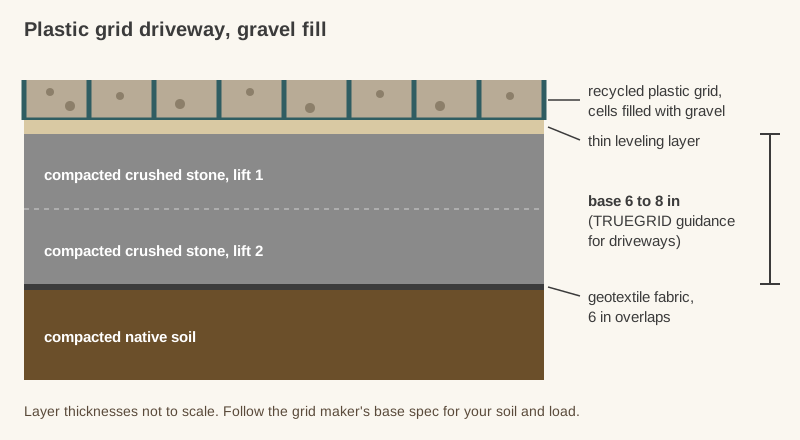
The panels are light and clip together by hand, which makes the job look easier than it is. The base is still the job. TRUEGRID's residential driveway guide says most installations need at least 6 to 8 inches of compacted crushed stone under the surface material. Its general guide describes placing that in two layers of 2 to 4 inches, compacting each one.
- Excavate and compact the soil. Dig to the depth of the base plus the grid. Compact the subgrade with a plate compactor and dig out any soft spots.
- Lay geotextile fabric. TRUEGRID calls for 6-inch overlaps. On clay especially, it stops the base stone sinking into the soil.
- Build the base in lifts. Spread crushed stone 2 to 4 inches deep, dampen and compact it, then repeat. Check grade as you go and slope it so water leaves the driveway rather than pooling.
- Add a thin leveling layer if the maker calls for one, and screed it flat.
- Lay the panels. Start at a straight edge, lock the panels together, and cut them to fit with a saw at curves and edges.
- Fill the cells. Spread clean, angular gravel and fill every cell to the top. Underfilled cells leave plastic walls exposed to tires, which is how panels crack.
- Edge it. Use an edge restraint or border along open sides so the panels and the fill stay put.
Rent the plate compactor for the base. You'll only need it for a day.
Where plastic grid pavers struggle
Grid pavers are forgiving, but a few conditions push them past their limits:
- Tight, repeated turning. Tires scrubbing in place, such as turning the wheel while parked, grind fill out of the cells. Keep turnaround areas fully topped up, or pave them.
- Snowplows. A steel blade can catch exposed cell walls. Keep the cells full so no plastic stands proud, and plow with the blade raised slightly or fitted with a rubber edge.
- Slopes. Gravel creeps downhill even in cells on steep grades. Follow the maker's anchoring advice and consider grass fill on steep lawn paths.
- Thin or missing base. A grid laid straight on soft soil deforms with the soil. The grid spreads load; it doesn't replace the stone underneath.
- Heavy abuse. Wikipedia records damage to plastic and gravel grids from drivers "joy riding" on remote parking lots at night. For a home driveway that's unlikely, but it's a fair picture of what spinning tires do.
If a section does fail, it's easy to fix: pull the fill, unclip the damaged panel, repair the base, and clip in a new one.
Solid plastic pavers and patio tiles
Solid pavers made from recycled plastic, and plastic tiles that snap together, are a different product for a different job. They are light, cheap to ship and easy to lay or lift. They make sense for:
- Balconies and flat roofs, where weight matters, and snap-together deck tiles can sit on the existing surface. Our lightweight pavers guide covers load limits.
- Rental homes and temporary patios, where you want a surface you can take with you.
- Garden paths and shed floors with light foot traffic.
The limits are worth knowing before you buy:
- Heat. Plastic expands and softens more than concrete as it warms. Leave the expansion gaps the maker specifies, and expect dark plastic to get hot in full sun.
- UV. Look for UV-stabilized products. Cheap plastic chalks and turns brittle in sun.
- Standards. There is no equivalent of ASTM C936, the concrete paver standard, for plastic patio pavers. Buy from makers who publish load and weathering data, and read it.
- Look. Molded stone and brick patterns repeat, and it shows across a large area.
For a permanent patio on a proper base, concrete or clay pavers still win on lifespan, feel and repairability.
Plastic grid pavers vs other permeable options
| Option | Driveable | Looks like | Upkeep |
|---|---|---|---|
| Plastic grid, gravel fill | Yes | Gravel driveway that doesn't rut | Top up fill occasionally |
| Plastic grid, grass fill | Occasional use | Lawn | Mowing, watering, reseeding |
| Concrete grass pavers (turfstone) | Yes | Concrete lattice with grass | Mowing; concrete shows |
| Permeable interlocking concrete pavers | Yes | Paver driveway with wide joints | Vacuuming joints over time |
If you want the look of a paver driveway with the drainage of gravel, permeable concrete pavers are the closer match; our guide to permeable concrete pavers explains the open-graded base they need.
Put gravel in the grid and the effort in the base
Plastic grid pavers are one of the better ideas in paving: recycled material, a surface that drains, and a gravel driveway that finally stays where you put it. They only work on a properly built, compacted base, with every cell filled, and with gravel rather than grass wherever a car sleeps. Solid plastic pavers have their uses on balconies and temporary patios, but they aren't a substitute for concrete underfoot for decades. Build it right and the grid disappears under the stone, which is exactly the point. Nobody admires a plastic paver. They just stop complaining about the ruts.
FAQ
Are plastic pavers good for driveways?
Plastic grid pavers filled with gravel make a good driveway when they sit on 6 to 8 inches of compacted crushed stone, according to TRUEGRID's guidance. Solid plastic patio pavers are not made for vehicles.
Can you put plastic grid pavers directly on grass or dirt?
Not for driveways. The grid spreads load, but soft soil still moves beneath it. For a lightly used lawn path some systems allow shallow installation, but anything carrying a car needs a compacted base.
How long do plastic grid pavers last?
Manufacturers quote long lives when the system is built as specified; TRUEGRID gives an expected life of 60 years for its grids filled with the recommended gravel. Exposed, underfilled cells and a weak base shorten that.
Will grass grow in plastic grid pavers?
Yes, with good topsoil, sun and watering during the first year. Grass struggles where cars park daily, because it is shaded and compacted, so use gravel fill for everyday parking spots.
Are plastic pavers cheaper than concrete pavers?
Grid panels and solid plastic pavers are usually cheaper to buy and ship per square foot, but a grid driveway still needs a full compacted base, which is where much of the cost sits. Prices vary by product, and the main grid makers quote per project.


