Last Updated on September 23, 2026 by Umar Farooq
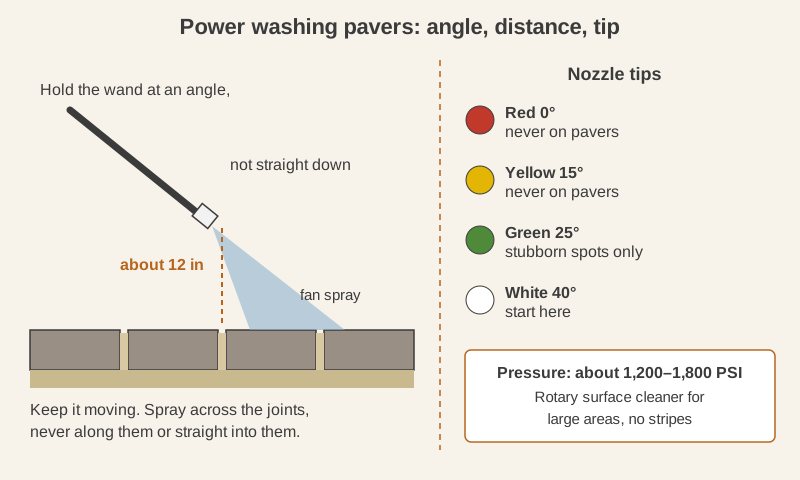
Power washing pavers is safe as long as you keep the pressure moderate and the spray off the joints. Use about 1,200 to 1,800 PSI and start with a white 40-degree fan tip. Hold the wand around 12 inches from the surface at an angle, and keep it moving across the joints rather than along them. For anything bigger than a small walkway, a rotary surface cleaner gives an even clean without stripes. Expect to lose some joint sand anyway, so plan to re-sand once the pavers are completely dry. A pressure washer is the most satisfying tool you will ever point at a patio, which is exactly why it needs rules.
Can you power wash pavers without damaging them?
The damage people worry about is real, and it has two forms.
Surface damage. A narrow, high-pressure jet held close to a concrete paver strips the cement paste off the top and exposes the aggregate underneath. The result is a rough, lighter "wand mark" that won't wash off, because it's a new texture. You haven't cleaned the paver so much as edited it. Kärcher's guide to cleaning pavers notes that granite tolerates a pressure washer well, but the jet can quickly damage concrete pavers.
Joint damage. A jet aimed into a joint blows the sand out. Lose enough and the pavers shift, and weeds move into the vacancy.
Both come from too much pressure, too narrow a tip, or too little distance.
PSI, nozzle tip and distance
| Setting | What to use | Why |
|---|---|---|
| Pressure | About 1,200–1,800 PSI | Genstar Masonry's guidance: higher risks surface damage |
| Tip | White 40° to start; green 25° only for stubborn spots | Wider fan spreads the force |
| Never | Red 0° or yellow 15° tips, or a turbo/rotating nozzle held close | They cut the surface and drill out joints |
| Distance | About 12 inches, more if you see marks | Pressure at the surface drops quickly with distance |
| Angle | Wand tilted, spray sweeping across the surface | Lifts dirt without driving water into the joints |
I compared a handful of manufacturer care pages, and Unilock's spring maintenance advice puts it most simply: use a fan-angled tip, hold the pressure washer at knee height and angle it at 45 degrees to avoid dislodging the joint sand.
Get the patio ready before the water goes on
- Clear and sweep. Move furniture and planters, then sweep off leaves and grit, which scours under the spray.
- Pull weeds from the joints with a joint scraper or hook tool so their roots don't lift more sand.
- Pre-treat stains. Use a dedicated paver cleaner or a mild detergent on oil, algae and moss, with the label's dwell time. Family Handyman's paver cleaning walkthrough uses plain dish soap and a stiff brush for general grime.
- Pre-wet the surface so cleaner doesn't dry in the sun, and work from high side to low so dirty water runs off finished areas.
Using a surface cleaner on a paver patio
A rotary surface cleaner is a round hood with a spinning bar and two nozzles, run over the paving like a floor polisher. (It also ends the argument about whose stripes those are.) For power washing pavers across a whole patio or driveway, it's the better tool:
- Even results. Fixed-height nozzles leave no wand stripes.
- Gentler on joints. The spray never gets aimed straight into a joint.
Match it to your machine's rated pressure and flow, and use the wand only for edges and corners.
Can you pressure wash pavers with polymeric sand?
Yes, once the polymeric sand has fully cured, but gently. Cured polymeric sand resists rain and rinsing, not a concentrated jet: a distant fan tip aimed across the joints usually leaves them intact; a narrow tip held close cuts them out.
Two cautions:
- Freshly installed joints. Don't pressure wash new polymeric sand until it has fully cured, which depends on the product, temperature and humidity. See how long polymeric sand takes to dry.
- Haze isn't dirt. If the pavers have a cloudy film after a poly sand job, more pressure won't fix it. That's polymeric sand haze, and it needs a cleaner, not force.
The exception: stripping failed polymeric sand, where running the fan tip along the joints clears them fastest.
Re-sanding the joints after power washing
Most power-washed patios lose some joint sand. Unilock's guidance is to scrape failed sand out to about 1 1/2 to 2 inches deep so new polymeric sand can bond, then sweep it in and mist it to activate.
The order matters:
- Let everything dry completely. Pavers and joints must be dry through, often 24 to 48 hours in good weather and longer in shade or humidity. Damp joints are the main cause of haze and weak joints.
- Clear loose material from any joint that's partly empty, so the new sand isn't a thin cap over debris.
- Refill with polymeric sand (or regular joint sand if that's what the patio had), compact it in, blow the surface clean and water it per the bag.
See our guide on how to apply polymeric sand.
Cleaning first, then sealing
If you plan to seal, power washing is the prep, not the last step. Clean, re-sand, let the joints cure, and only then seal a completely dry surface; sealing over damp pavers or fresh haze traps it. Techniseal's Natural Look sealer, for one, says to wait 30 days after polymeric sand.
My view: a freshly cleaned paver is not automatically a paver that needs sealing. There should be a reason, like stains you want kept out or a color you want deeper. Belgard's sealing guide says "the basic rule of thumb is every 3-5 years," and Techniseal's own rule is to recoat only when worn, and not sooner than 2 years. Sprinkle some water on the clean pavers: if it sits in droplets, the old sealer is still working.
Low pressure, wide tip, then re-sand
Power washing pavers is safe when you respect the surface and the joints. Keep the pressure moderate, the tip wide and the spray moving across the joints, then re-sand once the patio is bone dry. And when the red tip starts looking tempting for that one stubborn spot, put it back in the holder; the spot will survive, and so will your pavers.
FAQ
What PSI should I use to power wash pavers?
About 1,200 to 1,800 PSI for concrete pavers. Higher pressure risks stripping the surface and blowing out the joints. If your machine is stronger, use a wider tip and more distance, and test on a hidden paver first.
Which nozzle is best for power washing pavers?
Start with the white 40-degree fan tip. Switch to the green 25-degree tip only for stubborn spots, held farther back. Never use the red 0-degree or yellow 15-degree tip on pavers.
Will power washing remove the sand between pavers?
Some, almost always, especially if the spray hits the joints directly. Angle the wand across the joints and keep it moving to limit the loss, then re-sand any low joints once the pavers are completely dry.
How long after power washing can I apply polymeric sand?
Wait until the pavers and joints are completely dry, typically 24 to 48 hours in warm, dry weather and longer in shade or humid conditions. Polymeric sand swept onto damp pavers sticks to the faces and causes haze.
Is a surface cleaner better than a wand for pavers?
For patios and driveways, yes. A surface cleaner keeps the nozzles at a fixed height, so it cleans evenly without stripes and doesn't aim water straight into the joints.
How often should you power wash pavers?
Once a year is typical, usually in spring, plus sweeping in between. Washing more often just keeps removing joint sand.