


Last Updated on October 20, 2026 by Umar Farooq
How to re-sand pavers comes down to four moves: clear the old sand, weeds and debris out of the joints, let everything dry, sweep in fresh sand until the joints are full, then compact and set it. Use plain joint sand if the patio never had a hardening sand, and polymeric sand if you want the joints to stay put. Do it when the joints are visibly low, the pavers feel loose underfoot or weeds have moved in.
It is one of the few paver jobs where a broom is a power tool. (It is also the job that turns a weekend into a weekend and a Monday, because the pavers have to dry first.)
How to tell the joints need sand
Joint sand does not disappear in one event. It leaves a little at a time with rain, foot traffic and sweeping, until there is a gap you can feel with a fingertip. Check for:
- joints with visible gaps or a groove along the edge of each paver
- weeds, moss or small ants' sand piles in the joints
- pavers that shift or rock when you step on them
- sand washed out in a fan below a downspout or the low end of a slope
JS Brick's guide to re-sanding pavers suggests re-sanding about every two to three years with regular sand, or whenever the sand looks depleted. Polymeric sand can last much longer, up to ten years or more in the same guide, but inspect the joints instead of trusting a calendar. If one rocking paver is your only symptom, our guide to keeping pavers from moving goes deeper than a top-up.
Plain joint sand or polymeric sand
The right choice depends on what is already in the joints and how deep they are.
| Situation | Use | Why |
|---|---|---|
| Joints are plain sand, shallow or narrow | Plain joint sand (ASTM C144, or C33) | A hardening sand needs depth to grip |
| Joints are deep, 1 1/2 inches or more | Polymeric sand | Both Techniseal and Alliance Gator list that as the minimum depth |
| Old polymeric sand still hard in the joint | Remove what you can, then refill | New sand will not bond to a hard, old cap |
| A patio with weeds or ants | Polymeric sand | Hardened joints deter both |
CMHA's guide specification allows ASTM C144 sand for joints, with C33 also allowed, and ICPI recommends 5 percent or less passing the No. 200 sieve. In plain words: use proper joint sand sold for pavers, not play sand and not stone dust. Our guides to sand for pavers and polymeric sand explain the differences if you are buying.
The cheap, small option comes first. If you just need to top up a few joints on a patio with plain sand, a bag of joint sand and a broom is the whole job. Reach for polymeric only when you want the joints to last. JS Brick puts plain sand at about $2 to $4 per 50 lb bag and polymeric at about $20 to $40 per bag.
Clean out the old joint, not only the top
New sand on top of dirt does not fill a joint. It sits in a thin layer over the old fill and washes out in the first storm.
- Deal with weeds first. JS Brick suggests treating them and waiting a few days before cleaning.
- Remove debris and loose sand. A narrow tool, a stiff brush or a shop vacuum clears small areas. For a whole patio, a pressure washer is common.
- Keep the water gentle. JS Brick suggests a wide-spray nozzle (25 or 40 degrees), starting at low pressure with the wand at a slight angle. Aiming a jet straight into the joint can wash out the bedding below, which destabilizes the pavers.
- Let it dry fully. JS Brick says several days of drying. Damp joints make the sand cling to the paver sides instead of falling in.
How to re-sand pavers: fill the joints to the right level
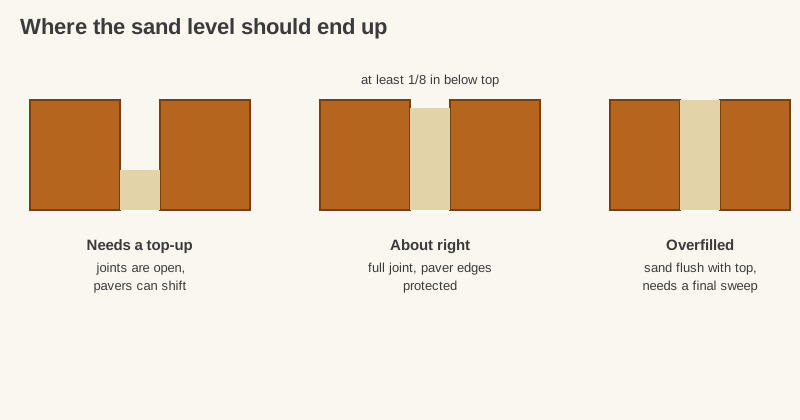
Pour the sand over a dry surface and sweep it into the joints with a stiff broom, working in several directions. Go over each area more than once. Sweeping across the joints as well as along them fills the ends.
Then settle it. A plate compactor with a protective mat or a hand tamper vibrates the sand deeper. Alliance Gator says roughly 30 to 50 percent of polymeric sand drops after the first compaction, so expect a second round of filling. Add sand, sweep and compact again until the level stops dropping.
The target is simple: full joints, with the sand finishing at least 1/8 inch below the paver top or the chamfer, which is Alliance Gator and Techniseal's figure for polymeric sand. Overfilling to the surface leaves residue that is hard to remove, a problem our guide to polymeric sand haze covers in depth.
Blow off the surface before any water
Excess sand left on the paver faces hardens into a film if it is polymeric. Use a leaf blower on low, or a soft broom, until the surface is clean. This is the step people skip because the sand looks tidy. It is not tidy once the first rain turns that dust into a film.
Wet polymeric sand without washing it out
Plain joint sand needs no water. Polymeric sand does, because water activates the binders.
- Set a hose nozzle to a shower or mist, never a jet.
- Spray in short passes, then pause and watch. JS Brick's rule is to continue only while the sand keeps absorbing water and stop once water starts pooling on the surface.
- Make sure the joints are damp at depth and not flooded at the top.
The product's own sheet gives the timing. Alliance Gator's SuperSand G2 data sheet says rain safe 15 minutes after activation. The Techniseal HP NextGel data sheet says rain safe at 60 minutes but needs 24 to 48 hours to dry fully, allows foot traffic immediately and vehicles after 48 to 72 hours. Both want installation above 32 degrees F. The sheet on your bag counts, and not this paragraph.
Where the sand keeps going
If a patio loses its sand every season, something is moving it. Look for these:
- Downspouts or sprinklers hitting the same joints
- A slope that sheds water across the paving and carries sand with it
- Ants excavating the joints. See ants between pavers
- A pressure washer used too close that scours the joints every time
Sealing can help hold sand in place. Techniseal's natural look sealer asks for a 30 day wait after polymeric sand, while HP NextGel says at least 7 days and up to 30. Check the sheets for your products.
Full joints, clean surface, one dry day
The whole job reduces to preparation. Clean the old joints, dry them, fill them to just below the surface, settle the sand twice, brush the pavers clean and only then add water. Get the order right and a bag of sand does more for the patio than any amount of re-leveling.
FAQ
How often do pavers need new joint sand?
JS Brick suggests every two to three years for regular sand, or whenever the joints look depleted, and up to ten years for polymeric sand. Inspect the joints yearly and refill when you see gaps.
Can you add new sand on top of old sand between pavers?
Over plain sand, yes, after you clean out debris and weeds. Over hardened polymeric sand, remove what you can first, because fresh sand will not bond to the old hard cap.
What kind of sand do you use to re-sand pavers?
Joint sand sold for pavers, meeting ASTM C144 (C33 is also allowed), or polymeric sand for deeper joints. Do not use play sand or stone dust.
Do you need to wet the sand after re-sanding pavers?
Only if it is polymeric. Mist it gently so the binders activate, and stop when water starts pooling. Plain joint sand is swept and compacted dry.
Can you re-sand pavers in the rain?
Not usefully. Joints need to be dry for the sand to flow in, and polymeric sand data sheets set rain limits after activation, from 15 minutes for Alliance Gator SuperSand G2 to 60 minutes for Techniseal HP NextGel.


