

Last Updated on October 20, 2026 by Umar Farooq
River rock pavers mean three different things: loose rounded river rock raked over a path, pebble-mosaic stepping stones you cast in mortar, and thin manufactured slabs finished to look like river stone. Loose rock is not a paver, because round stones do not interlock, and it needs a compacted crushed-stone base under it for any walkway. The mortar-set stones and the thin slabs behave like real pavers, and each has its own rules.
I read a gravel supplier's guide (Hello Gravel), a DIY stepping-stone tutorial and a manufacturer's product page to separate them. The supplier sells the rock, so I flag where that shows.
Loose rock, cast stones or thin slabs: what you are really buying
| What it is | Behaves like | Best for | Watch for |
|---|---|---|---|
| Loose river rock | Gravel, decorative | Garden paths, foundation beds, fill between stepping stones | Rock shifting and sinking without a base |
| Cast pebble stepping stones | Individual stepping stones | Lawn paths, accents | Cracking if cast thin, and a day of work per batch |
| Thin river-look slabs | Thin pavers | Patios, walks over a slab | Mortar or thin-set only |
For flat stone slabs in the same colors, our aggregate pavers guide covers exposed-aggregate and pebble pavers sold as units.
Why rounded stones need a crushed-stone base
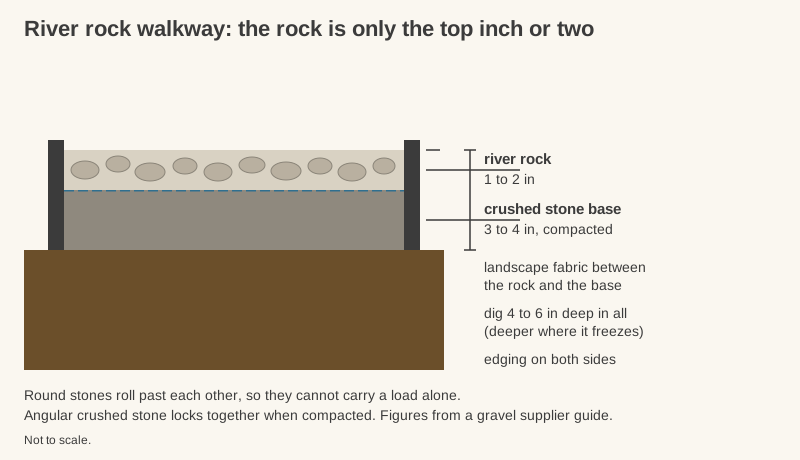
Hello Gravel, a gravel seller, explains the physics: angular crushed stone locks together when compacted, while rounded river rock shifts and moves. So the supplier's walkway recipe is to excavate 4 to 6 inches, compact 3 to 4 inches of crushed stone, lay landscape fabric, set edging, and spread only 1 to 2 inches of river rock on top. For foundation beds, where nobody walks, it says 2 to 4 inches of rock over fabric is enough.
That agrees with what our paver walkway with gravel guide says about loose stone. My opinion: skip the idea of a walkway made entirely of river rock. Use it where it is good, in the borders and between stones, and put something flat under the feet. The mechanism is the one above: round stones roll, so every step displaces a few. On a soft base that is a rut by the second summer.
Foundation beds have one more rule. Hello Gravel says the grade should fall at least 6 inches over the first 10 feet away from the house before you add rock, and the rock should stay below wood siding. That is the same 6-inches-in-10-feet rule from IRC R401.3 that our pavers around house foundation guide explains.
Rock size, color and heat
Rock size changes how it walks. Hello Gravel suggests 3/8 to 3/4 inch for walkways, which gives better footing and less shifting, and larger stones, up to 3 inches, around foundations. Larger cobbles look great and turn an ankle.
Color matters on a south-facing path. The same guide warns that dark stones absorb and hold heat, which is uncomfortable on bare feet, and that light stones stay cooler. (A black river-rock path in July is just a very slow frying pan.)
Cast your own river rock stepping stones
The Family Handyman tutorial makes 12 by 12 inch stepping stones in a plywood mold. The numbers worth keeping:
- Build the mold from 3/4 inch plywood and oil it with linseed or vegetable oil.
- Fill it with Type S dry mortar to about 3/4 inch below the top edge.
- Press in smooth river stones, buried at least halfway and set on end, not lying flat.
- Tamp the tops level, then wet the mortar with a fine spray, alternating with mallet taps for about 45 minutes.
- Keep the stone damp in shade under a cloth and plastic for at least 48 hours before removing the mold.
The article puts the first batch at about $80 for seven or eight stones, then under $1 per stone. A full day, a beginner skill level. That is far cheaper than buying manufactured stones. When they are cured, set them like any other stepping stone. Our how to lay stepping stones guide covers spacing and depth.
River-look pavers for a flat surface
If you want the pebble look underfoot without loose stones, a thin manufactured slab is the other route. Wausau Tile's product page for a thin-line paver lists 12, 16 and 24 inch squares, 1 inch thick, weighing 13 lb per square foot, with a lightly ground and blasted finish. It states thin-set, mortar-set and Terra-Grid installations only. That rules out a sand-set base. Like the slabs in our thin pavers guide, it goes on a solid surface with a mortar or thin-set bed.
I could not tell from that page what the paver is made of, only the test results (average compressive strength over 9,500 psi, absorption under 5 percent, freeze-thaw loss under 1 percent). Ask for the material and the test sheet before you order.
Rock for the borders, flat stone for the feet
Use river rock where it is strong: beds, borders, drainage strips and the gaps around stepping stones. Use a real paver, a cast stone or a flat slab where people walk. Do it that way and you get the pebble look without a path that moves every time someone crosses it.
If you are standing at a pile of river rock wondering about the walkway, go back to the base. Everything on top of it is optional.
FAQ
Can you use river rock as pavers?
Not loose. Rounded river rock shifts underfoot, so a walkway needs a compacted crushed-stone base with 1 to 2 inches of rock on top, or flat stepping stones set into the rock.
How deep should river rock be on a walkway?
A supplier guide gives 1 to 2 inches over a 3 to 4 inch compacted crushed-stone base and landscape fabric. Around foundations it recommends 2 to 4 inches over fabric.
What size river rock is best for a path?
The same supplier suggests 3/8 to 3/4 inch for walkways. Larger stones, up to 3 inches, suit foundation beds and borders.
How do you make river rock stepping stones?
Fill a 12 by 12 inch mold to 3/4 inch below the top with Type S mortar, press smooth river stones in at least halfway, tamp, mist and cure at least 48 hours before unmolding.
Does river rock get hot?
Dark stones absorb and hold heat, so they get uncomfortable in full sun. Light-colored stones stay cooler.


