


Last Updated on October 20, 2026 by Umar Farooq
A roller compactor beats a plate compactor on large, open areas and on asphalt: it covers ground faster, rolls a smooth finish instead of leaving plate marks, and the bigger ride-on drums compact deeper. A plate compactor wins almost everywhere on a residential paver job: thin base lifts, corners, edges against a house, small patios and walkways, and anything you have to lift into a pickup. The one roller that belongs on a paver job is the small vibratory paver roller, used on large slabs where a plate risks cracking them.
So the question is less "which is better" and more "how big, how open, and what's on the surface." Here is how to decide.
Three machines people mean by "roller compactor"
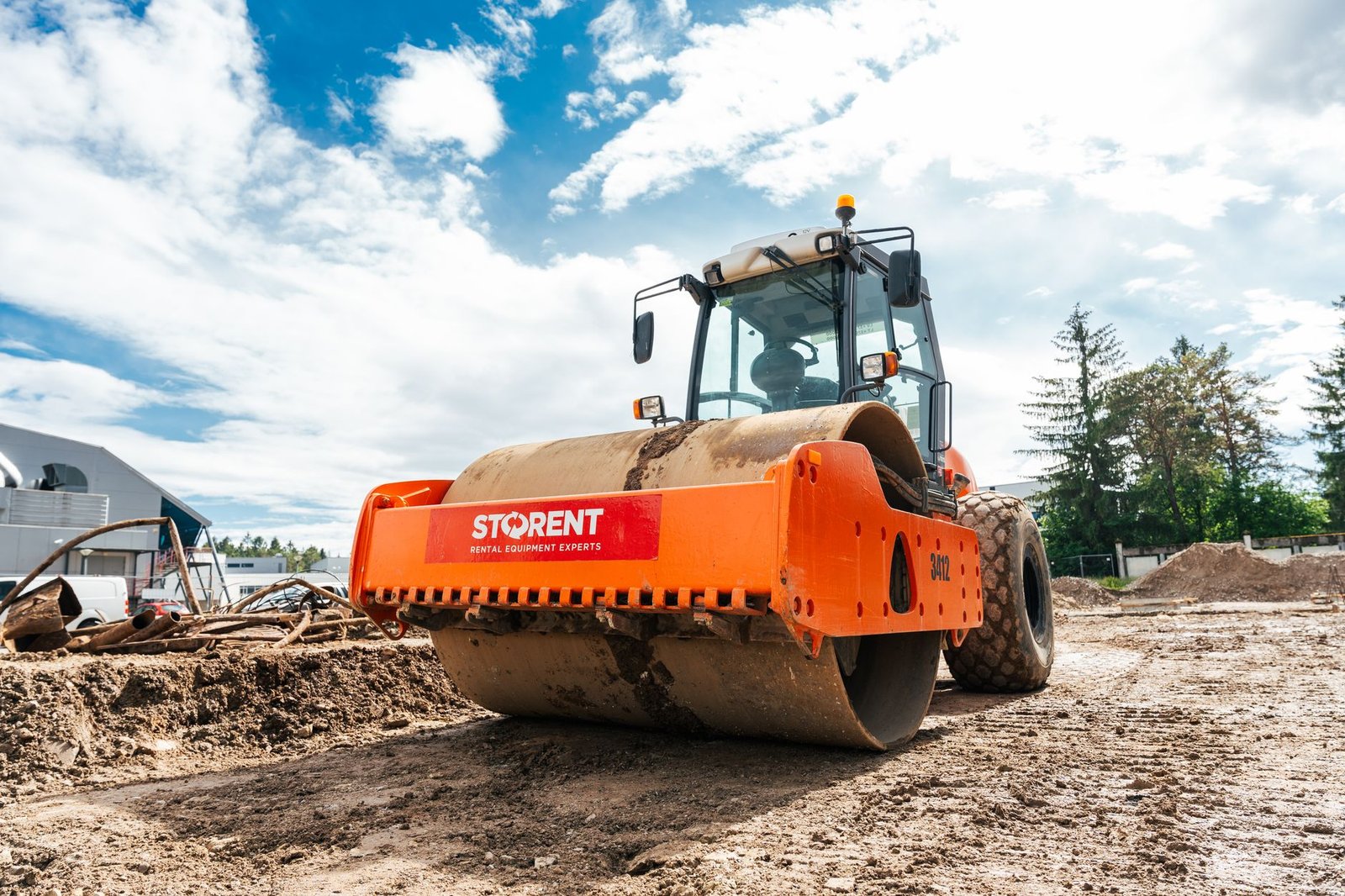
The phrase covers machines that weigh anywhere from about 250 lb to several tons, so pin down which one you are looking at before comparing:
- Walk-behind drum rollers. One or two steel drums, steered from a handle, usually with vibration. BOMAG's single-drum BW 55 weighs 158 kg (about 350 lb) with a 560 mm (about 22 inch) drum, and BOMAG pitches it for pavements, shoulders and estate roads in confined spaces. Double-drum versions are the ones you see on asphalt patches.
- Ride-on rollers. Small tandem rollers such as the Wacker Neuson RD12 up to full-size soil rollers. Wacker lists the RD12 for parking lots, driveways, secondary roads, repair work and trails. These need a trailer, and often an operator.
- Vibratory paver rollers. A frame with four or five small steel rollers and a Honda-class engine, built to run over laid pavers and slabs. The Bartell BPR1080 is the example most people find.
A plate compactor, by contrast, is a single flat steel plate with an exciter on top, usually around 200 lb in the forward class used for patios. The basics of how it shakes stone into place are in what a plate compactor is.
How a roller compacts differently from a plate

A plate presses its whole face onto the surface and shakes it, then hops forward. A drum touches the ground along a narrow strip and rolls, adding static weight and, on vibratory models, a shake of its own. If this applies to your yard, our guide to pavers spalling goes into more detail.
That difference has consequences you can see:
- Finish. A drum leaves a continuous, smooth surface. A plate leaves slight overlaps and edge marks, which you can live with on gravel but not on a finished asphalt driveway.
- Coverage. A roller keeps moving in a straight line. A forward plate has to be turned at the end of each run. Over a long driveway, that adds up to hours.
- Depth. Heavier ride-on rollers compact thicker layers. Rollercompactor.net's comparison puts plates at about 2 to 6 inches and rollers at 6 to 24 inches and more, depending on the machine.
- Edges and corners. A drum can't reach within a few inches of a wall, and a large one won't turn tight. A plate goes right up to the foundation.
(A roller does not care that your patio has a lovely curve. It will go straight, and then it will go straight somewhere else.)
Where a plate compactor still wins
My position is simple: for a residential patio or walkway base, renting a roller is the wrong call even when the rental yard has one sitting idle. The mechanism is in the base spec. ICPI's Tech Spec 2 builds the base in lifts of 4 to 6 inches with a 7,000 lbf plate, and thinner with smaller plates. That means several passes per lift, right up to the edge restraint and the house wall, on an area often smaller than a two-car garage. A plate does every one of those passes. A walk-behind roller does the middle and leaves you finishing the edges with a plate anyway.
A plate also wins on:
- Weight and transport. A 200-lb forward plate fits in a pickup with two people and a ramp. Even the small BW 55 is around 350 lb, and a ride-on needs a trailer.
- Rental cost. Rollercompactor.net lists plates at about $60 to $100 a day and rollers at about $250 to $500 or more. Prices vary by region, but the gap is consistent.
- Granular material. Crushed stone and sand respond to vibration, which is what a plate is built around.
Speed is the argument people make for the roller, so I ran the numbers. Marshalltown rates its VP3800 forward plate at a maximum of 9,733 sq ft per hour. Take a 600 sq ft residential driveway base built in three lifts with four passes each: that is 7,200 sq ft of plate travel, or under an hour of machine time on paper, and perhaps two or three in real life with turning and watering. A roller saves some of that, but not enough to cover the trailer, the higher day rate and the plate you still need for the edges. Coverage only starts to favor the roller on long rural driveways and lots measured in thousands of square feet.
Clay is the exception to both machines. Cohesive soil wants impact, which is why a rammer usually handles it better than either a plate or a small roller; that comparison lives in jumping jack vs plate compactor.
Asphalt: the one job rollers were built for
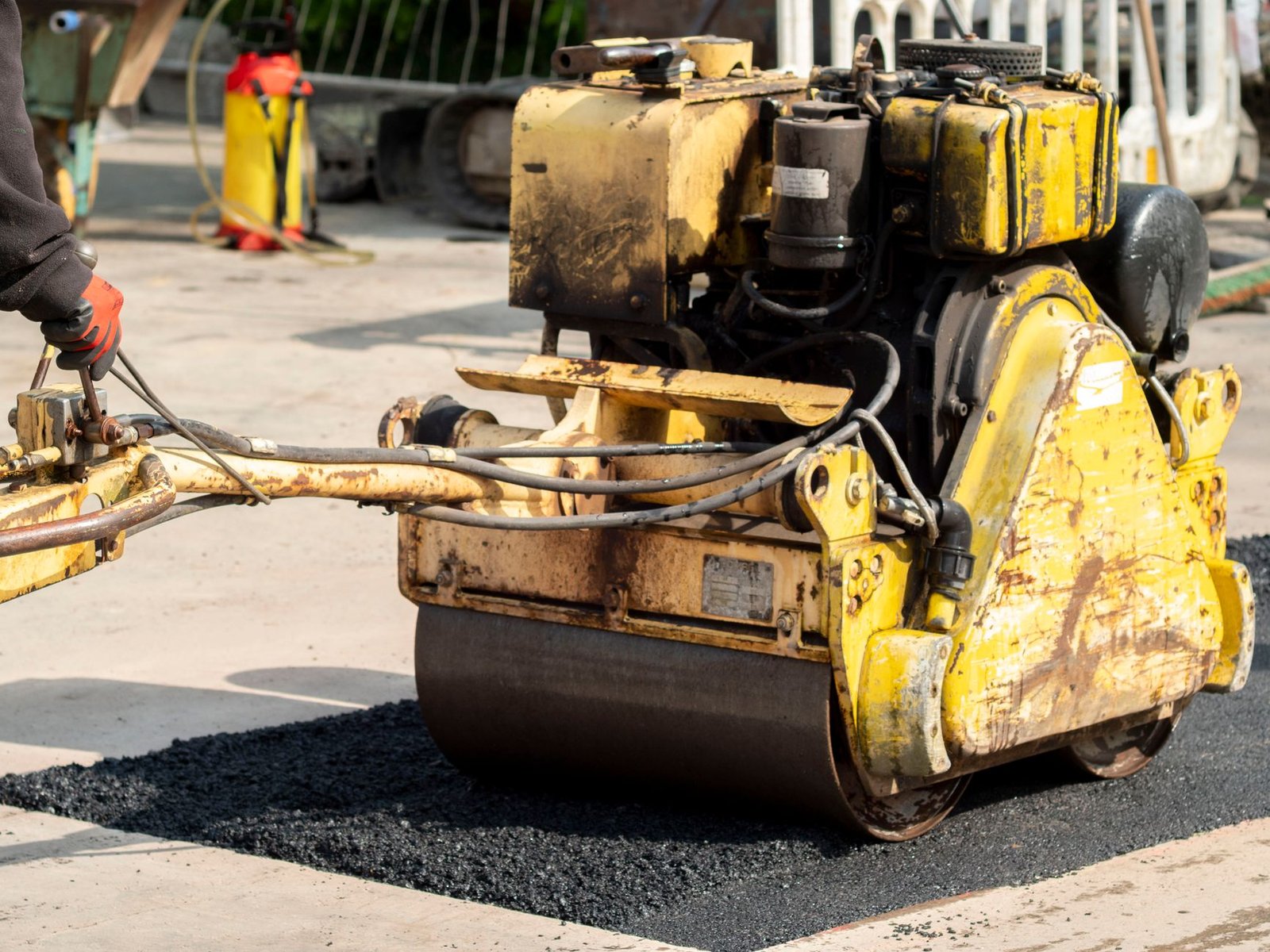
If the surface is asphalt, the roller earns its rental.
- Small patches and pothole repairs: a plate with a water tank does the job. Marshalltown's VP3800 manual says the water tank is necessary for keeping material from sticking to the bottom of the plate during asphalt paving and patching. That is what an "asphalt plate compactor" usually means: an ordinary plate with a water tank and sprinkler bar.
- A full asphalt driveway or path: a walk-behind or small ride-on double-drum roller. Hot mix cools as you work, and a roller covers the area and leaves the smooth finish before it stiffens. A plate leaves marks you will look at for years.
- Asphalt millings: they behave more like a gravel base than like hot mix. Spread them in thin layers, dampen them, and a plate handles a small area; a roller makes sense once the driveway is long enough that turning a plate every 20 feet becomes the whole afternoon.
An "asphalt tamper" in the hand-tool sense is just a flat steel tamper for patch edges and spots the machine can't reach.
Vibratory paver rollers for large slabs
This is the corner of the roller world that does touch paver work. A vibratory paver roller rides on several small rollers instead of a flat plate, so each paver or slab feels the vibration from rolling contact rather than a steel face slapping down on its corners.
Bartell's BPR1080 product page gives the numbers:
| Spec | Bartell BPR1080 |
|---|---|
| Compaction force | 2,381 lbf (10.5 kN) |
| Frequency | 93 Hz (5,600 rpm) |
| Width | 21.5 in |
| Weight | 243 lb (4 rollers), 258 lb (5 rollers) |
| Engine | Honda GX160 (4.8 hp) or Briggs & Stratton XR950 |
Bartell says it works polymeric sand into the joints "right down to the bedding layer" without the cracking and chipping that can happen with traditional compactors. That lines up with the problem it solves: large-format slabs and thin units are the ones a plate is most likely to crack, especially if one corner sits a hair high.
Is it worth renting for a normal patio of standard 60 mm pavers? Usually not. A padded plate does that job; see plate compactor for pavers for what to look for. Consider a paver roller when:
- the slabs are large format, such as 24 x 24, or thin;
- the installer or manufacturer recommends against a plate on that product;
- you are running polymeric sand into a big field of slabs and want it settled without marking the faces.
Roller compactor vs plate compactor at a glance
| Question | Plate compactor | Roller compactor |
|---|---|---|
| Patio or walkway base | Yes, in thin lifts | Rarely worth it |
| Edges, corners, next to walls | Yes | No, leaves a strip |
| Long gravel driveway | Works, slowly | Faster, smoother |
| Asphalt patch | Plate with water tank | Either |
| Full asphalt driveway | Leaves marks | Yes |
| Laid concrete pavers | Yes, with a pad | Paver roller only |
| Large slabs | Risky | Paver roller |
| Transport | Pickup, two people | Often a trailer |
| Typical day rate (per rollercompactor.net) | about $60 to $100 | about $250 to $500+ |
Roll the asphalt, plate the patio
A roller compactor is the right machine for asphalt and for long, open runs where finish and coverage matter, and a vibratory paver roller is worth it for large slabs. For the base and surface of an ordinary paver patio, walkway or small driveway, the plate is lighter, cheaper, reaches the edges and matches how the base spec is written. If a rental counter tries to upsell you a ride-on for a 12 x 16 patio, the drive home will be longer than the job. You can read more in the guide to asphalt vs pavers driveway.
FAQ
Is a roller compactor better than a plate compactor?
Only for large open areas and asphalt. A roller covers ground faster and leaves a smoother finish. For patio and walkway bases, corners and edges, a plate compactor does the job better and costs less to rent.
What is a walk-behind roller compactor used for?
Asphalt patching and paving, paths, parking areas, shoulders and small roads. Single-drum models such as BOMAG's BW 55 are made for confined spaces; double-drum models are common on asphalt repairs.
Can you use a roller on pavers?
Use a vibratory paver roller, not a drum roller. Paver rollers such as the Bartell BPR1080 spread vibration over several small rollers and are designed to settle pavers and slabs and work joint sand in without chipping them.
What is the best compactor for asphalt?
For a full asphalt driveway, a walk-behind or small ride-on double-drum roller. For patches and potholes, a plate compactor with a water tank, which keeps hot mix from sticking to the plate.
Can a plate compactor compact asphalt millings?
Yes, on small areas. Spread the millings in thin layers, dampen them and make overlapping passes. On a long driveway, a roller is faster and leaves a smoother surface.


