

Last Updated on October 20, 2026 by Umar Farooq
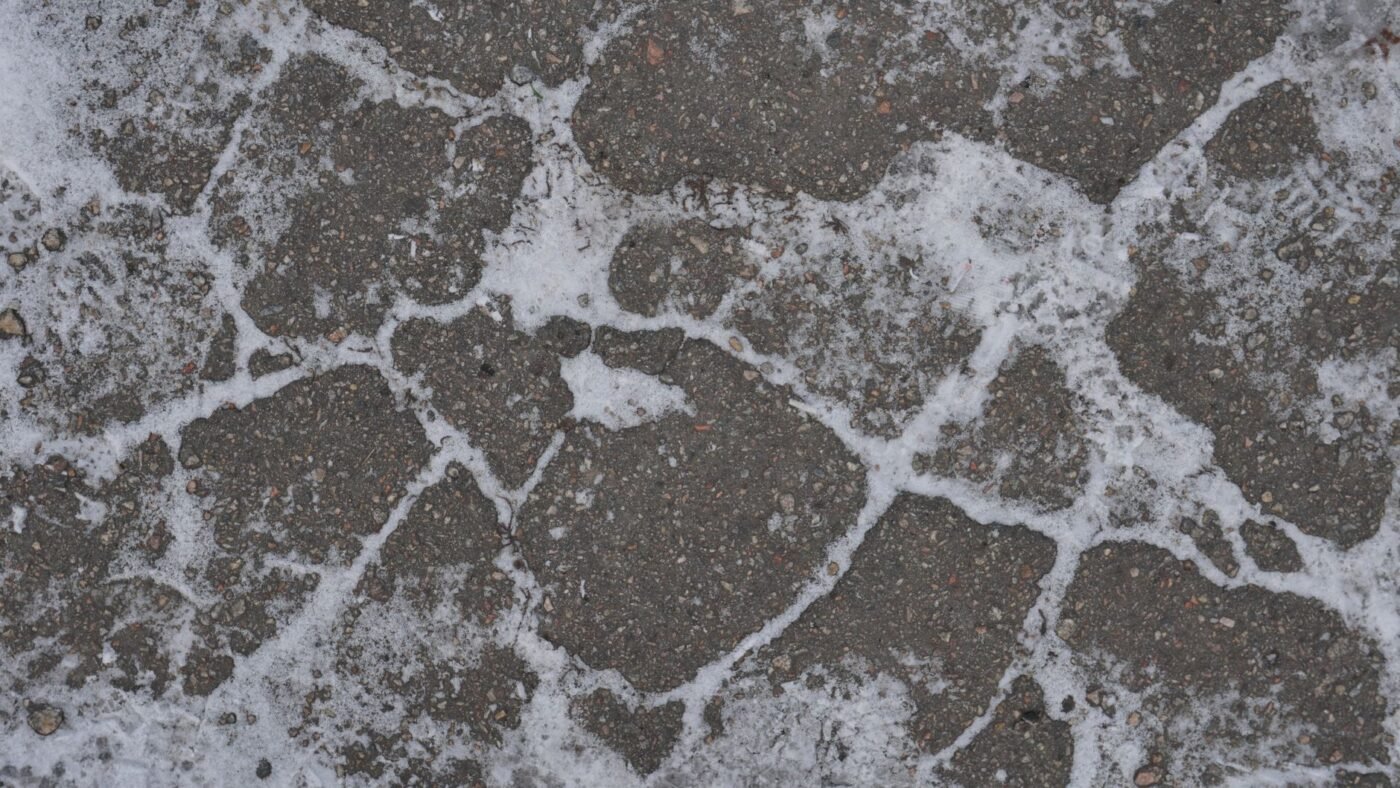
Pavers spalling means the surface of a concrete paver chips, flakes or breaks away, and the usual cause is water that has soaked into the paver and frozen, helped along by de-icers. A spalled paver is normally replaced, not patched. If a whole area is flaking, treat it as a product or warranty question before you start lifting pavers.
I went looking for paver-specific advice and mostly found the wrong material. The top pages cover poured concrete and chimney brick, and none mentions pavers. Where I borrow from them below, I say so. The paver-specific parts come from CMHA, the trade association (formerly ICPI), and from the test standards it cites.
Chip, flake or white haze? Name the damage first
People use "spalling" for several different things, and the repair depends on which one you have.
| What you see | Likely name | Notes |
|---|---|---|
| Thin skin peeling off the face, rough surface left behind | Scaling | Defined by the concrete industry as local flaking of the surface from freezing and thawing. The slab guide I read grades scaling as light to moderate to severe, with up to about 1/8 to 3/8 in of surface mortar lost at moderate. That guide is for poured slabs. |
| Chunks breaking off an edge or corner | Spalling or chipping | CMHA's maintenance note lists "chips, cracks, or spalls" together under damaged pavers. |
| Straight lines through the paver | Cracking | See cracked pavers. |
| Pale powder on the surface | Efflorescence | A surface deposit, not damage. |
A brick guide adds a useful test: spalled brick is often brittle or crumbly, and sometimes can be powdered by hand. That is about brick, not concrete pavers, but if the surface is soft rather than just chipped, the material itself is the problem.
Why concrete pavers spall

Every source I read blames the same chain: water gets in, freezes, expands, and the surface gives way. These are the contributing factors with a source behind them:
- Water that stays. The concrete-slab guide says poor drainage that keeps water or salt water standing on the surface raises the risk. A patio that puddles is a patio that soaks. See patio drainage.
- De-icing chemicals. This is where sources disagree. ICPI, as quoted on Techo-Bloc's winter guide, recommends sodium chloride, and says calcium chloride, magnesium chloride and CMA caused scaling, cracking and mass loss in its tests. A number of contractor pages say plain rock salt is the worst offender. Our own salt on pavers page lays out who says what.
- Pressure washing. CMHA's note says joint sand can be lost from pressure washing, and a brick guide lists high-pressure washing as a cause of spalling. Keep the nozzle back.
- Hard tools. CMHA's seasonal guide advises a synthetic snow blade instead of steel and shoveling at an angle to the pattern. Steel blades catching a raised edge is my inference, but it is an easy habit to change.
- Sealer that traps moisture. The brick guide warns that an incompatible sealer can trap water. It is a brick source, so treat it as a caution, not a proven paver mechanism.
What the standard says a paver has to survive
CMHA's guide specification requires concrete pavers to meet ASTM C936: average water absorption of 5% with no unit over 7%, and in the freeze-thaw test (ASTM C1645) no more than 225 g/m² of surface loss after 28 cycles, or 500 g/m² after 49. If pavers will see de-icers, the test uses the lowest freezing temperature, -15°C (CMHA PAV-GSP-011-21).
My arithmetic: 225 g/m² is about 21 g lost from one square foot, roughly the weight of a few coins. That is a lab limit, not a field forecast. But it tells you what compliant pavers are meant to do: shed a fine dusting. If chunks the size of a thumbnail are coming off a field of new pavers, that is not what the standard describes.
Replace the paver, don't patch it
CMHA's maintenance note puts spalls under damaged pavers and lists the remedy as replacing the pavers, compacting and refilling joint sand. It also says that a cracked paver with little to no opening generally will not affect performance, and I would apply the same logic to a minor chip. For slabs, guides recommend color-matching patch compounds and overlays, and one says overlays "don't address the underlying cause." I did not find any paver manufacturer that publishes a patch repair for a spalled paver face.
My opinion: replace the one or two that failed, and leave the rest alone. One chipped corner is not a reason to strip and reseal the whole patio or to buy a pricey "paver-safe" de-icer. Use a spare from the leftover pallet (guide specs ask for extras from the same production run). The steps are in replace a broken paver.
When a whole patio is flaking, it's a warranty question
One paver is bad luck. A whole area flaking after a winter or two is a pattern, and before you replace anything, check three things:
- What went on it. What de-icer, how much, and was it swept up afterward?
- Where the water sits. Pooling shows up as flaking in the low spots first.
- What the supplier can show. ICPI's application guide says paver suppliers will typically provide laboratory results showing the product meets ASTM C936. Ask for the C936 and C1645 figures, and read your paver warranty for salt and freeze-thaw terms. The same Techo-Bloc page, quoting ICPI, says to choose pavers with a warranty that covers salt damage.
If the pavers meet the spec and the damage still spreads, the cause is likely how the patio was used or drained. If they fail it, you have a claim.
Keep the ice off instead of the salt on
Prevention is not complicated. ICPI says to remove snow and ice mechanically first, reserve de-icers for ice that remains, and to promptly remove loosened snow, ice and excess salt to avoid a buildup of concentration. Spread thin, sweep up, and fix the puddle.
Replace what failed, then find out why it flaked
Pavers spalling is rarely a reason to rip the patio out. Replace the damaged pavers, keep the water off the surface, go easy on de-icers and, if a whole area is going, ask the supplier for the test results before anyone starts digging. If you are holding a hammer and a chisel over a single chipped corner, put them down and fetch a spare instead.
FAQ
What does spalling mean on pavers?
It means pieces of the paver surface chip or flake off. The usual cause is water absorbed by the paver freezing and expanding, made worse by standing water and de-icing salts.
Can spalled pavers be repaired?
CMHA's maintenance guidance is to replace damaged pavers, compact and refill the joint sand. Patch compounds exist for poured concrete, but I found no paver maker recommending them for pavers.
Does salt cause pavers to spall?
It can speed the freeze-thaw damage. The sources disagree on which chemistry is least harmful: CMHA and ICPI favor sodium chloride, while other contractors blame it. Use as little as possible and sweep up the excess.
Is a spalled paver dangerous?
Usually it is a cosmetic and tripping issue, not a structural one. CMHA says a cracked paver with little opening generally will not affect performance. Check that neighboring pavers are within 1/8 in of each other.
Is spalling covered by the paver warranty?
It depends on the terms. Some warranties exclude de-icer damage and some cover it. Read yours, and ask the supplier for ASTM C936 and C1645 results if a whole area is affected.


