


Last Updated on October 20, 2026 by Umar Farooq
Sandstone pavers are slabs of natural sedimentary stone, made of sand grains cemented together, sold in warm buffs, golds, reds and greys, and in finishes from rough riven to smooth sawn. They make excellent patios, paths and pool surrounds, but "sandstone" covers a wide range: some grades absorb up to 8% of their weight in water and reach only 4,000 psi, while dense quartzitic grades absorb 3% or less and exceed 10,000 psi. Buy by the test data, seal the thirstier grades, and use only thick setts or cobbles on a driveway.
I read ASTM C616, the standard for quartz-based dimension stone, to find out what separates the good sandstone from the rest. The short answer is a table most sellers never mention. The longer answer is below.
What sandstone pavers are made of

Sandstone forms when layers of sand are buried, pressed and cemented by minerals such as silica, calcite or iron oxides. Those layers, called bedding planes, are why the stone splits into slabs so readily, and why the surface of a riven paver has gentle ripples.
The cement is the part that matters for paving. Silica cement makes a hard, dense stone. Calcite cement makes a softer stone that acids can attack. Iron oxide cement gives reds and browns. Two slabs that look alike in the yard can behave quite differently after five winters, depending on what holds their grains together.
A few names you'll meet:
- Indian sandstone. The largest source of imported sandstone paving, sold under trade names such as Kandla Grey, Raj Green, Rippon Buff and Autumn Brown. Stonewise's sandstone paving guide lists more than twenty color names, which gives you some idea of the catalog problem.
- Arizona flagstone. A red-to-buff sandstone that is common in the western US, usually sold as irregular flagstone or snap-cut pavers.
- Pennsylvania bluestone. Geologically a dense sandstone too, although it's sold as its own category.
- Australian sandstone. Sydney and Queensland sandstones (hence searches for sandstone pavers in Brisbane) are widely used locally but rarely shipped to the US.
If you're still comparing sandstone with granite, travertine, slate and limestone, our natural stone pavers guide lines them up side by side.
Sandstone grades: why test data beats the color name

This is my strong opinion on sandstone: "sandstone" on a label tells you almost nothing about how the stone will wear. Ask for the absorption and compressive strength figures, and if the seller can't give them, choose a different seller.
The reason is in ASTM C616, which sorts quartz-based stone into three classes:
| ASTM C616 class | Max absorption | Min density | Min compressive strength | Min modulus of rupture |
|---|---|---|---|---|
| I Sandstone | 8% | 125 lb/ft³ | 4,000 psi | 350 psi |
| II Quartzitic sandstone | 3% | 150 lb/ft³ | 10,000 psi | 1,000 psi |
| III Quartzite | 1% | 160 lb/ft³ | 20,000 psi | 2,000 psi |
Now compare those with a concrete paver. ASTM C936, as quoted in the CMHA guide specification, requires an average of 8,000 psi and 5% absorption. A stone that only just meets Class I is therefore half as strong as a standard concrete paver and can absorb more water. A good Class II stone is stronger and tighter than either.
Both kinds get sold as "premium Indian sandstone." In a stone catalog, premium is a mood, not a grade. The spec sheet is the only way to tell them apart. What to ask the supplier for:
- Water absorption (ASTM C97). Under 3% is good; under 1% is excellent. Above 5%, plan on sealing and keep it out of freezing, wet spots.
- Compressive strength (ASTM C170). Over 10,000 psi for a driveway border or busy walk.
- Flexural strength or modulus of rupture (ASTM C99). This matters most for thin, large slabs, which fail by bending.
- Freeze-thaw testing, if you live somewhere cold.
Finishes and formats
Sandstone paving comes in three broad formats, and each one changes how you lay it:
| Format | What it looks like | Thickness | Laying method |
|---|---|---|---|
| Hand-cut, riven | Natural split face, uneven back, rough edges | varies, often 3/4 to 1 1/2 in within one pack | Full mortar bed that takes up the variation |
| Calibrated | Riven or sawn face, back ground flat | uniform, commonly about 7/8 in (22 mm) | Thinner, even mortar bed; faster to lay |
| Sawn and honed or sandblasted | Smooth or lightly textured face, crisp edges | uniform | Mortar bed; also used on pedestals for decks |
| Setts and cobbles | Small blocks, split or tumbled | about 1 1/2 to 2 1/2 in | Mortar bed on a vehicle-grade base |
Riven stone grips well and hides dirt. Sawn and honed stone looks modern but can be slippery when wet, especially in shade where algae grows. Sandblasted or flamed finishes add grip back to a sawn face. Tumbled edges soften a formal layout.
If your heart is set on an irregular, random-edge look, you're really shopping for flagstone, which our flagstones guide covers in detail.
How long sandstone pavers last, and what wears them out
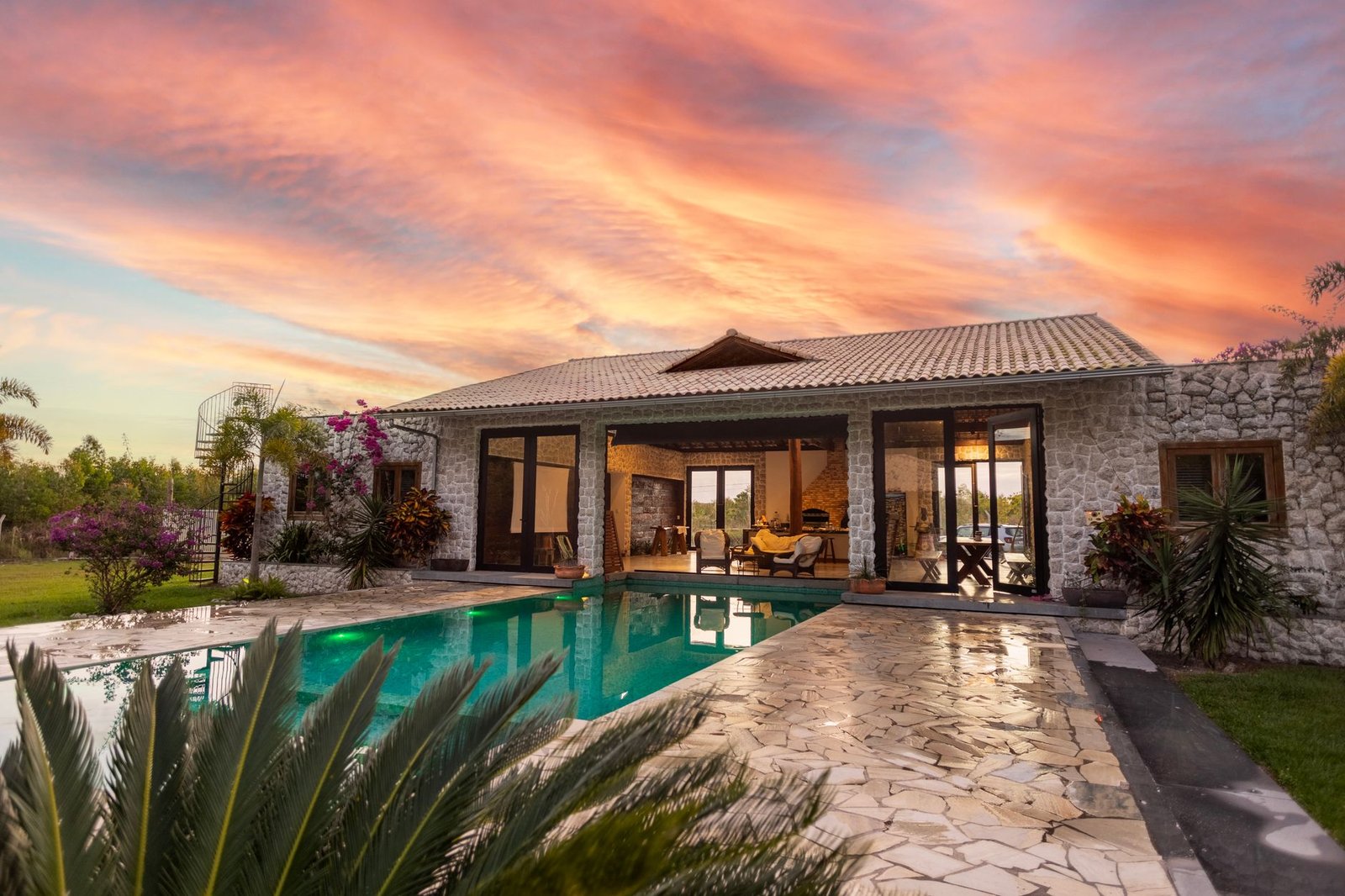
A dense, well-laid sandstone patio can outlast the house. A soft one can start shedding its face within a few winters. The difference comes from three things:
- Water. Porous stone that stays damp grows algae, stains more easily, and in cold climates suffers freeze-thaw damage as water in the pores expands. Laminated stones can also delaminate, flaking off in thin layers along their bedding planes.
- Salt. De-icing salts and pool water can crystallize inside the pores and push grains apart. Rinse chlorinated or salt water off pool surrounds and avoid rock salt on sandstone steps.
- Acid. Calcite-cemented sandstones are softened by acids, including some patio cleaners and vinegar. Check before you scrub with anything sour.
Sunlight also fades some colors. Pale grey stones such as Kandla Grey and green-tinged ones such as Raj Green are often described as softening in tone over a few years. That's a normal change in the stone, not a defect, but it's worth knowing before you match a new section to an old one.
Cold climates. Dense grades handle freezing well; soft grades don't. Natural Paving USA describes its Indian sandstone lines as low-absorption and freeze-thaw tolerant, which is the right claim to look for. Ask for a test result to back it up. In a freezing climate, lay the stone on a sloped surface so water leaves quickly, and avoid shaded, flat spots where water sits.
Sealing sandstone pavers
Most sandstone benefits from sealing, because it slows the uptake of water, oil, leaf tannins and algae. Denser grades need it less. Here's how to approach it:
- Wait for the stone to dry out. New installations hold moisture from the mortar. Seal too early and you trap it, which shows as white efflorescence or a cloudy film.
- Use a penetrating, breathable sealer, usually labeled impregnating. It soaks into the stone and leaves the surface looking natural. Film-forming acrylics on outdoor sandstone tend to peel, whiten and turn slick when wet.
- Test first. Some sealers darken sandstone noticeably. Try a spare slab or a hidden corner.
- Re-seal when water stops beading. Sun, foot traffic and cleaning wear sealer off at different rates, so let the stone tell you rather than the calendar.
Why absorption drives long-term wear in every paver material, stone or concrete, is covered in our guide to durable pavers.
Can you use sandstone pavers on a driveway?
Yes, with the right format. Ordinary sandstone patio slabs cannot take cars. Paving Slabs UK's guide to Indian sandstone for driveways puts typical patio slabs at about 22 mm calibrated and says they should not be used for regular parking. For vehicles it points to setts and cobbles, typically around 50 mm (about 2 inches) thick and commonly 40 to 60 mm, such as 100 x 100 mm or 200 x 100 x 50 mm units.
The reasoning is the same one behind concrete paver aspect ratios. A big, thin slab has fewer joints, so when a tire turns or brakes on it, the stress runs through one piece of stone, which cracks. Small, thick units spread the movement across many joints. CMHA applies the same logic to concrete: pavers with a length-to-thickness ratio of 4:1 or more shouldn't carry vehicles. A 600 mm slab that is 22 mm thick has a ratio of about 27:1.
For a sandstone driveway you also need:
- a compacted, vehicle-rated base of crushed stone,
- a full mortar bed with no voids under the setts,
- edge restraints that stop tires pushing the edge courses outward,
- a Class II or better stone, from the table above.
A practical compromise is a concrete or granite driveway field with a sandstone border, or sandstone setts only in the parking strip.
Laying sandstone patio pavers
Most sandstone patios are laid on a full mortar bed over a compacted base, which is how the stone is set in the UK and India where most of it is quarried. The outline:
- Dig and build the base. At least 4 inches of compacted crushed stone for a patio on well-drained soil, more on clay or where it freezes. Slope it away from the house.
- Prime the backs. Sandstone is porous, and some installers brush a bonding slurry onto the back of each slab so the mortar grips rather than drying into the stone.
- Use a full mortar bed. Spread mortar under the whole slab, not in dabs at the corners. Spot bedding leaves voids where water collects and slabs rock or crack.
- Tap to level. Seat each slab with a rubber mallet. Check level and slope as you go, allowing for the natural variation in riven stone.
- Joint it. Fill the joints with a mortar mix or a jointing compound rated for natural stone. Keep mortar off the faces, because it stains porous stone.
- Seal once the job is dry, as above.
Calibrated slabs speed this up considerably, since every piece is the same thickness. Hand-cut stone needs a thicker bed and more patience.
Sand-setting sandstone on a gravel base is possible with thick, calibrated stone in mild climates, but thin slabs rock and crack without a rigid bed underneath them.
Buying Indian sandstone: color, lot and source
- Order from one lot, and all at once. Natural color varies by quarry face and batch. A second order a year later rarely matches.
- Mix crates when laying. Pull from several crates at once to spread the color variation across the patio rather than in stripes.
- Order about 10% extra for cuts and for the slabs you'll reject for color or chips. Hand-cut packs also include thickness variation, so budget more if you dislike surprises.
- Ask about sourcing. Indian sandstone quarrying has well-documented labor concerns. Reputable importers will tell you how they audit their quarries. If the answer is vague, it's a data point.
Choose sandstone by its test sheet, not its name
Sandstone pavers can be the best-looking patio on the street, or a surface that sheds its skin one winter at a time. The difference is a set of numbers: absorption, strength and freeze-thaw performance. Get those in writing, pick a riven or textured finish for grip, set the stone on a full mortar bed, and seal the porous grades with a breathable product. Keep thin slabs off the driveway entirely. The stone spent a few hundred million years getting here. It can wait another week while you ask for the spec sheet.
FAQ
Are sandstone pavers durable?
Dense sandstone is very durable, and quartzitic grades are stronger than concrete pavers. Soft sandstone is not. Under ASTM C616, basic sandstone needs only 4,000 psi and may absorb up to 8% water, while quartzitic sandstone needs 10,000 psi and 3% or less. Ask for the test data.
Do sandstone pavers need to be sealed?
Most do benefit from it, especially porous grades and light colors. Use a breathable, penetrating sealer after the stone and mortar have fully dried, and re-seal when water stops beading. Very dense sandstone may not need sealing.
Is Indian sandstone good quality?
It varies by quarry and grade. The best Indian sandstone is dense and low-absorbing; poorer stone is soft and laminated. Buy from a supplier who can provide absorption and strength test results and who can tell you where the stone was quarried.
Is sandstone slippery when wet?
Riven and sandblasted sandstone grips well when wet. Sawn, honed or sealed sandstone with a glossy film can be slippery, and algae in shaded areas makes any stone slick. Choose a textured finish for pool surrounds and steps.
Can sandstone pavers be used for a driveway?
Only in the right format. Standard patio slabs, often about 22 mm thick, crack under cars. Use sandstone setts or cobbles around 50 mm thick on a full mortar bed over a vehicle-rated base, with solid edge restraints.


