


Last Updated on October 20, 2026 by Umar Farooq
The most durable pavers are the densest ones. That means concrete pavers that meet ASTM C936 (8,000 psi average strength and no more than 5% water absorption), clay brick pavers rated ASTM C902 Class SX, and dense natural stone such as granite. Durability isn't about how hard a paver looks. It's about how little water the paver soaks up, because in most of the US, freezing water is what wears pavers out. Then comes thickness for the traffic, and a base that doesn't move. I went looking for real lifespan data on paver patios and came back with standards and warranties rather than studies. That turns out to be more useful anyway.
Durable pavers start with three numbers
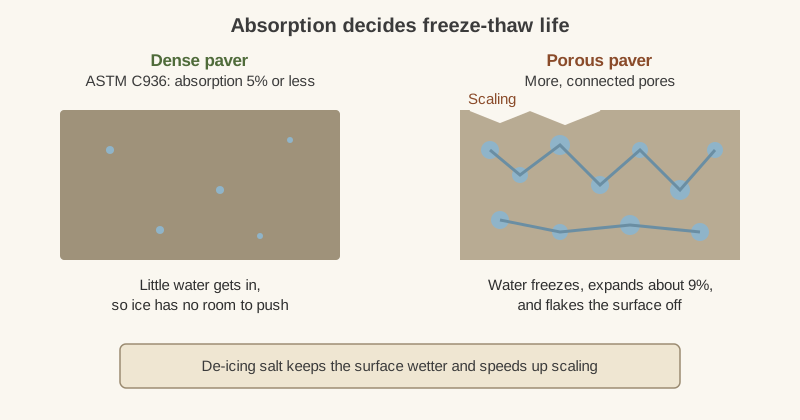
For concrete pavers, the standard is ASTM C936. The CMHA's guide specification for interlocking concrete pavements spells out what compliance means:
| Property | ASTM C936 requirement (per CMHA guide spec) | Why it matters |
|---|---|---|
| Compressive strength | 8,000 psi average, no unit under 7,200 psi | Resists cracking and edge chipping |
| Water absorption | 5% average, no unit over 7% | Less water inside means less freeze damage |
| Freeze-thaw (ASTM C1645) | No more than 225 g/m² lost after 28 cycles, or 500 g/m² after 49 | Proves the surface won't scale in winter |
Absorption is the one to watch. Water that gets into a paver's pores expands by about 9% when it freezes. Do that a few dozen times a winter and the surface flakes off. De-icing salt makes it worse, because it keeps the surface wet and cycling. The same guide spec asks for freeze-thaw testing at the coldest test temperature where pavers will see de-icers. It also says projects should get test results from an independent lab. You can ask a dealer for that report, too.
For clay brick, the Brick Industry Association's Technical Note 14 sorts pavers by weather and wear:
- Class SX for places where pavers may freeze while saturated. Its minimum strength is 8,000 psi as an average of five units.
- Class MX for outdoor use where it doesn't freeze. Class NX isn't for outdoor use.
- Type I for heavy abrasion such as driveways and public sidewalks. Type III for low-traffic residential patios.
A paver sold without any of these ratings isn't necessarily bad. But nobody has promised you anything about it either.
Durable paving stones by material
| Material | Durability | Weak point | Best use |
|---|---|---|---|
| Dry-cast concrete pavers (ASTM C936) | Very high | Surface color can wear in traffic lanes over the years | Patios, walks, driveways |
| Clay brick pavers (C902 SX, Type I) | Very high; color is fired through | Chipping at edges if poorly restrained; costs more | Walks, driveways, historic looks |
| Granite setts and cobbles | Highest of the common options | Price, weight, uneven surface | Driveways, formal paths |
| Bluestone and sandstone | Good to high, varies by quarry | Some beds delaminate in freezing weather | Patios, steps, stepping stones |
| Limestone and travertine | Moderate | Softer; acid-sensitive; some types scale | Patios in mild climates, pool decks |
| Porcelain pavers | High surface durability | Thin (often 3/4 in); cracks under point loads on a poor base | Patios, pedestals, overlays |
| Wet-cast concrete pavers | Moderate | More porous; often excluded from salt warranties | Sheltered patios, decorative areas |
The table says why concrete is the default on most patio projects. It's the one material with a single national spec behind it, which you can ask to see. It's also the cheapest way to get a paver rated for freeze-thaw. For the concrete families, the manufacturing method matters as much as the material. Our dry-cast vs wet-cast concrete pavers comparison explains why.
How long do pavers last?

Decades, on a sound base: a C936 concrete paver or SX clay paver will outlast most of the other things in your yard, and each unit can be lifted and reset rather than replaced. The warranty evidence, what actually fails first and the maintenance that keeps it that way are covered in how long do pavers last.
High quality pavers: what to check before you buy
A durable paver and a high-end paver aren't the same thing. Before paying extra, check the things that decide how long it lasts:
- Ask for the ASTM C936 or C902 test report. Reputable manufacturers can supply one. If a pallet has no standard printed anywhere on the tag or the website, treat that as the answer.
- Check the thickness for the use. CMHA recommends 2 3/8 inch (60 mm) pavers for pedestrian areas and residential driveways, and 3 1/8 inch (80 mm) for vehicular pavements. Keep the length-to-thickness ratio under 4:1 where cars drive. Our paver thickness guide covers the math.
- Look at a broken paver. Dry-cast concrete should look dense and uniform all the way through, with no layers of loose material inside.
- Check the face mix. Many concrete pavers have a colored face layer over a gray core. That's normal and durable, but in a driveway's tire paths the face may wear to show the aggregate over the years. Through-colored products hide this better.
- Check consistency across the pallet. Pavers that vary visibly in thickness from unit to unit make a patio with lippage, where edges chip.
Most durable pavers for high-traffic walkways and driveways

For a front walk used every day, or a driveway, stack the odds:
- Choose a textured, tumbled or blended color. Wear, tire marks and small chips disappear into it. A smooth, single-color face shows every scuff.
- Go thicker where vehicles drive. A 60 mm paver is fine on a residential driveway. 80 mm pays off where trucks turn or park.
- Pick a pattern that locks. Herringbone resists tire-driven creep better than running bond on a driveway.
- Choose chamfered edges. A small bevel keeps edges from chipping when neighbors are slightly uneven.
- Skip thin porcelain and wet-cast anywhere cars or snowplows go.
The base under a driveway is its own subject, covered in our paver driveway guide.
Price buys finish, not lifespan
My take: a mid-range, dry-cast concrete paver that meets C936 is as durable as most premium ones, because the durability bar is the same standard for both. What the extra money buys is the finish: a smoother face, larger formats, more natural-looking color blends, sometimes through-body color. Those are good reasons to pay more. Longer life isn't one of them. And several finishes that look the most luxurious, such as large, thin, smooth or wet-cast slabs, are actually the ones most vulnerable to cracking and wear.
Dense, rated and thick enough: that's what lasts
The most durable pavers are the ones that soak up the least water and come with a rating you can check. That means concrete pavers meeting ASTM C936, clay brick pavers rated Class SX, and granite if the budget stretches. Choose the thickness for the traffic, keep salt and plow blades in mind, and let the rest of the budget go wherever your eyes want it. The paver will almost certainly outlast its warranty paperwork. For the longer answer, see how long do pavers last?.
FAQ
What is the most durable paver material?
Granite is the hardest of the common options. Among everyday pavers, dry-cast concrete pavers meeting ASTM C936 and clay brick pavers rated ASTM C902 Class SX, Type I are the most durable choices for freezing climates and heavy traffic.
How long do pavers last?
Expect decades on a sound base, with occasional re-sanding and releveling. The evidence behind that is in the dedicated guide to how long pavers last.
Are brick pavers stronger than concrete pavers?
Both have similar minimum strengths: 8,000 psi average for ASTM C936 concrete pavers and for C902 Class SX clay pavers. Clay keeps its color longer because the color is fired through, while concrete is usually cheaper and comes in more shapes.
Do pavers last longer than poured concrete?
Pavers don't crack the way a slab does, because the joints let the surface flex, and a damaged paver can be lifted and replaced. A slab that cracks has to be patched or broken out.
Are thicker pavers more durable?
Thicker pavers resist breaking and tipping under vehicles. CMHA recommends 3 1/8 inch (80 mm) for vehicular pavements, while 2 3/8 inch (60 mm) is standard for patios and residential driveways. Extra thickness doesn't help freeze-thaw resistance. Low absorption does.


