Last Updated on September 23, 2026 by Umar Farooq
A paver driveway is a driveway surfaced with interlocking concrete, clay or stone units laid on a compacted gravel base instead of a single poured slab. It is also the only driveway you can partly take apart with your hands, which sounds like a flaw until the day you need to. It costs more up front than concrete or asphalt, but it doesn't crack as one piece, it can be repaired one paver at a time, and a well-built one lasts for decades. If you want a driveway that looks custom and can be fixed without a jackhammer, pavers are usually worth it. If the lowest price on day one matters most, they usually aren't.
This guide covers the decision. The build lives in our paver driveway installation guide.
Why a paver driveway flexes where a slab cracks
A concrete driveway is one rigid plate. When the soil under it heaves in a freeze or settles after a wet spring, the plate can't bend, so it cracks. Concrete has many talents. Flexibility isn't one of them.
Pavers work the other way. The sand-filled joints let the surface move slightly without breaking, passing a tire's load from paver to paver and into the base. Belgard's comparison of pavers with concrete and asphalt describes those joints as a way to release pressure during freeze-thaw cycles without losing strength.
The units are also dense. I read the ASTM C936 requirements in the CMHA guide spec expecting wiggle room, and there isn't much: concrete pavers must average at least 8,000 psi in compressive strength and absorb no more than 5% water. A typical poured driveway slab is mixed to around 4,000 psi. When a paver driveway fails, the base underneath has almost always failed first.
Paver driveway vs concrete and asphalt
| Pavers | Poured concrete | Asphalt | |
|---|---|---|---|
| Up-front cost | Highest | Middle | Lowest |
| Cracking | Joints absorb movement; single units rarely break | Cracks as a slab; control joints only guide where | Cracks and ravels as it ages |
| Repairs | Lift and relay the affected area; no patch marks | Patches show; bad slabs get replaced | Patches and sealcoat |
| Routine upkeep | Top up joint sand; optional sealing | Occasional sealing | Sealcoat every few years |
| Looks | Many colors, shapes and patterns | Plain, or stamped and stained | Black only |
| Drive on it | As soon as the joints are sanded and compacted | After the concrete cures, usually about a week | Within a few days |
Belgard puts paver driveways at 30-plus years and says asphalt, concrete and stamped concrete last roughly half as long. That's a manufacturer grading its own homework, but the logic holds: what wears out on pavers, joint sand and the odd unit, is replaceable.
What you give up with pavers
The brochures are strangely quiet about these:
- Cost. Pavers cost more than a slab because of the deeper base, the edge restraints and the hand labor. Our paver driveway cost breakdown covers published price ranges.
- Joints need attention. Sand washes out, weeds and moss take root, and ants dig. (Ants regard a sand joint as free housing.) Polymeric sand reduces all three, but joints still need a look every spring.
- Settling shows. A soft spot in the base shows up as a dip or a rut.
- Snowplows. A steel blade can catch a raised paver edge. Use a plow with a rubber cutting edge or skid shoes, and set the blade slightly high.
- Oil stains. Unsealed concrete pavers soak up drips. Darker colors hide them, and stained units can be swapped.
Choosing pavers for a driveway
The best pavers for a driveway are the ones rated for vehicles. Most driveway paving stones fall into four groups:
- Interlocking concrete pavers. The default choice: made to ASTM C936, in the widest range of colors, and the easiest to match for replacements.
- Clay brick pavers. Color is fired through the clay, so it doesn't fade. Use heavy-vehicular brick rated for driveways, not thin patio brick.
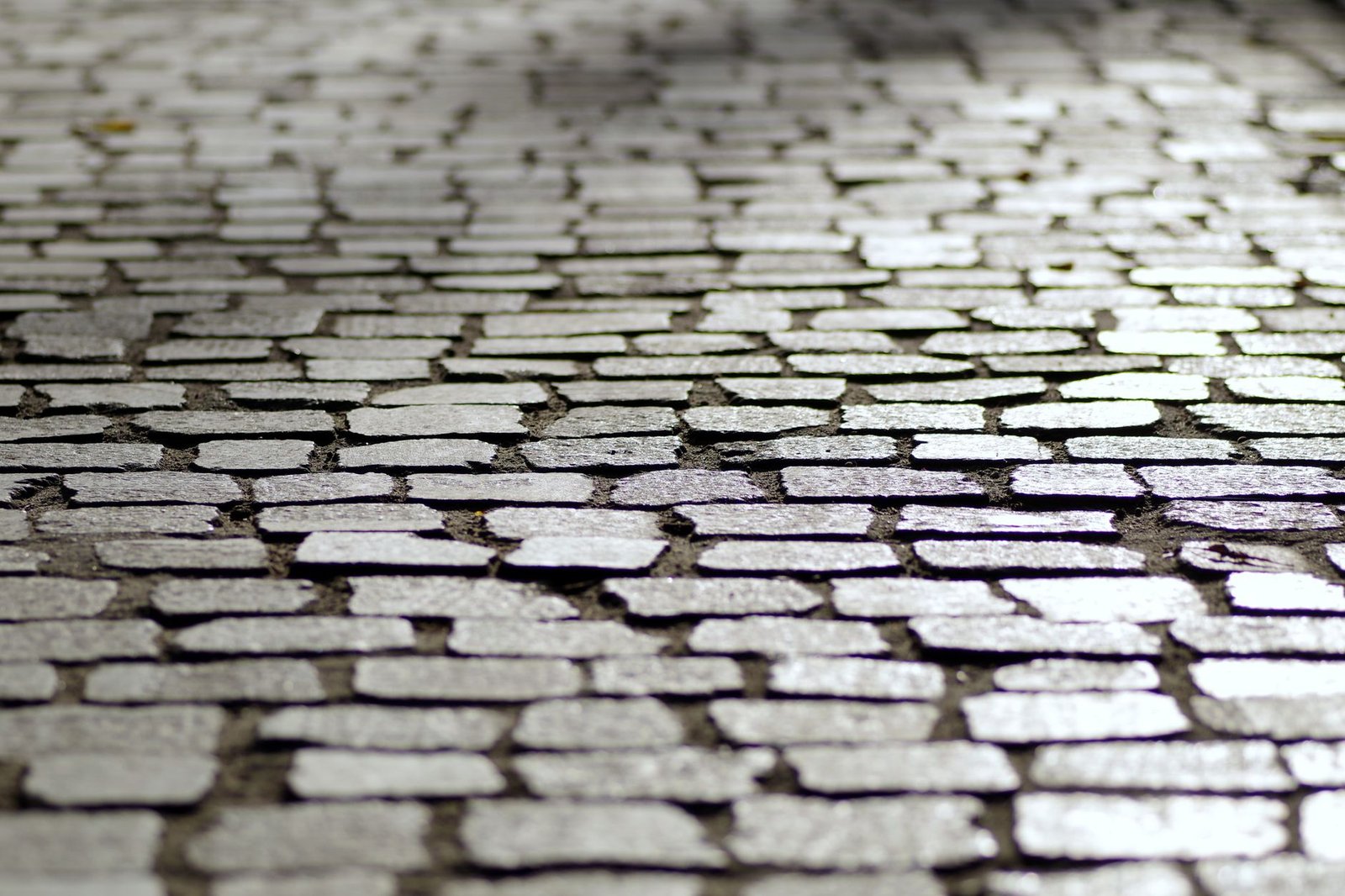
- Natural stone and cobbles. Granite cobbles are very durable. Sawn flagstone slabs are usually too thin for cars unless they are set on a concrete slab.
- Permeable pavers. Wider joints filled with stone chips let rain drain through. They also help where a town limits impervious surfaces.
Thickness matters more than brand. CMHA Tech Spec 10 recommends 2 3/8-inch (60 mm) pavers for residential driveways and 3 1/8-inch (80 mm) where vehicle traffic is heavier, so go thicker for trucks, RVs or tight turning areas.
Large driveway pavers and long plank shapes look sleek, but a big, thin unit acts like a lever under a tire, so it rocks and cracks. CMHA keeps anything with a length-to-thickness ratio of 4:1 or more off driveways. Use a large format only if the manufacturer rates that exact product for vehicles.
Paver driveway ideas that hold up under tires
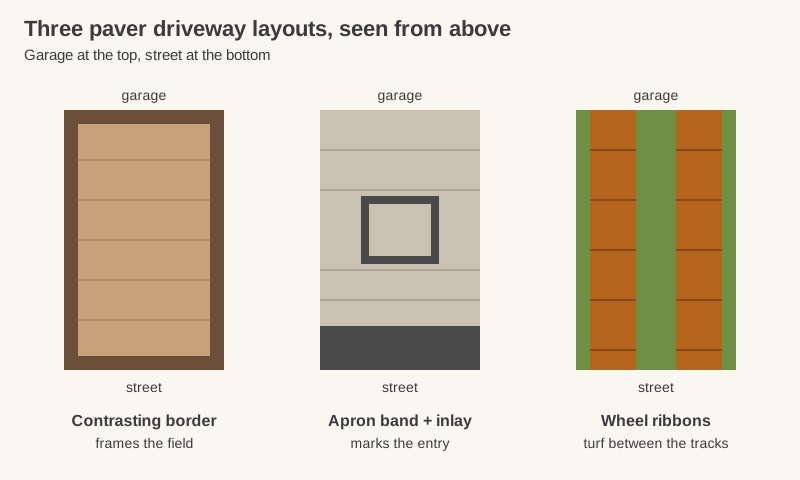
A single color across 600 square feet can look flat. These driveway paver ideas break it up without weakening it:
- A contrasting border. A darker soldier course around the edge frames the field and gives the herringbone cuts a straight line to end on. Our guide to driveway border pavers covers the edge details.
- An apron band or inlay. A dark band marks the entrance at the street; a square or circle inlay breaks up a wide parking pad.
- Two-tone blends. Mixed colors hide dirt and tire marks.
- Modern driveway pavers. Smooth-faced, large-format units in charcoal or light gray with narrow joints give a clean, contemporary look. Lay them in herringbone or a staggered pattern rated for vehicles.
- Wheel ribbons. Two paver strips with grass or gravel between them suit long rural drives and cost less to build. The grass strip needs mowing, which makes it the only driveway feature with a lawn-care schedule.
- Heated or lit. Plan snow-melt tubing and lights before the base.
Whatever the look, keep herringbone or another interlocking pattern in the tire paths.
How long pavers last on a driveway
A properly built paver driveway lasts for decades, and the pavers are rarely what limits that. I went looking for a study on how fast thin driveway bases fail and found contractor blogs quoting each other, so no number from me. What the specs do agree on is what shortens a driveway's life:
- a base too thin for the soil, or not compacted in lifts
- downspouts dumping water into the base
- missing or weak edge restraints that let the field spread
- joint sand that washes out and is never topped up
When a section does sink, it can be lifted, the base re-compacted and the same pavers relaid.
Worth it if the base is built to match
Here is my one strong opinion: a paver driveway is really a gravel driveway with a good-looking top. The pavers spread a tire's load; the compacted stone carries it. ICPI Tech Spec 2 puts that stone at 6 inches minimum under a residential driveway on well-drained soil, and 8 to 10 where the soil is wet, weak or freezes. If the budget only covers a thin base, pour concrete or build wheel ribbons instead, because a cheap paver driveway turns into a rutted one. If your quote doesn't mention base depth, ask. The answer is the part of the driveway you're actually paying for.
FAQ
Are pavers good for a driveway?
Yes, if they are rated for vehicles and set on a proper base. Pavers made to ASTM C936 are stronger than a typical poured slab, and the joints let them handle freeze-thaw and small ground movement better than a single slab.
Is a paver driveway cheaper than concrete?
No. A paver driveway usually costs more to install than poured concrete, and much more than asphalt. The gap narrows over time, because you repair small areas instead of replacing slabs.
Can you put pavers over an existing concrete driveway?
Sometimes. If the slab is sound, drains and has room for the added height at the garage and street, thin overlay pavers can be set over it. A cracked or heaving slab should come out. Our pavers-over-concrete guide explains how to judge the slab.
What is the best paver for a driveway?
For most homes, an interlocking concrete paver at least 2 3/8 inches (60 mm) thick, laid in herringbone, is the best paver for a driveway. Go to 3 1/8 inches (80 mm) for trucks, RVs or tight turning areas. Clay brick and granite cobbles also work well when they are rated for vehicles.
Do paver driveways need to be sealed?
No. Sealing is optional; it can deepen the color, ease oil cleanup and help lock in joint sand. Unilock's driveway paver FAQ notes that its pavers don't need sealing. If you do seal, use a breathable paver sealer and reapply when water stops beading, not on a calendar.