Last Updated on September 23, 2026 by Umar Farooq
Driveway border pavers are a strip of concrete pavers, clay paving brick or granite cobble laid along the edges of a driveway, usually one to three pavers wide. Unlike a patio border, this one gets delivery vans. So it needs vehicle-rated pavers (3 1/8 in, 80 mm, is the safe pick for an edge tires hit), the same compacted base as the driveway, and a concrete haunch on the lawn side to stop tires pushing it outward. Get those three right and the border outlasts the asphalt or concrete it frames.
A border that gets driven on is not decoration
Every wheel on the outside course pushes it toward the lawn. Unrestrained, the border creeps outward and the pavers rock. So the rules differ from a decorative patio border:
- The border sits on the full driveway base, not a shallow sand trench.
- The outside edge is restrained by something heavier than plastic spikes.
- The pavers are rated for vehicles.
Design choices (soldier versus sailor courses, contrast colors, double rows) are in our guide to paver border patterns.
Which pavers and edging stones suit a driveway edge
| Border material | Suitable for tire traffic? | What to check |
|---|---|---|
| Concrete pavers, 80 mm (3 1/8 in) | Yes | Sold as driveway or vehicular pavers |
| Concrete pavers, 60 mm (2 3/8 in) | Only where tires rarely reach | Fine for an edge beside a walk, not a parking strip |
| Clay paving brick | Yes, if rated | ASTM C1272 heavy vehicular paving brick; C902 is for pedestrian and light traffic |
| Building brick (wall brick) | No | Not made for paving; spalls in freeze-thaw |
| Granite cobble or Belgian block | Yes | Set on a concrete bed, since the units are irregular |
| Thin "garden edging" blocks | No | Too thin; they tip and crack under a wheel |
Rectangular pavers are the easiest choice. CMHA's Tech Spec 10 calls 2 3/8 in (60 mm) fine for residential driveways and 3 1/8 in (80 mm) typical for vehicular pavement, so I'd spend the extra on the edge course, where tires load one side of a paver with nothing beyond it. A paver 4 or more times longer than it is thick stays off anything driven on (CMHA). Granite cobbles are the toughest option.
How the base and haunch hold a driveway paver border
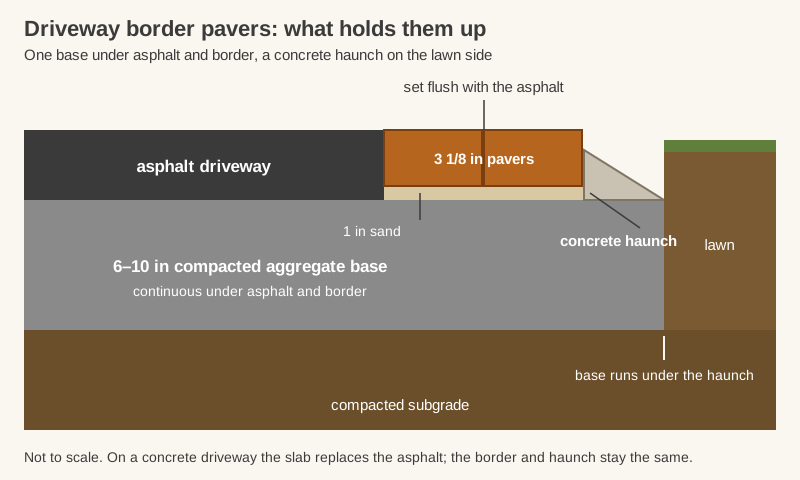
Dig the border trench to the full driveway depth and carry the compacted base, 6 inches minimum for a residential driveway, and 8 to 10 on weak, soggy or frost-prone ground (ICPI Tech Spec 2), right under the border and past it by its own thickness. A border on a shallow sand trench beside a deep driveway base settles and leaves a lip.
The border pavers then go on a 1-inch screeded bed of ASTM C33 concrete sand, or on a concrete bed for cobbles.
The lawn side is where most driveway borders fail. Plastic edging spiked into gravel is fine along a patio, which rarely gets a three-point turn. Beside a driveway I won't hedge: spikes are not enough. A tire on the outer course shoves sideways with a car's weight behind it; a spike in gravel holds by friction alone. The usual answer is a concrete haunch: a wedge of concrete against the outside face of the border, sloped from partway up the paver onto the base. Heavy-duty metal restraint is an alternative on well-drained soil; our paver edging guide compares both.
Asphalt driveway with paver borders: new or retrofit
New driveways. Install the border first: base, border pavers, compaction, haunch. The asphalt crew then paves against it as a form, finishing flush with the pavers. Unilock's page on asphalt driveway paver borders suggests two- to four-course borders and matching aprons.
Existing asphalt. Two choices, cheaper first:
- Add the border outside the asphalt. This widens the driveway. Dig a trench along the edge, build the base, lay the pavers and haunch the outside. The asphalt edge becomes the inside restraint, so cut back any crumbling edge first.
- Cut the border into the asphalt. Snap a straight line, saw-cut the asphalt with a cut-off saw, and remove the strip. Rebuild the base below before setting pavers.
Either way, set the border flush with the asphalt and carry the cross slope through it. A proud border catches plow blades and dams water; a low one collects puddles (and, reliably, the one puddle you step in getting out of the car).
Concrete driveway with paver border
A concrete driveway with a paver border follows the same rules, with one difference: the slab does not flex. It has opinions about that. Where the border meets the slab, leave a tight joint and keep the pavers flush with the concrete. Do not mortar or glue the border to the slab edge. The slab and the base-set pavers move differently with frost, and a rigid bond cracks.
A border band across the drive at the garage or street (an apron or "rumble strip") is full driveway paving, same base depth. Budget Dumpster's roundup of DIY driveway border ideas compares cobblestone, brick and gravel edging if you are still choosing a look.
Build the border as part of the driveway, not an add-on
The best driveway border pavers are simply driveway pavers laid in a different color or direction. Use vehicle-rated units on the full base, haunch the lawn side, and set them flush. A border built to garden standards moves the first time a truck cuts the corner, and somebody always cuts the corner.
FAQ
How wide should a driveway border be?
One to three pavers wide, roughly 4 to 24 inches. One course is an accent; two or three frame the drive and add width.
Can you put a paver border on an existing asphalt driveway?
Yes. You can either add the border outside the existing edge, which widens the drive, or saw-cut a strip off the asphalt and set the pavers in its place.
How thick should pavers be for a driveway border?
Use 80 mm (3 1/8 inch) pavers anywhere tires can reach. Thinner 60 mm pavers are more prone to cracking and shifting at an edge.
Should driveway border pavers be set in concrete?
Rectangular concrete pavers are normally set on a 1-inch sand bed over a compacted base, with concrete only as a haunch along the outside edge. Irregular granite cobbles and Belgian block are the exception. They are usually set on a concrete bed because their heights vary.
Can I use regular bricks to edge a driveway?
Not wall bricks. Use clay paving brick made to ASTM C1272 for areas that carry vehicles. Wall brick spalls and cracks in wet ground under tires.