


Last Updated on October 20, 2026 by Umar Farooq
Slate pavers are thin, hard slabs of a fine-grained metamorphic rock that splits along natural layers, giving a textured face in charcoal, grey, green, purple and copper tones. Good slate resists frost, staining and scratching, and grips well when it has a cleft face. The catch is that quality varies enormously between quarries: soft or layered slate can flake, and thin "tiles" are not pavers. Buy slate by the quarry and the test sheet, choose a cleft or honed face, and set it on a flat, well-compacted base.
I read three slate guides (FreshPatio, Primethorpe Paving and Nustone) that agree on the pleasant parts (the colour, the grip) and go suspiciously quiet on thickness, absorption and frost. That gap is where slate patios fail, so I spent most of my time on it. If you are still choosing between stones, our natural stone pavers guide puts slate next to granite, bluestone and travertine.
What slate pavers are, and what to ask about the stone
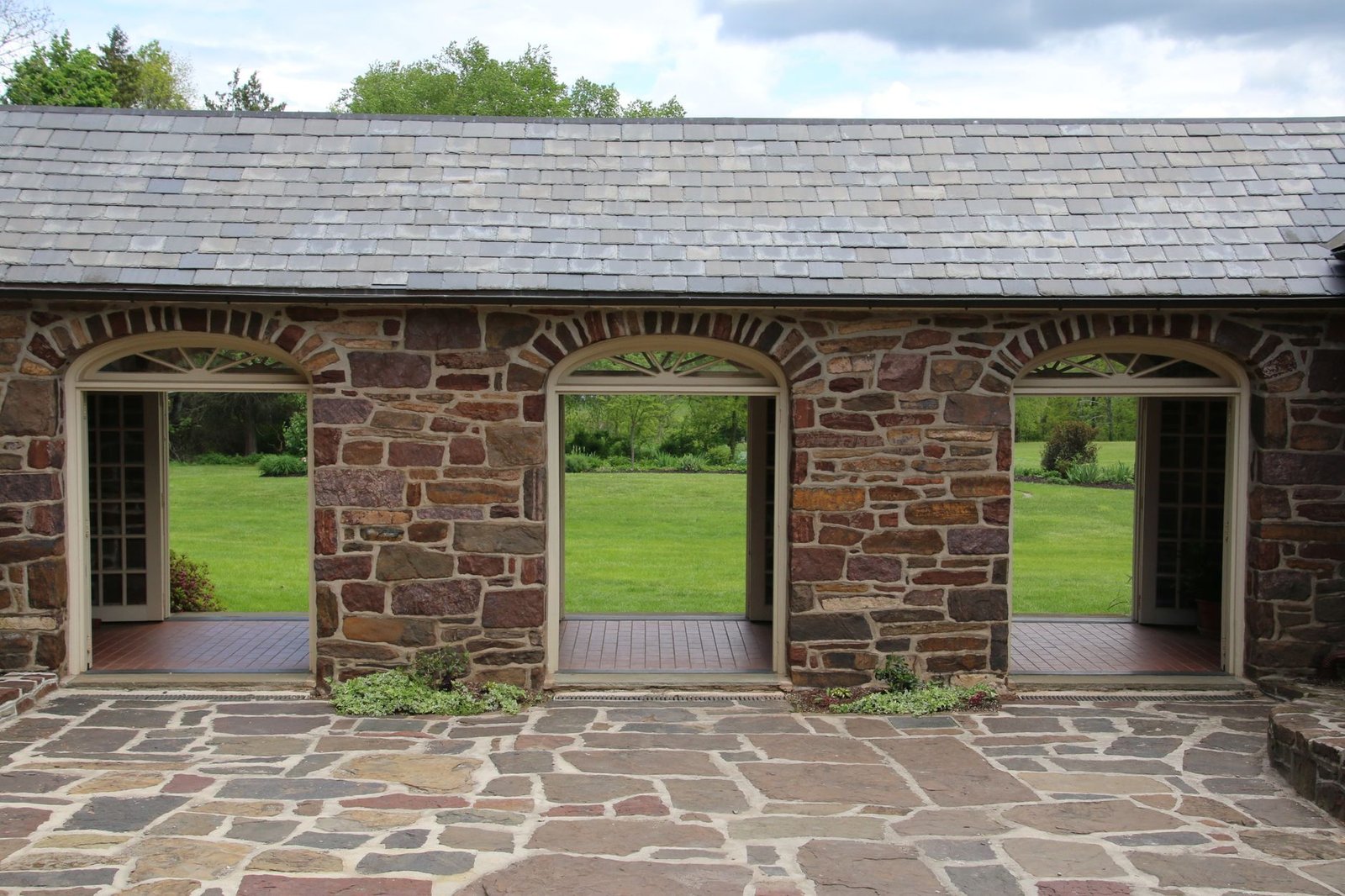
Slate forms when shale or mudstone is squeezed and heated until its clay minerals line up in thin parallel sheets. FreshPatio describes it as made mainly of quartz, muscovite or illite. Those sheets are why slate splits so cleanly, and why the surface of a split paver has that natural, rippled texture.
ASTM C629 is the specification for slate dimension stone. Its abstract says slates are selected for either exterior or interior use, and it tests absorption, abrasion resistance, acid resistance and modulus of rupture across and along the grain. That tells you the first question to ask: is this slate sold for exterior paving, and can the supplier show the test results?
A list worth taking to the stone yard:
- Where was it quarried (the quarry, not just the country)?
- Is it rated for exterior paving?
- What are its absorption and modulus of rupture figures?
- Is it gauged to a consistent thickness, or ungauged?
- Has it been installed in a climate like yours for several winters?
Brazilian, Indian, Welsh and the rest
The origin names you will see are really shorthand for texture, price and quality. The three guides agree on the broad picture:
| Slate | Look and surface | Price signal |
|---|---|---|
| Indian | Dark grey to blue-black, very riven and rough. FreshPatio says darker black and blue stone is harder and lighter colours can be softer and may delaminate | Budget. Primethorpe quotes about £25 to £30 per m² |
| Brazilian | Smoother, only lightly riven. FreshPatio calls it premium and one of the best for outdoor use. Primethorpe says it is prone to scratching | A little more than Indian, about £30 to £40 per m² |
| Welsh | Dark grey or blue with occasional white veins, a heritage stone | Primethorpe says upwards of £80 per m² |
| Vermont | FreshPatio says it is blasted and hand-split, which makes it more brittle than Brazilian or Welsh | Check locally |
| Chinese | FreshPatio says quality varies widely and lower grades can contain lime, iron pyrite and salt, which can cause white bloom or rust staining | Cheap, but see below |
The guides do not agree on Chinese slate. FreshPatio treats it as an available, affordable option to buy only from a reputable source, while Primethorpe says Chinese quarries have stopped producing paving slate. Both can be true, because stock and sources change. The sensible reading: if a supplier is offering you a very cheap slate of unknown origin, ask more questions.
Prices in pounds come from UK suppliers and are a guide to the relative cost, not a US quote.
Cleft, honed or tumbled: the face you will walk on

Slate comes in three surfaces, and each changes both the look and the grip:
- Cleft (riven). The natural split face, textured and uneven. Best grip, and it hides dirt. Thickness varies across a single piece, so it needs a thicker bed.
- Honed. Ground smoother and matte. FreshPatio says honed slate is less slippery than polished, though it is still smoother than cleft.
- Tumbled. Rolled to soften the edges and give a weathered look.
Cleft slate is the best choice for pool surrounds, steps and shaded paths. A smooth face looks modern and suits dining areas, but it is more slippery after rain and when algae grows, so keep it for dry, open areas. Our slip-resistant pavers guide goes into traction more broadly.
Slate also changes colour when wet, which is normal. Many slates look much darker after rain, and then lighten as they dry.
Layers, flaking and the soak test

The problem with a stone that splits into layers is that it can split where you do not want it to. FreshPatio says some Indian slates, particularly lighter coloured ones, can delaminate, and that Vermont slate is more brittle. Good slate has tight layers and very low absorption. Poor slate has layers that open up as water gets between them and freezes.
I could not find a published failure rate for slate by origin, and none of the three guides gives one, so I am not going to give you a number. What I can give you is a test you can run yourself:
- Ask the supplier for two spare pieces of the exact product.
- Soak one in water for several days and leave the other dry.
- Compare the edges and surface. Look for lifting, flaking, white bloom or rust spots.
- If you live somewhere cold, put the wet piece through a few nights in the freezer.
A supplier who will not hand over a sample is telling you something. This is my one strong opinion on slate: sample before you order, test it for a week and take the supplier's answers seriously, because the same stone in different crates is not the same stone.
Layering is also why edges matter. Do not cut slate thinner than necessary or leave thin, unsupported edges where a flake can lift.
Heat, slip and the dark-stone problem
Slate has a slightly contradictory reputation. FreshPatio says it is very low in water absorption, resists staining, weathering and frost cracking, and is suitable for freeze-thaw cycles. It also says that in very hot climates its non-porous nature means it can heat up on summer days. Both are true, because dark, dense stone absorbs sun and holds it.
What to do about heat:
- Choose lighter tones such as grey-green or copper over charcoal for sunny spaces.
- Add shade over a seating area.
- Test a sample in the afternoon sun, with your hand.
Our natural stone guide compares heat across stones, and the granite pavers guide covers the harder, denser alternative. For wet-surface traction, cleft faces are the safe choice, and FreshPatio says sealing can also reduce slipperiness.
Thickness: a slate tile is not a paver
This is the most important detail that the top guides skip. Slate is sold both as paving and as thin wall or floor tile, and the two are not interchangeable. Thin tile belongs on a concrete slab with full mortar contact, and in a protected spot, not on a sand bed.
For a sand-set patio, our natural stone guide uses about 1 1/4 inches (3 cm) as the working thickness for natural stone, and thinner stone, around 1/2 inch, is mortared to a slab. For a mortar-set patio, ask the supplier for the thickness and whether it is gauged. Cleft slate that varies in thickness is harder to set flat and needs more bedding material.
Ask the supplier for the recommended thickness for your use, and take it in writing.
Laying slate on sand or on a slab
The method depends on the thickness and the surface you are covering.
Sand-set, thicker slate. ICPI Tech Spec 2 asks for at least 4 inches of compacted crushed-stone base under a patio or walkway on well-drained soil, with 2 to 4 inches more on wet, weak or freezing ground. Bedding sand is a nominal 1 inch of ASTM C33 concrete sand, screeded and left loose. CMHA's guide spec adds a flatness limit of 3/8 inch over a 10 foot straightedge, and ICPI's lippage limit for pedestrian routes is 1/8 inch. With cleft slate, you will not hit 1/8 inch everywhere, so lay it where small variation is part of the look.
Mortar-set, thinner slate. Bond to a sound concrete slab with a full mortar bed and keep the mortar off the face. Slate's colour can stain if mortar slurry dries on it.
The pavers are the finish. The base is the patio. Slate looks heavy and permanent, and it will still telegraph a lumpy base to everyone who walks across it. Our paver base guide covers depth and compaction.
Irregular, natural-edged slate is sold as flagstone, and our flagstones guide covers that format. FreshPatio says slate is installed like travertine, with mud-set and dry-set both possible. Slate cuts best with a wet diamond blade. OSHA's rule for masonry saws is water on the blade (29 CFR 1926.1153), and cutting stone makes respirable dust.
Sealing slate: penetrating, not a plastic coat
The advice conflicts. Nustone says there is no fixed rule for when to seal, and some people seal before laying and others wait up to a year. FreshPatio says to seal before use and after installation, with thin coats of acrylic sealer, and to double-seal. Nustone adds that slate is naturally stain-resistant, but sealing helps against staining, moss, algae and fading, and some sealers enhance the colour.
My view: slate is dense, so it needs far less help than sandstone or travertine. If you seal, use a breathable, penetrating sealer made for natural stone rather than a glossy film. Acrylic films can turn slick when wet on a stone you chose for grip, and a film on top of a dense stone can trap moisture and peel. Always test a spare piece, because sealers can darken slate, and remember that colour enhancement is permanent.
Reseal only when water stops beading. For cleaning, FreshPatio suggests plain dish soap and avoiding heavy-duty cleaners, and says baking soda on oil stains works with plastic wrap over it for an hour.
What slate pavers cost
FreshPatio puts slate at roughly $5 to $20 per square foot, with about a third of a project's budget going to the stone. It estimates a 45 square foot cleft slate walkway at about $350 for materials and $150 for labour, and a 160 square foot mortar-set patio at about $2,700 in total. Those are single-guide figures, so treat them as a rough range, and add the base, sealer and any delivery.
UK suppliers show the relative picture: Indian and Brazilian slate are close to each other in price, and Welsh slate costs several times more. The cheapest slate is rarely the cheapest patio if it flakes in three winters.
A concrete paver in a slate-like colour costs a fraction of the price. If your reason for choosing slate is the dark look, the cheaper option is worth a look first. If your reason is the texture and the long life, buy the real stone and buy it carefully.
Buy it by the quarry, then lay it on a base you trust
Slate pavers can be one of the best-looking and best-gripping stones for a patio, provided you buy a dense, exterior-rated grade with a known quarry and a test sheet. Choose a cleft face for traction, a lighter tone for hot sun, a thickness suited to sand or mortar, and a flat, well-compacted base underneath. Soak a sample for a week before you order. The rock was layered over millions of years, so you can spare it seven days.
FAQ
Are slate pavers good for outdoor patios?
Yes, when the slate is a dense, exterior-rated grade. It resists staining, weathering and frost, and a cleft face grips well. Poorer, softer slate can flake along its layers, so ask for absorption data and a sample.
Do slate pavers need to be sealed?
Not always. Slate is naturally stain-resistant, and sealing mainly helps against staining, moss, algae and fading. If you seal, use a breathable, penetrating stone sealer, test a spare piece first and reseal only when water stops beading.
What is the difference between Brazilian and Indian slate?
Indian slate is usually rougher and more riven, often darker, and the budget option. Brazilian slate is smoother and lightly riven, and is considered premium, though it can scratch more easily. Welsh slate costs several times more than either.
Does slate get hot in the sun?
Dark slate can. FreshPatio notes that its non-porous nature means it heats up in very hot climates. Choose lighter tones, add shade and test a sample in the afternoon sun.
How thick should slate pavers be?
Sand-set natural stone is usually about 1 1/4 inches (3 cm) thick or more. Thinner slate should be mortared to a concrete slab. Thin slate wall or floor tile is not a patio paver.
Is slate slippery when wet?
Cleft slate grips well. Honed slate is smoother and less safe in wet, shaded areas, and algae makes any stone slick. Choose a cleft finish for pool surrounds, steps and shade.


