


Last Updated on October 20, 2026 by Umar Farooq
Granite pavers are cut or split blocks and slabs of granite, a dense igneous rock, used for patios, walkways and driveways. Granite is the hardest-wearing paving stone you can buy, but thickness and finish decide whether it suits your job: thin tiles of about 3/4 inch are for foot traffic, while a driveway needs thick setts around 2 inches deep on a deeper base. Pick a flamed, sandblasted or split face for grip, avoid polished faces outdoors, and budget for the base and the slow cutting, which cost more than the stone's reputation suggests.
I opened a cost guide, a UK paving supplier's guide and an export supplier's overview, and checked what the stone standard covers. The disagreements are small, but the gaps are interesting. For how granite compares with other natural stones, see our natural stone pavers guide.
Why granite is the benchmark for hard-wearing stone
Granite is a coarse-grained igneous rock, mostly quartz and feldspar, formed from cooled magma. It is hard, dense and low in porosity. In practice that means it resists scratching, resists staining and shrugs off the freeze-thaw cycles that flake softer stones.
ASTM C615 is the specification for granite dimension stone. Its abstract says it covers granite for building cladding, curbstone, paving and landscape features, structural components, retaining walls and monuments. It requires limits on absorption, density, compressive strength, modulus of rupture, abrasion resistance and flexural strength. That is the right list to ask a supplier about.
Flodeal's overview describes granite as durable, impact resistant and low maintenance, suitable for hot, cold, rainy and snowy climates. Most supplier claims are marketing, but the mechanism behind this one is sound: low absorption leaves little water to freeze. Colours run through grey, black, brown, red and mixed natural shades.
Finishes: flamed, sandblasted, split, and the polished trap
Granite's surface is a manufacturing choice, and it is the main thing between a safe patio and a slick one.
| Finish | What it is | Where it works |
|---|---|---|
| Flamed | Heat makes the surface crystals shatter into a rough, textured face | Patios, pool surrounds, driveways. Universal Paving says the flamed face stays slip-resistant even when wet |
| Sandblasted | Fine textured surface from blasting | Pool decks, pathways, gardens (Flodeal) |
| Shotblasted | Uniform texture with good grip | Busy walkways (Flodeal) |
| Split | Rough, rustic face with excellent grip | Steps, borders (Flodeal) |
| Natural | The stone's original surface | Informal paths |
| Polished | Glossy ground face | Indoors, or dry covered areas only |
Skip polished granite for any outdoor surface that gets wet. It is lovely and it is slippery, and ice and rain are not polite about the difference.
Choose flamed or sandblasted for dining areas where furniture sits. Choose split or bush-hammered for steps. A split face is wonderful for grip and awkward for chair legs.
Thickness decides the job: tile, slab or sett

Here is my one strong opinion about granite: hardness is not the same as strength in use. A big, thin slab of the hardest stone on earth still bends, and it cracks where the base is soft. Thickness and unit size decide the load it can take.
Flodeal lists granite paver thicknesses of 25 mm (light outdoor use), 40 mm (medium duty), 50 mm (heavy duty) and 60 to 80 mm for high load. Universal Paving says 40 mm flamed setts take car traffic comfortably on a properly compacted, vehicle-rated sub-base, and recommends them for patio borders and edging. Those are supplier guides, not a code, so ask the maker for the load rating of the product you are buying.
The concrete paver rules give you the logic, though not a granite spec. CMHA says concrete pavers with a length-to-thickness ratio of 4:1 or more should stay off the driveway. A 24 inch granite tile that is 3/4 inch thick has a ratio of 32:1. Granite is stronger than concrete, so that limit does not transfer directly, but the geometry does: one big thin piece carries a tire load through a single slab, while many small thick setts share it across their joints. It is the same reasoning as in our paver driveway guide.
Rough guide, from the supplier figures above:
- Foot traffic, patios and walks: around 25 mm to 40 mm.
- Cars: around 40 to 50 mm setts on a vehicle-rated base.
- Heavier vehicles: thicker units, from 60 mm up, and a deeper base.
Setts, cobbles, slabs: which format to order
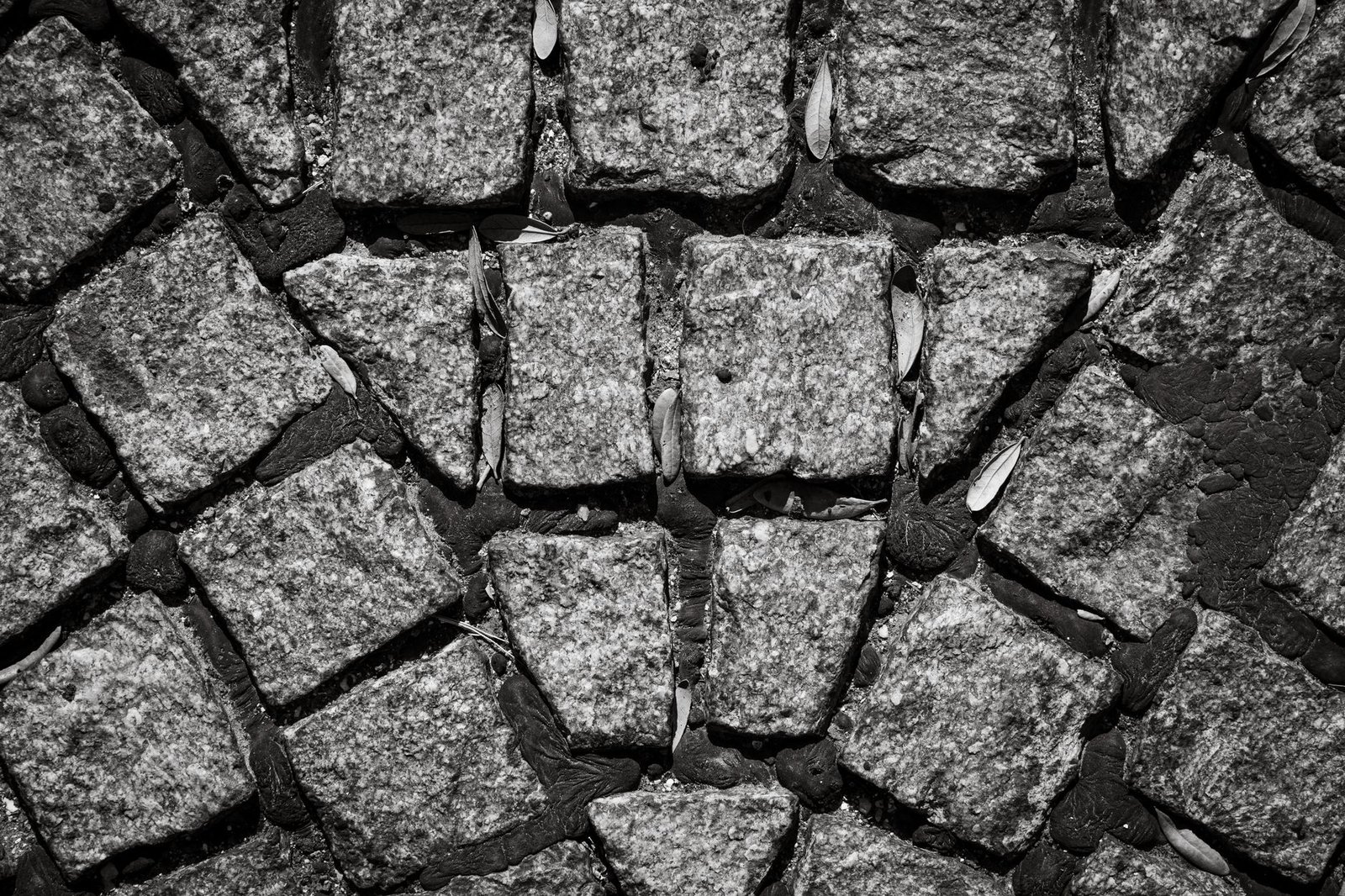
Granite comes in three useful formats:
- Setts. Small, thick blocks, often 200 x 100 mm. They lay in classic patterns and tolerate vehicles. Our cobblestone pavers guide covers how they compare with concrete cobbles.
- Slab pavers. Larger rectangles for patios, such as 300 x 600 mm. They look clean and modern, and they need a flat base.
- Irregular or split pieces. For informal paths and borders.
Sizes from export suppliers range from 200 x 100 mm up to 600 x 300 mm, or cut to size. Allow about 10 percent extra for cuts and breakage, which is the Universal Paving figure, and blend pavers from several packs as you lay so colour variation spreads out. Granite varies from batch to batch, so order everything at once.
Laying granite: the base is the patio
Granite pavers are laid like any other paver or stone. The detail changes with thickness, and I could not find a single authoritative granite installation standard, so I will give you the paving industry's numbers and the supplier cautions.
For a sand-set patio or walkway, ICPI Tech Spec 2 calls for at least 4 inches of compacted crushed-stone base on well-drained soil, and at least 6 inches under a residential driveway. Add 2 to 4 inches in cold climates or on wet or weak soil. Bedding sand is a nominal 1 inch, screeded and left loose, using ASTM C33 concrete sand. The base should be flat to within 3/8 inch over a 10 foot straightedge, and the maximum lippage between pavers on a pedestrian route is 1/8 inch.
The pavers are the finish. The base is the patio. A granite paver on a poor base is a very hard thing sitting on a very soft thing, and the hard thing wins until the soft thing moves.
A few more points from the suppliers:
- Universal Paving says a vehicle-rated, compacted sub-base is the requirement for driveways.
- Planner5D's cost guide says replacing pavers on a solid, level gravel bed is inexpensive, while a new patio or driveway needs excavation, geo-fabric and compacted aggregate, which adds labour and equipment cost.
- Mortar-set granite on a concrete slab is common for thinner units and for steps. It needs its own slope and joints.
Our paver base guide covers depth and compaction in detail.
Cutting hard stone without ruining the saw or your lungs
Granite is hard to cut and shape, and it shows up in the quote. Expect slower cuts and more blade wear. Use a diamond blade and keep it wet. OSHA's rule for masonry saws is water on the blade, every time, because cutting stone throws off respirable crystalline silica (29 CFR 1926.1153). Indoors or in an enclosed area, add a respirator from the first cut. Granite dust is not something to improvise around.
A good layout reduces cutting. Plan the pattern so your cuts fall on the edges and corners, and order edge pieces rather than cutting full setts. Simple patterns cost less than complex ones, because a running bond needs fewer cuts than herringbone.
Sealing granite: optional, and mostly cosmetic
Granite does not need sealing for protection. Universal Paving says sealing is optional, and that a sealer mainly deepens the colour of black setts, because granite is dense. Other suppliers recommend a penetrating sealer on all natural stone, so check what the quarry or maker says for your stone. If you do seal:
- Let the stone dry completely first.
- Use a breathable, penetrating sealer, not a glossy film.
- Test a spare paver, because sealers can change the colour.
- Reseal when water stops beading, not on a date.
Sweep and wash as needed. Universal Paving points out that granite resists staining and wear, so upkeep is minimal.
What granite pavers cost, and what the quotes leave out
Cost guides disagree, so use them as ranges. Planner5D's 2024 estimate for a 235 square foot patio is $5.27 to $7.96 per square foot installed, with about $1,240 to $1,870 for materials and $1,994 to $3,346 for labour, which implies labour is the larger share. Universal Paving prices flamed black setts at £59.90 per square metre in the UK, which is a supplier list price and not an installed cost. I would treat the Planner5D figure as the low end, because stone prices, thickness and regional labour move the total a lot.
What drives the price:
- Thickness and finish. Thin split-face pavers of about 1 inch are the budget option. Thicker 2 to 3 inch pavers with flamed or bush-hammered faces cost more (Planner5D).
- Base preparation. A new area needs excavation, fabric and compacted stone.
- Pattern. A running bond costs less than herringbone, because of the cutting.
- Delivery, permits and disposal. Usually quoted separately.
Cheaper first, as always: if the budget is tight, use granite setts only for the border, the apron and the steps, and a concrete paver in the field. Our bluestone pavers guide covers the other cold-climate natural stone choice.
Use granite where everything else wears out first
Granite pavers are worth the money where the surface is hit hardest: driveways, entry walks, steps, borders and cold-climate patios. Pick a flamed, sandblasted or split face, choose the thickness for the load, build a base of at least 4 inches for patios and 6 for driveways, cut it wet, and seal only if you want the colour deepened. Skip it for a budget patio where nothing will test it. It formed under a mountain, and it will outlast whatever you put on the other side of the fence.
FAQ
Are granite pavers good for driveways?
Yes, in the right format. Use thick setts of about 40 to 50 mm or more on a compacted, vehicle-rated base of at least 6 inches. Thin patio tiles are made for foot traffic and can crack under cars.
Do granite pavers need to be sealed?
Not for protection, because granite is dense and resists staining. A sealer mainly deepens colour. If you use one, choose a breathable, penetrating product and test a spare paver first.
Are granite pavers slippery?
Polished granite is slippery when wet. Flamed, sandblasted and split finishes give good grip, which is why they are the usual choice outdoors, around pools and on steps.
How thick should granite pavers be?
For patios and walkways, about 25 to 40 mm. For car traffic, about 40 to 50 mm setts on a deeper base. For heavy vehicles, thicker units of 60 mm or more. Ask the supplier for the load rating.
Is granite a good paver for cold climates?
Yes. Its low porosity leaves little water to freeze, so it handles freeze-thaw cycles and de-icing better than softer stones. Build the base for frost by adding 2 to 4 inches where the ground freezes.
Why is granite hard to install?
It is heavy, hard to cut and slow to shape, so labour costs more. Use a wet diamond blade, plan the layout to minimise cuts and follow the silica water rule when cutting.


