

Last Updated on October 20, 2026 by Umar Farooq
A vegetable garden paver path should be wide enough for what moves down it. University of Georgia extension gives 12 inches as the bare minimum between raised beds, 18 to 24 inches as comfortable, and 4 feet if you push a wheelbarrow, cart or wheelchair. So pave the main route at 4 feet, keep any side paths to 2 feet, and give a wheelbarrow path the same base as any other walkway. For everything else, mulch is cheaper.
Match the path width to what rolls down it
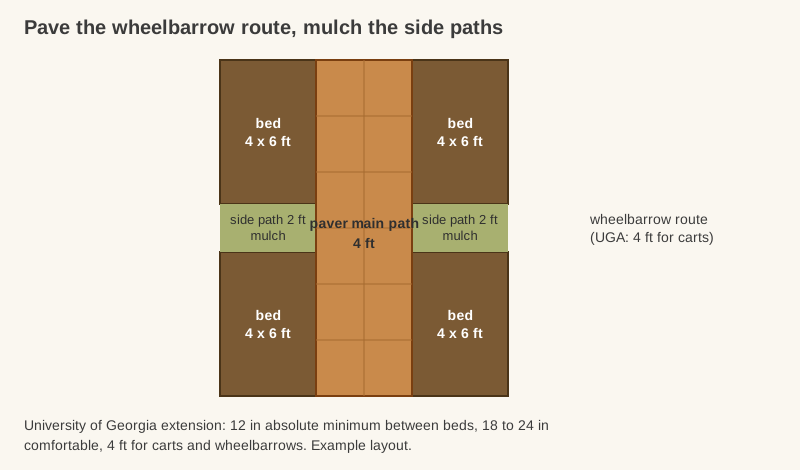
The UGA extension raised bed dimensions publication is the cleanest source I found. Its figures:
| Path use | Width |
|---|---|
| Absolute minimum between beds | 12 in |
| Comfortable walking | 18 to 24 in |
| Carts, wheelbarrows, wheelchairs | 4 ft |
| A small truck on the central path | At least 10 ft |
Our own garden bed pavers article suggests 24 to 36 inches for a wheelbarrow, which is narrower than UGA. The difference is whether you turn the barrow or only roll it straight in. I would take UGA's 4 feet for the main route, since a full barrow is wider than the wheel and is harder to steer than an empty one. The other numbers fit the side paths.
Where a vegetable garden paver path earns its cost
This is my one opinion, and it saves money. Pavers earn their cost where the load is: the route you push a barrow along, where mud collects and where you stand most. The side paths between beds, which you walk single file, do fine as mulch or gravel. Paving everything doubles the base and the cutting, and makes the beds harder to change next year.
Brick or concrete pavers suit this job. Fine Gardening's author laid brick between raised vegetable beds, using bricks 7 1/2 by 3 1/2 by 2 1/2 inches, about 5 pounds each, and 800 for the whole garden. He recommends hard brick where the ground freezes. If you use concrete pavers, get ones rated for freezing; see our pavers in cold climates guide.
How much base a garden path really needs
The sources disagree, and the disagreement is worth knowing. ICPI's Tech Spec 2 calls for at least 4 inches of compacted base under a walkway on well-drained soil (ICPI Tech Spec 2). The Fine Gardening gardener skipped the sand and gravel entirely, because his paths were already compacted soil and the job was not a driveway or patio. He did level with a hoe and rake, spread fine sand over the bricks and swept it into the gaps.
I would treat his method as the exception. A path that carries loaded wheelbarrows is a pedestrian walkway with a wheeled load, so I would follow ICPI on the main route: at least 4 inches of compacted crushed stone and 1 inch of loose bedding sand. The garden-soil shortcut works for a bed-edge path nobody drives over. (A wheelbarrow of wet compost is heavier than it feels, as anyone who has tipped one knows.)
Run water before you lay anything
The Fine Gardening author buried 1/2 inch galvanized pipe 8 inches deep before the bricks went down, with a sprinkler head and a hose adapter, and notes that colder areas should bury it deeper or drain it in fall. Whatever you do for water, do it first, because digging up a paved path to fix a leak is a poor way to spend a Saturday. Call 811 before digging.
A weed barrier helps too. He used nursery cloth cut to the path width plus about 3 inches to run up the bed sides, where the brick hides it.
Joints and edges near food
Joints need thought near edible plants. Polymeric sand is the usual choice, but the dust can drift onto leafy crops while you install it. Our is polymeric sand toxic article recommends covering the nearby beds with a tarp and sweeping the surplus away from them, not into them. I found no data that cured joints leach into the soil, and none showing they do not. Plain joint sand is the simple alternative, though weeds love it, which our weeds growing through polymeric sand guide discusses.
On edges, wooden raised-bed sides can act as the path edge, as Fine Gardening's did. Where a path meets lawn, he slopes the end to lawn level or builds a shallow brick curb. If a side is open soil, use an edge restraint so the pavers do not creep toward the beds.
Four feet for the barrow, mulch for the rest
Walk your beds with the wheelbarrow before buying a single paver. If it turns without scraping a tomato, the layout works. Four feet on the main path, 2 feet on the side paths, a 4 inch base under anything wheeled, and the hose in the ground first. The cabbages will take the credit, as usual.
FAQ
How wide should a path be between raised garden beds?
UGA extension says 12 inches is the absolute minimum, 18 to 24 inches is comfortable, and 4 feet fits carts and wheelbarrows. Plants grow into paths, so go wider than you think.
Can you use pavers for paths between raised vegetable beds?
Yes. Pavers or brick give a firm, mud-free surface. Pave the main route and use mulch on narrow side paths to keep cost down.
Do you need a base for a garden paver path?
ICPI recommends at least 4 inches of compacted base under a walkway. One gardener skipped it on already-compacted ground and had no problem, but a wheelbarrow route should follow ICPI.
What goes between pavers in a vegetable garden?
Polymeric sand or plain joint sand. If you use polymeric sand, cover nearby beds with a tarp while you work and sweep the surplus away from them.
Do you need landscape fabric under a garden path?
It is optional. Fine Gardening's author used nursery cloth as a weed barrier, cut to the path width plus about 3 inches to run up the bed sides.


