


Last Updated on October 20, 2026 by Umar Farooq
Rubber pavers are tiles made mostly from recycled tire rubber that you lay over a slab, a compacted base or sometimes bare ground. They are soft underfoot, quiet and light, which makes them a good fit for play areas, pool surrounds and rooftops. They are a poor fit for a sunny patio where you want the look of stone, because they fade and get very hot.
The three pages that rank for this topic agree on safety and recycled content, and none of them tell you how the thing is actually laid. This page does, and it adds the heat problem they skip.
What rubber pavers are made of

Most rubber pavers are molded from shredded tires bound with polyurethane, then cut into squares or interlocking shapes. Rubber is also far lighter than the stone or concrete alternatives. As covered in our lightweight pavers guide, it runs about 3 lb per square foot per inch of thickness, which is why people choose it for roofs and decks that cannot carry a stack of concrete.
It does not behave like a concrete paver. It flexes, it does not interlock through joint sand, and it carries no ASTM strength rating of the kind a concrete paver does. You are buying a surfacing, not a structure.
Where rubber pavers beat stone and concrete
Rubber earns its place in a few specific jobs.
- Falls. It cushions a child or an older adult far better than stone. That is the main reason playgrounds use it.
- Wet grip. Textured rubber stays less slippery than smooth concrete. If grip is the goal, compare it with the options in slip-resistant pavers.
- No cracking. A rubber tile does not chip at the corners or crack from frost heave.
- Easy repair. One damaged tile lifts out and a new one goes in.
(It is the only paver you can honestly describe as bouncy, and the only one a toddler is unlikely to remember as a mistake.)
Why dark rubber gets so hot in the sun

This is the catch. A pilot study in Gilbert, Arizona measured a green and black rubber playground surface at 87.2 degrees C (about 189 F) at noon in full sun. Under a tree it read 42.2 degrees C (about 108 F), close to the 41.6 degrees C air temperature (Science Daily, summary of the Texas Tech and Arizona State study).
That was a desert and a dark surface, but the lesson travels. A black rubber patio in full afternoon sun is a barefoot hazard and a dog-paw hazard. If you want a cooler surface, read about pavers that don't get hot, choose a lighter color and give the area shade.
Rubber pavers vs concrete pavers
| Rubber pavers | Concrete pavers | |
|---|---|---|
| Weight | about 3 lb per sq ft per inch | far heavier, needs a real base |
| Feel underfoot | soft, cushioned | hard |
| Heat in full sun | very hot when dark | warm, less extreme |
| Looks | limited colors, obviously rubber | many shapes, colors, textures |
| Fading | fades in strong sun | holds color better |
| Install | slab or light base | compacted base, sand, joint sand |
| Cost | about $8 to $15 per sq ft quoted by one supplier | varies widely by brand |
The price is a supplier's figure, not a survey, so get quotes before you budget. The honest comparison is this: concrete wins on looks and lifespan, rubber wins on softness and weight.
How to install rubber pavers on a slab or a base
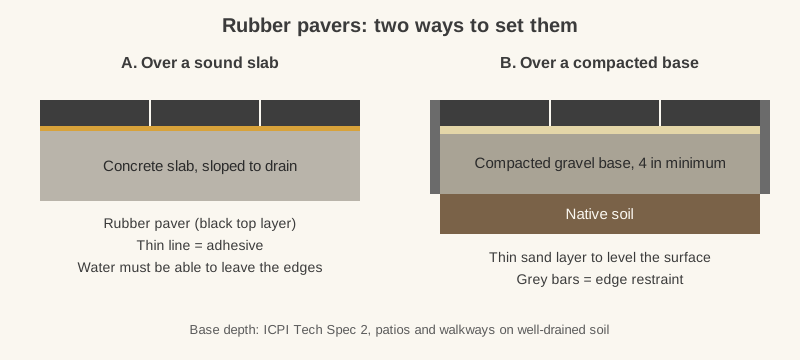
There are two workable setups.
- Over a sound slab. Sweep and clean the concrete, check that it slopes so water leaves the edges, then glue the tiles with the adhesive the maker specifies. Rubber glued down over a flat slab is the most reliable method.
- Over a compacted base. For patios and walkways on well-drained soil, ICPI Tech Spec 2 calls for at least 4 inches of compacted base. Rake a thin sand layer, set the tiles and fit an edge restraint so they do not creep. Use how to level ground for pavers for the dig and the stone base beneath it.
Some sellers say you can drop tiles straight on grass or dirt. That works as a temporary path. It will not stay flat or drain well as a patio.
What goes wrong with rubber pavers
- Moisture underneath. Water that cannot escape sits between tile and base and breeds mold. Slope and drainage matter more than the tile.
- Fading. Sun bleaches color faster than on brick or concrete.
- Shifting. Unglued tiles move at the edges and need resetting.
- Odor and stains. Fresh rubber smells for a while, and grease and pet waste mark it.
- Looks. Nothing about it passes for stone.
One supplier claims rubber pavers can need replacing after about a year, while others call them durable. The two claims conflict and neither is independent, so ask any seller for a written warranty before you commit.
Rubber vs plastic grid and other cushioned surfaces
If you want a soft or permeable surface rather than a tile, a grid system may suit you better. Our plastic pavers guide covers grids filled with gravel or grass, which drain through instead of trapping water. For playgrounds the wider category is covered under playground surfacing.
Use rubber where you need softness, not style
Pick rubber pavers for a play area, a pool edge or a roof where falls and weight are the problem. Pick concrete for a living patio where looks and sun matter. Stand on a sample in the afternoon sun first. Your feet will vote.
FAQ
Are rubber pavers any good for a patio?
They work on a shaded patio where comfort matters more than appearance. In full sun, dark tiles get very hot and fade, so a lighter color and some shade help.
How much do rubber pavers cost?
One supplier quotes about $8 to $15 per square foot. That is one source, so request local quotes.
Can you lay rubber pavers on dirt or grass?
You can, as a temporary surface. For a lasting patio, use a slab or a compacted base of at least 4 inches with edge restraint.
Do rubber pavers need adhesive?
Over a slab, yes, use the adhesive the manufacturer specifies. Interlocking types on a base rely on their shape plus an edge restraint.
Are rubber pavers slippery when wet?
Textured rubber tends to grip better than smooth concrete, but algae and debris can still make any surface slick.


