Last Updated on September 23, 2026 by Umar Farooq
Here's how to level ground for pavers: strip the sod and topsoil, set stakes and a string grid at the finished paver height with the drainage slope already built in, then measure down from the strings to your excavation depth everywhere. Shave off high spots, fill low spots with compacted base stone rather than loose dirt, and compact the soil. The goal, despite the name, isn't level. It's an even, firm surface that falls 2% away from the house, a quarter inch per foot.
"Level" ground for pavers is really graded ground: sloped to drain, and the same depth below the finished surface everywhere. A truly level patio is a very flat puddle waiting for rain.
Call 811, then strip the organic layer
Before digging, call 811 or file a request through Call 811 so utilities mark buried lines. It's free, and it's step one, not the whole job.
The NTSB report on the 2005 Bergenfield, New Jersey explosion is why I say that. The gas service line had been marked, twice. A contractor left a 4 to 5 foot trench open overnight about 2 feet from it, the soil slumped, the line pulled apart at a fitting, and three residents of the building died (NTSB PAB-07/01). A patio dig is far shallower, but it sits right beside the house, where service lines run. Near a mark, dig by hand.
Then remove everything organic: sod, roots and the dark topsoil below it. Topsoil compresses and rots, so it can't be leveled into a stable surface however lovingly you rake it. Dig until the soil changes to the lighter, firmer subsoil.
Make the dig bigger than the patio. Unilock's base preparation tips say to over-excavate the perimeter by the base depth, so a 20 x 10 foot patio with a 6-inch base becomes a 21 x 11 foot dig. The edge restraint sits on that extra stone.
Set a string grid at finished grade
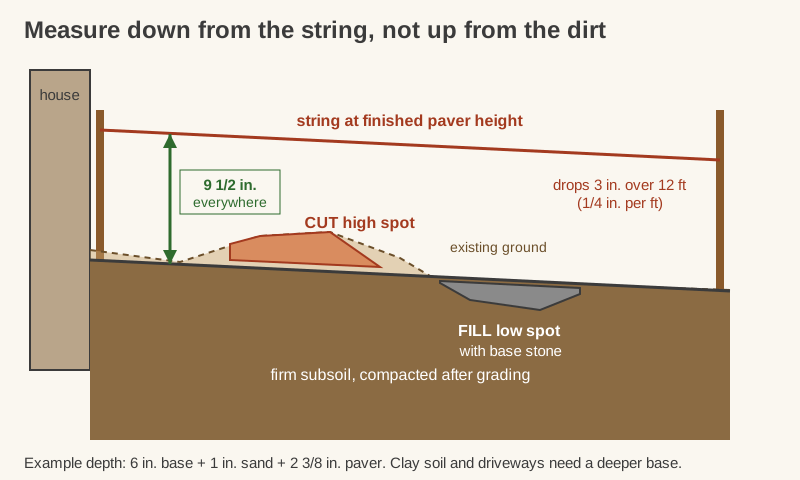
Every measurement comes off the strings, so set them before the main dig.
- Drive stakes just outside the excavation at each corner, and every 6 to 8 feet along long sides.
- Set the high string. Along the house side, tie a string at the finished paver height, below the door threshold and below any siding or weep holes.
- Set the slope. Run strings from the house side to the far edge. Level each with a line level, then lower the far end by the fall you want. At 1/4 inch per foot, a 12-foot run drops 3 inches. ICPI's minimum is 1.5%; within 10 feet of the house the IRC wants at least 2%, or 1/4 inch per foot (R401.3; check locally).
- Add cross strings so the grid is no more than about 6 to 8 feet on a side. Each crossing point is a checkpoint.
A sagging string hides low spots that later hold puddles, so keep them taut.
How to level dirt for pavers: measure down, cut and fill
Your excavation depth is the base thickness, plus 1 inch of bedding sand, plus the paver thickness. For a patio with a 6-inch base and standard 2 3/8-inch pavers, that's about 9 1/2 inches below the strings. The paver base guide has the depths for clay soil and driveways.
Make a story pole: a straight stick marked at your excavation depth. Then work the grid:
- Measure down at every string crossing and mid-span. Above the mark, dig; below it is a low spot.
- Cut the high spots first. Shave soil off with a flat shovel.
- Fill low spots with base stone, not dirt. Loose soil thrown into a hole settles, the classic cause of a dip in a new patio. Compact the stone as part of the first lift.
- Rake to a smooth grade. Drag a straight 2×4 between strings to find humps the eye misses.
One thing I'd insist on: the bedding sand is not a leveling layer. It goes down one inch, screeded and loose, on a base already within 3/8 inch over 10 feet (CMHA). Two inches of sand in a low spot compresses more than one inch elsewhere, and the patio shows you where a year later. Fix the dirt while it's only dirt.
Leveling the ground for pavers by hand or with a machine
Most small patios are dug by hand. It's not complicated, in the way that moving a small hill one shovel at a time is not complicated. You'll need:
- Flat and round-point shovels for cutting and trimming
- A sod cutter (rentable) if the area is lawn; it saves hours and your back
- A steel bow rake for shaping
- A long straight 2×4 and a 4-foot level for checking
- Stakes, mason's string and a line level, or a laser level
- A wheelbarrow and a plan for where the dirt goes
A 12 x 16 patio at about 10 inches deep is roughly 6 cubic yards of soil in place, and more once it's dug and loose. Plan the disposal first. (I checked that arithmetic because it looked wrong. It isn't.)
When to bring in equipment: a large patio, a driveway, hard clay, rocky ground or a real slope justify a rented mini excavator or an operator. Machines cut fast, and cut too deep just as fast, so stop an inch or two high and finish by hand. On big jobs a rented laser level beats strings, and it doesn't sag.
If your yard drops more than a few inches across the patio, leveling becomes a cut-and-fill or terracing job. Our guide to building a paver patio on a slope covers when that needs a retaining wall.
Compact the soil once it's shaped
Compact it with a plate compactor on sandy ground or a rammer on clay, then recheck against the strings, because compaction lowers the surface unevenly. Touch up highs and add base stone to lows.
Moisture and machine choice are covered in our guide to compacting soil. Then the base goes down in thin compacted lifts, following the same slope.
Shape the dirt right and the pavers inherit the slope
How to level ground for pavers comes down to one reference and matching everything to it. Mark utilities, strip the organic layer, and set a string grid at finished height with the drainage slope built in. Measure down a constant depth, cut the highs, fill the lows with stone, and compact. The strings will have been right all along. It's the dirt that needs convincing.
FAQ
How do you level ground for pavers by hand?
Strip the sod and topsoil, set stakes and strings at the finished paver height with a 1/4 inch per foot slope, then use a shovel and rake to bring the soil to a constant depth below the strings. Check with a story pole and a straight 2×4, fill low spots with base stone, and compact with a hand tamper or rented plate compactor.
Should the ground be perfectly level for pavers?
No. It should slope away from the house so water drains: at least 1.5% overall, and at least 2%, that same quarter inch per foot, near the house. What must be consistent is the depth below the finished surface, so the base and sand layers are an even thickness everywhere.
What do you use to fill low spots under pavers?
Crushed base stone, compacted. Loose soil or topsoil used as fill settles over time and causes dips. Sand isn't a fix either, because extra bedding sand settles unevenly.
How deep do I dig to level ground for pavers?
Add the compacted base thickness, 1 inch of sand and the paver thickness. For a typical patio on well-drained soil that's roughly 9 to 10 inches below the finished surface; clay soil and driveways need more.
Can I lay pavers on unlevel ground?
Not directly. Pavers follow whatever is beneath them, so any hump or hollow in the ground shows up in the finished surface. Grade it to an even slope, compact it, then build the base.