


Last Updated on October 20, 2026 by Umar Farooq
The paver leveling tools you need depend on how the pavers are set. Sand-set concrete pavers need a string line with a line level, a 4-ft level, a long straightedge and a rubber mallet, and the plate compactor does the final leveling. Porcelain or stone set in mortar adds a clip-and-wedge leveling system to hold neighbouring edges flush while it cures. Pavers on pedestals are leveled by the pedestal heads and rubber shims. A laser level saves time on big layouts but isn't required. The details are in our piece on rubber mallet for pavers.
Page one for this search is mostly shop category pages, so I built this from the install guides I could open instead. Leveling the dirt is covered in how to level ground for pavers. This page is about the pavers.
Two numbers every paver leveling tool is chasing
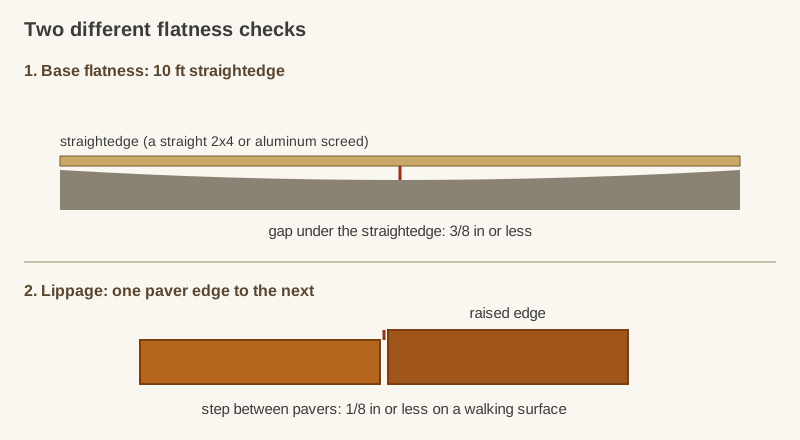
"Level" means two different things on a patio:
- Overall flatness. CMHA's guide specification for pavers on an aggregate base wants the base within ±3/8 inch under a 10-foot straightedge. The finished surface follows it.
- Lippage. The step from one paver edge to the next. ICPI's Tech Spec 2 caps it at 1/8 inch on pedestrian routes, roughly where a toe starts to catch.
A patio can have flush joints and a bowl in the middle, or be perfectly flat overall and trip people at every joint. Know which problem you're looking at before you buy anything.
"Level" is the wrong word anyway. A patio should fall away from the house, at least 1.5% by ICPI's minimum, so every tool below really measures even. (The bubble doesn't know that. You have to.)
String line and line level: the cheapest tool with the longest reach
For slope across a patio, nothing beats a mason's string, two stakes and a line level. Pull the string tight, center the bubble, then drop the far end by the fall you want and measure down from it to every layer.
Where it goes wrong: string sags over long spans, and a line level is only accurate at the middle of the string. Keep runs short enough to pull drum-tight, and flip the line level end for end. If the bubble reads differently, the level is lying, not the patio.
A string also shows lippage. Lower it until it just touches the paver tops and sight along it. Any paver that lifts the string, or leaves a gap, is out.
Levels and straightedges for the field
A 4-ft level checks slope over a few pavers at a time. A torpedo level is too short to tell you anything, and a tumbled face will rock it from bump to bump.
A straightedge checks flatness. An aluminum screed or a dead-straight 8 to 10 ft board shows what a level can't: light under the edge is a low spot, a rocking board is a high one. Sight down the board first. Lumber yards sell plenty of 2x4s that are straight the way a river is straight.
A rubber mallet or dead-blow hammer nudges a high or crooked paver into line. On sand-set pavers, tap and move on.
Laser levels for pavers: when they're worth renting
A rotary laser spins a level plane of light across the site, and a receiver on a grade rod beeps when it meets it. One person can check heights anywhere without restringing, and most can be dialed to a set slope. It earns its place on areas too long for a tight string (driveways, big terraces), on patios with several slopes or drains, and on pedestal decks with dozens of heights to set.
For a single-slope backyard patio, strings are as accurate and never need batteries. A cross-line laser that paints lines on a wall helps with square layout but is too short-range for grading. If you need a rotary laser, rent it.
Leveling clip systems for porcelain and slabs set in mortar
Porcelain or stone slabs set in mortar don't get compacted, so any lippage you leave is permanent. A clip-and-wedge system fixes that: clips slide under the edges of neighbouring slabs, a wedge or cap pulls both faces flush and holds them while the bed cures, then the clip tops snap off.
Match the clip to the slab. The Raimondi clips sold by Contractors Direct are rated for tiles 1/2 to 3/4 inch thick with a 1/16-inch joint, which covers 2 cm porcelain pavers. Thicker stone needs a clip made for it.
My one strong opinion here: leveling clips are useless on a sand-set patio. They work because mortar sets hard around a slab held flush, and sand never sets. Sand-set pavers are also meant to finish high: CMHA's spec lets them sit 1/8 to 1/4 inch above final grade before compaction, because the plate compactor vibrates the field down into the sand and levels neighbours against each other. That machine is the real leveling tool for interlocking pavers.
Pedestal heads and shims for rooftop and deck pavers
On a roof deck or balcony there's no base to level, so adjustable pedestals under each corner do it. Archatrak's pedestal installation guide marks the grid with sight lines or a laser, sets the first row along a wall, then levels each section by turning the pedestal screws. On a roof sloped for drainage, self-leveling heads or slope-correction rings let the paver sit flat while water runs off underneath. Rubber shims under a single corner fix the last rocker. Weight limits for decks and roofs are covered in lightweight pavers. You can read more in the guide to pedestal pavers.
Matching paver leveling tools to the job
| Setting method | Core tools | Skip |
|---|---|---|
| Sand-set concrete pavers | String, line level, 4-ft level, straightedge, mallet, plate compactor | Leveling clips |
| Porcelain or stone in mortar | 4-ft level, straightedge, clip-and-wedge system, mallet | Plate compactor (cracks slabs) |
| Pavers on pedestals | Laser or string grid, level, shims | Screed rails |
| Stepping stones in soil | 4-ft level, mallet | Anything with a battery |
Pick the tool that matches the bed
On sand, set slope with strings, check flatness with a straightedge, and let the compactor do the last leveling. In mortar, clip the edges flush before it sets. On pedestals, turn the screws and shim the rockers. The only tool that works on all three is patience, and nobody sells it by the pallet.
FAQ
What is the best tool to level pavers?
For sand-set concrete pavers: a string line and line level for slope, a long straightedge for flatness and a plate compactor to settle the field. For mortar-set porcelain or stone: a clip-and-wedge leveling system plus a 4-ft level.
Do I need a laser level for pavers?
Not for a typical single-slope backyard patio, where strings are as accurate. A rented rotary laser saves time on driveways, large terraces and pedestal decks.
Can you use tile leveling clips on pavers?
Only where the pavers are set in mortar or thinset, such as porcelain over concrete. On sand-set pavers the bed never hardens, so the clips have nothing to hold against.
How much lippage is acceptable between pavers?
ICPI's Tech Spec 2 allows up to 1/8 inch between adjacent pavers on pedestrian routes. Tumbled and cleft-face products vary more by design.
How do you level a paver that is too high?
Tap it down with a rubber mallet over a scrap board, or lift it, scrape out a little sand and reset it. If the base underneath is high, fix the base rather than thinning the sand.


