

Last Updated on October 20, 2026 by Umar Farooq
Sealing old pavers works on one of two surfaces: bare concrete or a coat of the same sealer that has worn out. Anything else, including an unknown film from a previous owner, has to be identified or stripped first. So the order is a water drop test, repairs, cleaning, drying, and only then sealer.
There is a more basic question first, and every sealing guide I read skips it: does an old patio need sealing at all? Age is not a reason. Stains, color and loose joint sand are.
Sealing old pavers starts with a water drop
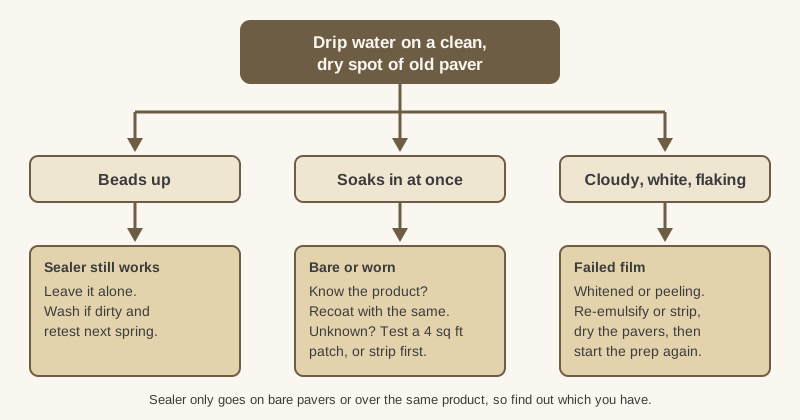
Drip a few drops of water onto a clean, dry spot. Belgard's rule of thumb in its spring guide is the same: if water beads, the pavers are still protected, and if it soaks in immediately, it is probably time. Techniseal uses the same test as a gate in its data sheet: if water is repelled, do not apply its sealer. Three results are possible:
- Beads. An existing sealer is still working. Wash the patio if it is dirty and test again next spring.
- Soaks in at once. The surface is bare, or the old coat has worn through. Go on to the next section.
- Cloudy, white or flaking. The old film has failed, and a new coat over it fails too. That is a stripping job, covered in paver sealer stripper.
Decide whether old pavers need sealing at all
Sealing is optional. Unilock says its concrete pavers do not require regular sealing, and describes sealing as more about looks than maintenance. For old pavers there are three good reasons to seal and one bad one:
- Good: you want to block oil, grease or leaf stains in a cooking or parking area.
- Good: you want the faded color back. Belgard's older spring guide describes a semi-transparent tinted sealer made to rejuvenate faded pavers.
- Good: you want to firm up loose joint sand with a joint-stabilizing sealer.
- Bad: "it has been a few years." Belgard's rule of thumb is every 3 to 5 years, and Techniseal says recoat only when worn, minimum 2 years. A calendar is not a test.
If none of the good reasons applies, put the sealer back on the shelf and clean the patio instead. Restore faded pavers covers what a good wash can do on its own.
Find out what is already on the surface
Most old-paver trouble starts here. The manufacturers I opened are blunt about compatibility:
- Techniseal's Natural Look sealer goes only onto bare material or material previously sealed with the same product. It says to remove any unknown coating with the appropriate stripper.
- Alliance Gator's Wet Look sealer is made for unsealed surfaces only and cannot be used as a resealer.
- Unilock tells you to test compatibility between old and new sealers before resealing.
If you did not seal the pavers yourself or have the receipt, you have an unknown coating. The cheapest answer is a test patch of 4 sq ft in a hidden spot. Techniseal and Gator both ask for one anyway. Let it cure and see if it clouds, tacks up or peels. If it does, strip. If the patio was never sealed, you are in the easy case.
Repair and re-sand before you touch the sealer
Old pavers have had years to move. Walk the surface, reset anything that rocks and replace cracked units, because a sealer lays a film over a loose paver and makes it harder to fix. Then deal with the joints.
Joints on an old patio are usually part sand, part weeds. Sakrete's guide to polymeric sand on an existing patio recommends removing all the old sand down to the bottom of the paver, and killing large weeds with a non-selective herbicide a few days before you start, because pulling them can leave the roots behind. It also warns that red clay brick will stain with polymeric sand. Re-sand pavers walks through the filling. Then wait: Techniseal's natural-look sealer asks for 30 days after polymeric sand before sealing.
Clean it until it is boring, then let it dry
Sealer fixes in place whatever is under it. Unilock warns that sealing over stains may accentuate them, and its list of tips starts with letting any efflorescence clear first. On an old patio, that means a proper wash and a spot treatment for oil, rust or algae. A white mineral film needs its own treatment before any coat.
Then drying. Unilock says a few hours in sun and warmth, or about 24 hours in cooler shade. The contractor guide I read asks for 24 to 48 hours after washing and at least two dry days before sealing. Unilock also wants 24 to 48 hours without rain in the forecast. If in doubt, wait a day.
Choose a sealer that suits worn pavers
Old pavers tend to be rougher and thirstier, so plan for extra sealer. The paver sealer coverage guide explains how to measure a test patch instead of trusting the label. Beyond that, think about three choices:
- Finish. Natural, tinted or wet look. Unilock warns that stopping mid-job can leave gloss variations, which suggests a natural finish is more forgiving.
- Traction. Techniseal's data sheet warns its film makes the surface more slippery when wet and suggests adding anti-slip grit. Do that on steps and pool decks.
- Temperature. Techniseal's sheet asks for 50 to 85°F and no rain for 24 hours. Gator asks for 60 to 85°F after 48 dry hours.
Apply it the way the sheet says. For the application steps themselves, from sprayer to wet edge, use paver sealing.
Seal only the pavers the water drop calls bare
So: bare gets sealed, worn gets the same product, beading gets left alone, and a failing film gets stripped. If you take one habit from this page, make it the test patch, which settles the compatibility, finish and coverage questions at once. Skip it and you are sealing blind. A patio that has lasted this long deserves four square feet of testing.
FAQ
Can you seal old pavers?
Yes, if they are bare or the old sealer is a compatible product that has worn out. Check with a water drop test and a 4 sq ft test patch. Do not seal over a failing or unknown film.
Do I need to remove old sealer before resealing pavers?
If the old coat is cloudy, flaking or an unknown product, yes. Techniseal says to remove any unknown coating with the appropriate stripper, and Alliance Gator's wet look sealer cannot be used as a resealer. If you know it is the same product and has worn, no stripping is needed.
How do I know if my old pavers are already sealed?
Drip water on a clean, dry spot. If it beads, there is still sealer. If it soaks in at once, the surface is bare or the sealer has worn off.
Should I re-sand the joints before sealing old pavers?
Yes, if joint sand is low or missing. Wait for the sand to cure before sealing: Techniseal asks for 30 days after polymeric sand for its natural-look sealer.
How long should old pavers dry before sealing?
Unilock says a few hours in warm sun, or about 24 hours in cool shade. One contractor guide asks for 24 to 48 hours after washing and two dry days. Wait longer if the pavers feel cold or damp.


