

Last Updated on October 20, 2026 by Umar Farooq
Pavers sinking in drought almost always means the clay under the patio has dried out and shrunk, and the first move costs nothing: photograph the dip, measure it with a straightedge, and see whether it keeps growing. Clay-rich soil loses water and contracts in a long dry spell, and it does not always swell back to where it started when the rain returns. A patio that stayed flat through several wet summers and dips in a dry one is usually telling you the base was thinner than the soil deserved. (Pavers are patient. They will sink through an entire drought without a single complaint.)
Pavers sinking in drought: what the clay is doing underneath

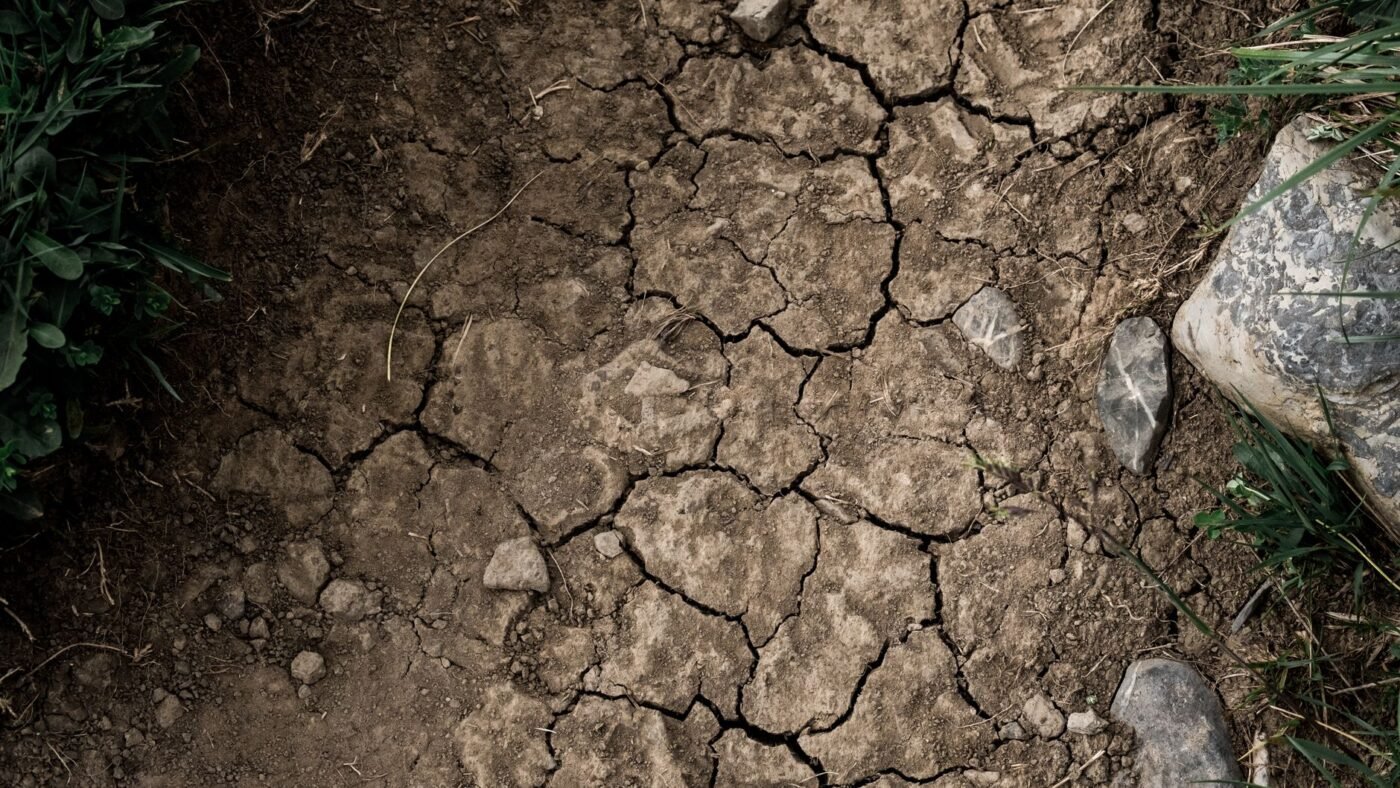
Texas A&M AgriLife Extension describes the heavy clay of Galveston County, Texas, the way a gardener would: a sponge, or an accordion. It swells when it absorbs water and shrinks when the water leaves, either by evaporating or by being drawn up by plant roots. In an extended drought, the column notes, gaps open along the side of a foundation and cracks form in lawns "many feet deep" (AgriLife Extension on drought and clay). Your patio sits on that same ground.
One landscape contractor puts the zone that moves at the top 3 to 4 feet of clay and says it can contract by several inches in a long dry spell (Green Scene Landscaping). I could not find a measured figure for that from an agency, so treat "several inches" as an upper-end contractor claim, not a rule.
Here is my one firm opinion on this. A drought does not sink a good patio. It audits it. ICPI asks for at least 4 inches of compacted stone under a patio, plus 2 to 4 inches more on wet or weak ground (ICPI Tech Spec 2), and the stone is the part that carries the load while the pavers spread it. Where the base is thick and clean, the surface tends to ride out soil movement. Where it is thin, the pavers follow the clay down. That mechanism is my own reading of how the layers share load; the contractor pages I read mostly say the same, but none of them measured it.
Drought dip, washout or thin base: three ways to tell
Drought is the popular suspect, but it is not the only one. This is my own sorting of what the pages I read describe, not a published test.
| What you see | Most likely cause | Where to read next |
|---|---|---|
| Wide, shallow dish. It grew in dry weeks. Soil beside the patio has cracks or a gap along the pavement edge. Sidewalk or steps nearby moved too | Shrinking subsoil under a base that is too thin | This page |
| Dip at a downspout or a low corner. Joints empty. It appears after storms | Water washing the base out | Paver base washout |
| Dished in the middle within the first year or two | Base not compacted in thin lifts | Pavers settling after installation |
| A hump beside the dip, near a tree | Roots lifting, or a root that rotted away | Pavers around a tree |
Two cheap checks sort most cases. Lay a string line across the dip and measure the deepest point, then measure again every few weeks. Then look at the soil beside the patio. A gap between the soil and the pavement edge, or cracks running across the lawn, is the same sign AgriLife describes next to foundations.
Don't relay anything yet
It is tempting to lift the dip the weekend you notice it. In a drought that may be the wrong weekend. The ground is at its smallest, and the same soil can swell when it is rewetted. A heavy shower can wet the surface without restoring moisture deeper down, so recovery is neither complete nor instant (The Conversation, on subsidence after drought).
My inference, labelled as such: pavers reset at the bottom of a shrink cycle, on clay that then swells back, could end up sitting high in the middle of what used to be a dip. So wait for the soil to settle into its normal moisture, measure again, and fix what is still wrong.
If the dip is a trip hazard today, treat that as a different problem. Lift and relay only the low pavers using the standard method in how to fix sunken pavers, and accept you may redo it. A cheap, local, reversible repair beats a twisted ankle. When you do the full job, set the pavers 1/8 to 1/4 inch above the surrounding surface before compaction, the settlement allowance in the CMHA guide specification, and never use bedding sand to fill the low spot.
Water the ground evenly, not the dip
AgriLife's advice for houses on clay is to keep the soil at a steady moisture level all the way around, a slow soak instead of a flood. Its column suggests a soaker hose 6 to 8 inches from the foundation, with the faucet only part open so water soaks in without puddling. It warns against blasting a hose into cracks, because a heavy flow can travel several feet along them and the sudden swelling can do its own damage.
That advice is written about foundations, not patios, and I could not find a study showing it stops a paver dip. Treat it as a sensible extension of the same mechanism: even moisture, no dumping. Check your local watering limits first, because drought usually brings restrictions.
Trees and the house wall make it worse
Trees extract water, and the ground nearest a tree can dry faster than the rest, which is the same source's point about roots. If your dip sits between the tree and the house, the roots are a prime suspect. Do not cut a large root to fix a paver. Talk to an arborist first.
Next to the house, the pavers can follow the soil away from the wall, and a gap at the slab edge is easy to see. The clearances and slope to keep at the wall are covered in our guide to pavers around a house foundation.
Fixes that will not hold
- Sweeping sand into the dip. It fills the joints, not the void. CMHA's application guide says plainly not to use bedding sand to fill depressions in the base, because they will show through the surface.
- Flooding the patio. Water pouring into joints and cracks is the thing that moves dry soil and washes the base out.
- Blaming the soil and rebuilding with the same thin base. If the base was thin once, the next dry spell will find it again.
- Assuming the drought is the only cause. Several contractor pages I read say a thin base or poor drainage is the more common reason pavers sink on clay. They are commercial sources, so weigh that, but the table above exists for a reason.
When the cracks reach the house
Stop treating it as a patio problem if the house is moving too. AgriLife lists doors and cabinets going out of alignment, cracks in brick veneer, drywall and tile. Take photos with a tape measure in the frame, note where the gaps are widest, and have a foundation specialist or structural engineer look at it. That is not a DIY repair, and a patio relay will not fix it.
Build for the dry years
If you are building new on clay, the fix is the one in paver patio on clay soil: dig deeper, line the hole with geotextile and build the base from clean stone in thin lifts. Add the 2 to 4 inches ICPI asks for on weak or wet ground. Keep downspouts well away from the edges, and keep the soil beside the patio from swinging between bone dry and soaked.
Wait for the rain, then fix what the dry spell exposed
Measure the dip now, wait for normal moisture, then lift and relay only what is still low, with a base that matches the rest of the patio. If the base was thin, rebuild it to the ICPI depth while the pavers are up. Then keep a tape measure in the shed and re-check the same spot after the next dry month, because a patio that stays put through a drought is the only review that counts.
FAQ
Can drought make pavers sink?
Yes, where the soil under the base is clay. Clay shrinks as it dries, and the ground can drop away from a thin base. Contractor pages also blame thin bases and drainage, so use the table above to rule those out.
Will my pavers come back up when it rains?
Sometimes the dip partly recovers, but do not count on it. Clay can swell back, yet recovery is neither complete nor instant, and a shower may only wet the surface. Measure the dip again after the soil returns to normal moisture.
Should I water the ground around my patio during a drought?
AgriLife advises even, slow watering around a house foundation on clay. I found no source showing it protects a patio, so treat it as a reasonable extension. Never flood the cracks, and follow your local watering restrictions.
Do I need to lift and reset pavers after a drought?
Only if a dip remains once the soil is back to normal moisture, or if it is a trip hazard. Lift past the dip, rebuild the base, and reset the pavers slightly high.
Why is the gap between my patio and the house getting bigger?
Dry clay shrinks away from hard surfaces, which can open a gap along a slab or wall. If doors stick or you see cracks in the walls, have a foundation specialist inspect it.
Do trees make pavers sink faster in a drought?
They can. Roots draw water from the ground, so the soil near a tree can dry and shrink faster than the rest. Ask an arborist before cutting any large root.


