


Last Updated on October 20, 2026 by Umar Farooq
Pavers sinking under roof drip line strips are almost always sinking because roof water lands in one line on the same strip of pavers every storm, washes the sand and stone out from under them, and leaves a dip that follows the eave. Look at the roof edge and then at the dip. If they run parallel, catch that water first: a gutter and downspout, or a stone-filled trench under the eave. Relaying the pavers without doing that buys you the same dip again.
A roof is a very large funnel with an opinion about where to pour.
Pavers sinking under roof drip line: how to tell it is the eave
Compare three things before you pick a repair.
| What you see | Most likely cause |
|---|---|
| Dip runs parallel to the roof edge, a few feet from the wall | Roof water landing on the pavers |
| Dip hugs the wall and ends where the old foundation hole ended | Settled backfill, see pavers sinking next to house |
| Dip sits under one spot, such as a downspout outlet | Concentrated washout, see paver base washout |
The Lake Sunapee Protective Association suggests a simple check: look under your eaves after a moderate to severe rainstorm for drip marks, displaced soil or bare soil (LSPA). On a paver patio I would expect sand cleared from the joints along that line. Do it while the water is still falling and you will see exactly which pavers are taking the hit.
What a roof edge does to the ground below it
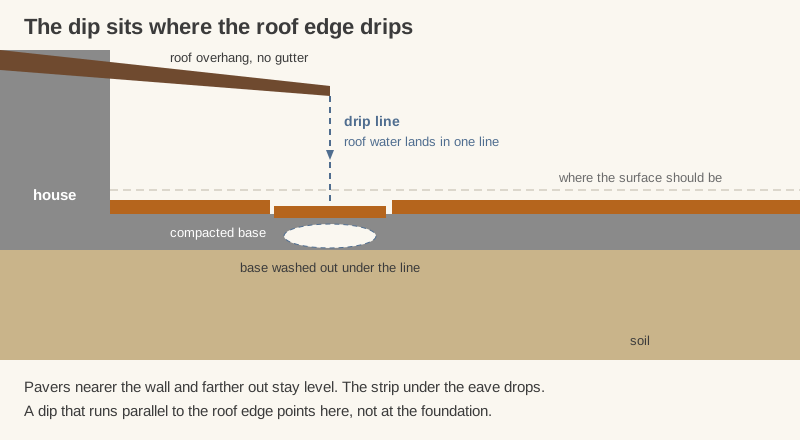
The drip line is where the roof edge lets go of its water. Iowa State Extension notes that thousands of gallons fall on a roof in a heavy rain and must be removed quickly from around the house, which is the whole job of a gutter and downspout (Iowa State, via North Dakota). With no gutter, that water drops in a single line and soaks the joint sand and base beneath it. My explanation of why a dip follows is simple, and it is my inference: sand and stone move with the water, so the strip loses support first.
Builders on a Fine Homebuilding thread describe the same splash-back and erosion on houses without gutters, and one warns that concentrated runoff can cut channels that undo the grading (Fine Homebuilding forum). That is a forum, so it shows what people report, not a measurement.
Catch the water, cheapest fix first
- Check the gutter you already have. A gutter that overflows will drop water in a line too (my inference, not a measured claim). Iowa State's sheet says downspouts should dump at least 5 to 10 feet from the house where basements have water problems.
- Add a gutter and downspout. The extension answer to roof water is gutters and downspouts that carry it away. If it is a short roof with no gutter by design, move to the next step.
- A gravel-filled trench under the eave. LSPA lists a drip-line infiltration trench and a dry well as DIY options and says they need occasional upkeep, like gutters do. I could not open a readable copy of the trench dimension sheets, so I will not quote depths. Read the guide you follow.
- Pipe the downspout away. Downspout drain under patio covers pipe, fall and outlets.
Then rebuild the strip
Lift one paver in the dip first and look at what is under it. Wet, loose or missing stone confirms washout. Firm stone with only a thin sand bed means the trouble may be the bedding alone. Then pull the pavers across the dip and a few feet past it, dig out the soft base, rebuild in thin lifts, screed one inch of loose sand, and relay. How to fix sunken pavers shows how deep the repair goes in each case. Keep the surface falling away from the wall, at least 1.5% (ICPI Tech Spec 2).
When to call someone
If water is reaching the wall or a basement, or the roof is large and the soil is clay, a landscaper or drainage contractor can size a drain. A leak inside is a house problem, not a paver problem.
Four ways to repeat the dip
- Relaying the pavers and nothing else. The same water returns.
- Packing the dip with sand. It washes out again.
- A rain barrel as the only fix. LSPA says barrels must be emptied between storms, so a full one in the next storm does nothing.
FAQ
Why are my pavers sinking where the roof ends?
Roof water falls in one line at the drip line, washes the base out, and the pavers settle into the gap.
Do I need gutters over a paver patio?
If you can see drip marks or bare soil after a storm, a gutter and downspout is the standard answer.
Can a gravel trench stop pavers sinking under the eaves?
It can soak the water in before it reaches the base, per LSPA. Maintenance and soil matter.
Will relaying the pavers fix it?
Only after the water is caught. Otherwise the same line fails again.
How far from the house should roof water go?
Iowa State says at least 5 to 10 feet where there are basement water problems.
Move the water first, then the pavers
A dip that sits under the eave is the roof telling you where it drips. Fit the gutter, level the strip, and sweep the sand back in. Pavers are patient, but they are not waterproof.


