Last Updated on September 23, 2026 by Umar Farooq
The paver patio tools you need follow the order of the job, and I noticed every tool list I read front-loads the shiny machines and forgets the knee pads. For layout: a tape, stakes, string, a line level and marking paint. For digging: flat and round shovels, a wheelbarrow and a rake. For compaction: a plate compactor and a hand tamper. For screeding: 1-inch rails and a straight board. For laying: a rubber mallet and knee pads. For cutting: a splitter or a diamond-blade saw. For finishing: a push broom and a leaf blower. Buy the hand tools, and rent the plate compactor, sod cutter and saw.
Paver patio tools at a glance, by phase
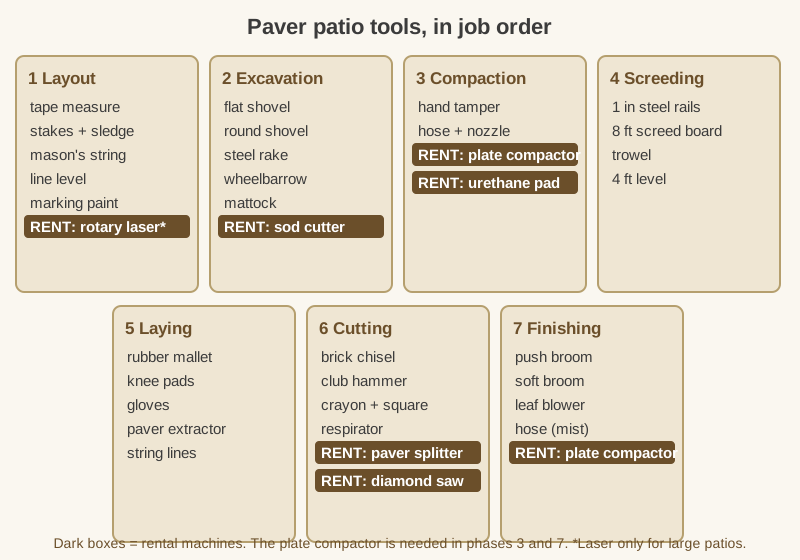
Grouped by phase, the list shows when to book each rental, so the compactor isn't idling in the driveway while you argue with a stake.
Mark it out with string, stakes and a line level
- 25-ft or 30-ft tape, plus a 100-ft tape for diagonals on larger patios.
- Wooden stakes or rebar pins and a small sledge (3 lb) to drive them.
- Mason's string (bright nylon; brown string on brown soil is a prank).
- Line level or 4-ft level. On a big patio, a rented rotary laser is faster.
- Marking paint (upside-down spray) and a garden hose for laying out curves.
- Framing square for corners, or the 3-4-5 triangle method with the tape.
What the dig takes: shovels, a wheelbarrow, a sod cutter
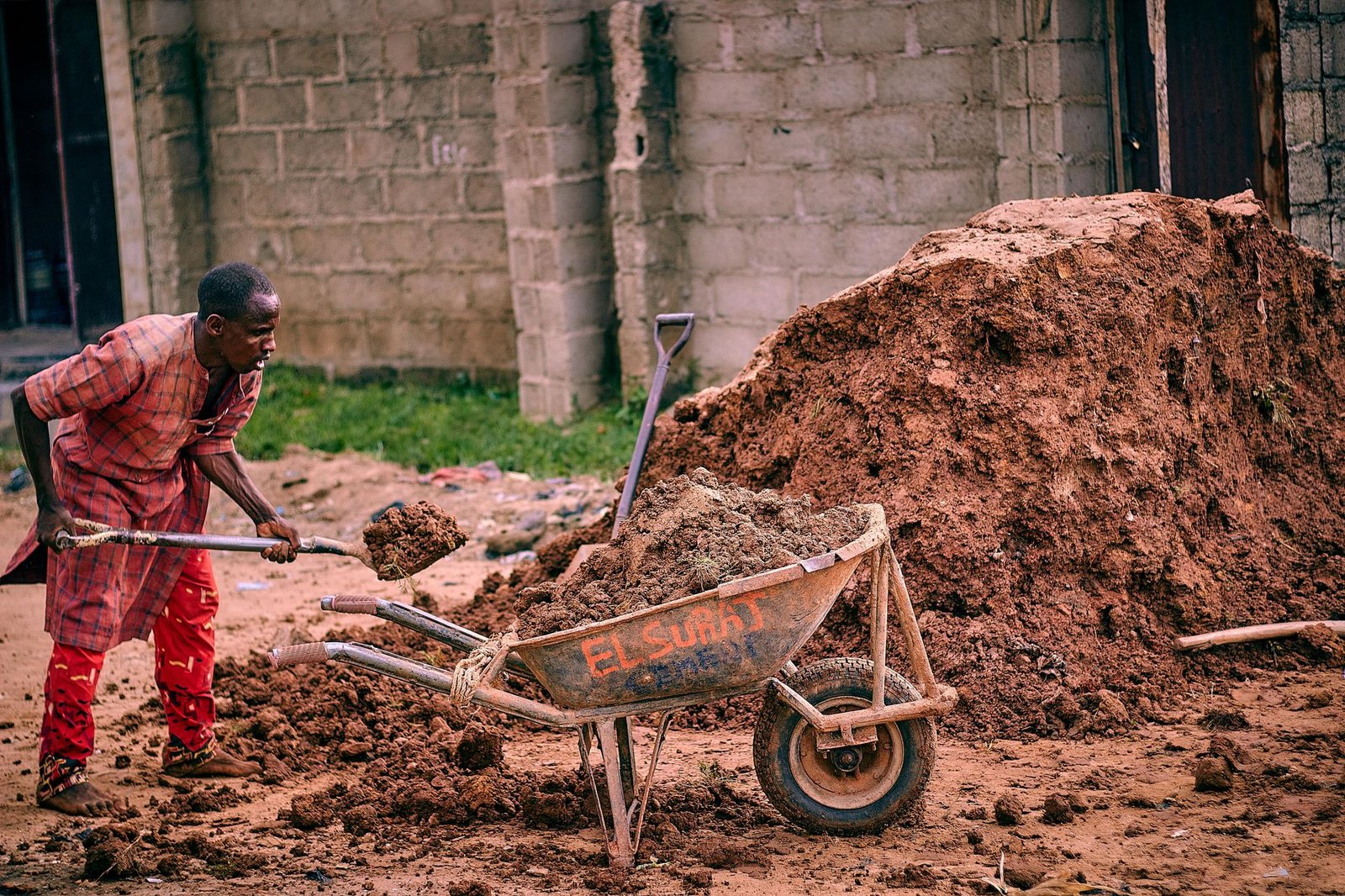
- Flat (square) shovel for trimming the dig, and a round-point shovel for breaking ground.
- Steel bow rake for spreading base stone.
- Wheelbarrow, ideally a steel contractor model.
- Mattock or pick for roots and hardpan clay.
- Sod cutter (rent) for more than a small patch of lawn.
Compaction: the one machine you can't skip
- Plate compactor (rent). You need it twice: for the subgrade and each base lift, then again to vibrate the laid pavers into the sand. Ask what force it's rated for; the 4-to-6-inch lifts ICPI describes assume a plate of 7,000 lbf, and smaller rental plates need thinner lifts.
- Hand tamper (8 × 8 or 10 × 10 inch) for corners, along walls and around posts where the plate won't reach.
- Urethane pad for the compactor's plate, to protect paver faces on the final pass. Ask for one with the rental.
- Garden hose with a spray nozzle to dampen dry base stone before compacting.
More in our plate compactor rental guide.
Screeding tools for a flat sand bed
- Two or three screed rails: 1-inch outside-diameter steel pipe or 1-inch square tubing. They set the 1-inch sand depth, so skip PVC, which flexes.
- Screed board: a straight 8-ft 2×4 or an aluminum screed bar.
- Trowel for filling rail grooves.
- 4-ft level for checking rails.
Western Interlock's must-have hardscaping tools list gives budget and pro options for most hand tools.
Why knee pads matter as much as the mallet
- Rubber mallet (a white, non-marking face won't scuff light pavers) for nudging pavers into line.
- Knee pads. You will spend a day on your knees on hard pavers. The mallet gets the credit; the knee pads do the work.
- Work gloves. Pavers are abrasive and heavy.
- Paver extractor or two flat bars for lifting a misplaced paver.
- String lines across the field every few courses to keep joints straight.
- Hand truck or paver cart to move stacks from the pallet.
Cutting gear, and the respirator that goes with it
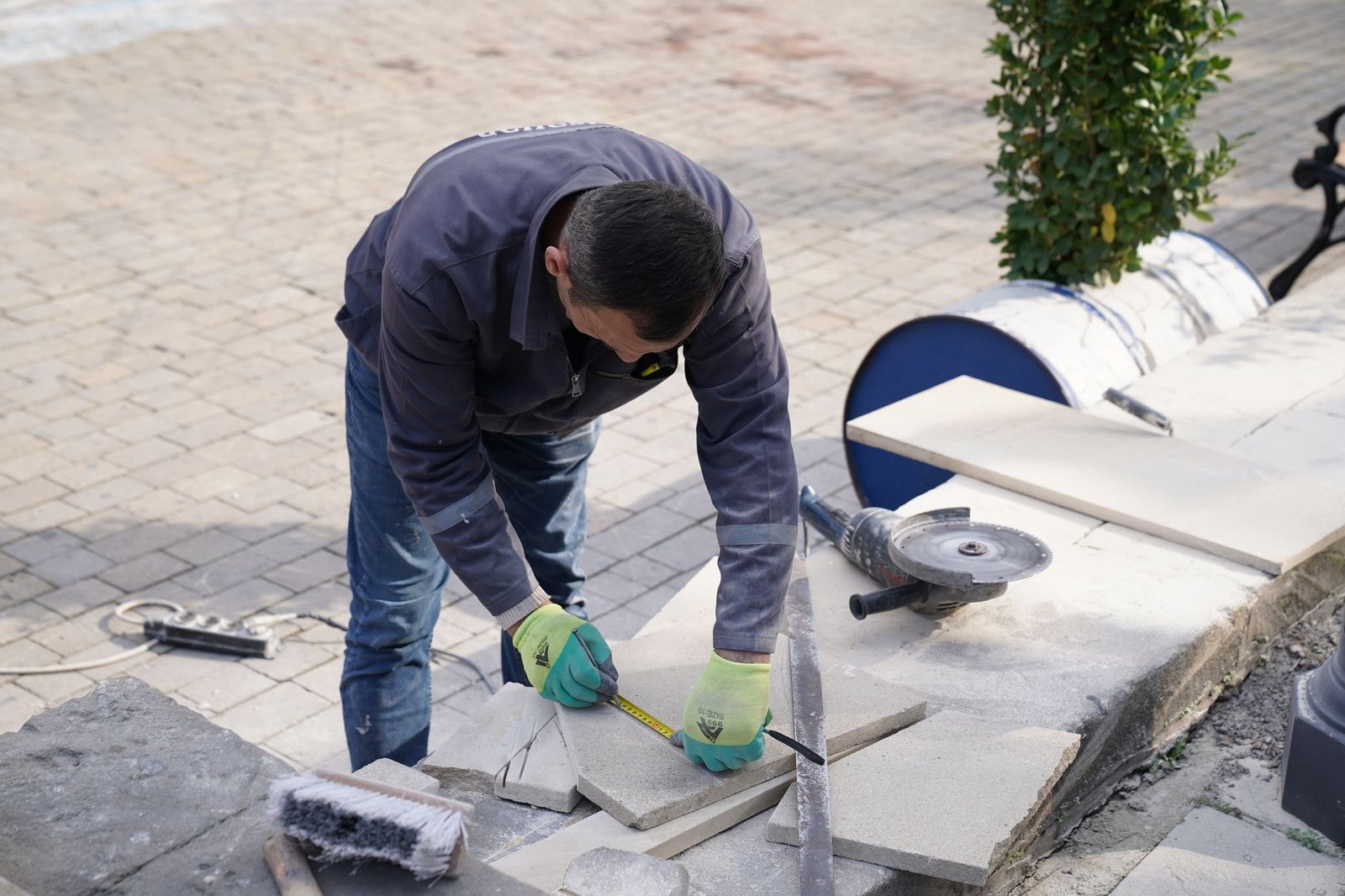
- Paver splitter (rent) for straight cuts with no dust.
- Wet masonry saw or gas cut-off saw with a diamond blade (rent) for curves, angles and a clean face.
- Brick chisel and club hammer for trimming.
- Paver crayon or pencil and a speed square for marking.
- Safety glasses, hearing protection and a respirator rated for silica dust.
Compare cutters in our paver cutting tools guide.
Sweep, blow and mist to finish
- Stiff push broom to sweep joint sand into the joints.
- Soft broom and leaf blower to clear polymeric sand off the faces before wetting.
- Hose with a mist setting for activating polymeric sand.
- Edge restraint and spikes, plus a sledge to drive the spikes.
Rent or buy: how to decide
| Tool | Rent or buy? | Why |
|---|---|---|
| Hand tools (shovels, rake, mallet, level, tape, trowels) | Buy | Cheap, and useful for years |
| Wheelbarrow | Buy, or borrow | Used on almost every yard job |
| Plate compactor | Rent | Heavy and expensive, needed only on a few days |
| Sod cutter | Rent | Used once |
| Wet saw or cut-off saw | Rent | Needed for a day or two of cutting |
| Paver splitter | Rent | Heavy and single-purpose |
| Screed rails | Buy | Cheap steel pipe works fine |
| Rotary laser | Rent, for large or complex patios | Only pays off on big layouts |
I'll be blunt: for one patio, don't buy a plate compactor. You use it on two or three days, then it needs fresh fuel, a clean air filter and somewhere to live that isn't your car's spot. If base and paving fall in one week, a weekly rental can beat booking twice. Three Timbers' paver tool and supply list shows a pro crew's much bigger kit.
Buy the hand tools, rent the machines
Buy the hand tools and screed rails; rent the machines, timed to the phases that need them. For the build order, see our paver installation guide. Keep the knee pads. Your future self, halfway down the second pallet, will want a word otherwise.
FAQ
What tools do I need to lay a paver patio?
At minimum: tape, stakes and string, a level, shovels, a wheelbarrow, a rake, a plate compactor, a hand tamper, screed rails and board, a rubber mallet, a splitter or diamond-blade saw, and a push broom.
Can I lay pavers without a plate compactor?
Only for very small areas, such as a landing or a few stepping pavers, tamped by hand. A patio base needs a plate compactor for each lift and again to set the pavers. Without one, the patio will settle.
Should I use a rubber mallet on pavers?
Yes, for small adjustments like tapping a paver into line or closing a joint. Use a non-marking face on light pavers. Don't level pavers with it; that's the plate compactor's job.
Is it cheaper to rent or buy a plate compactor?
For one patio, rent; the rental covers maintenance. Buy only if you plan several projects.
What is the best tool for cutting pavers?
A gas cut-off saw or wet masonry saw with a diamond blade gives the cleanest, most versatile cuts. A splitter is faster and dust-free for straight cuts.