Last Updated on September 23, 2026 by Umar Farooq
Paver curbing is a landscape curb built from individual pavers or curb units, set on a compacted gravel base and locked in with concrete, instead of one continuous strip of poured concrete. Poured curbing is one long piece of concrete waiting to find out where it cracks; paver curbing starts with the joints. Compared with poured (extruded) curbing, paver curbing costs more and takes longer to build, and grass can find the joints. In exchange, it can be repaired one unit at a time, it matches your patio or driveway pavers, and it copes with frost movement without the cracking that poured curbs are known for.
Edging a paver patio rather than a garden bed? You need a structural edge restraint, not landscape curbing; see our paver edging guide.
Two ways to build a landscape curb
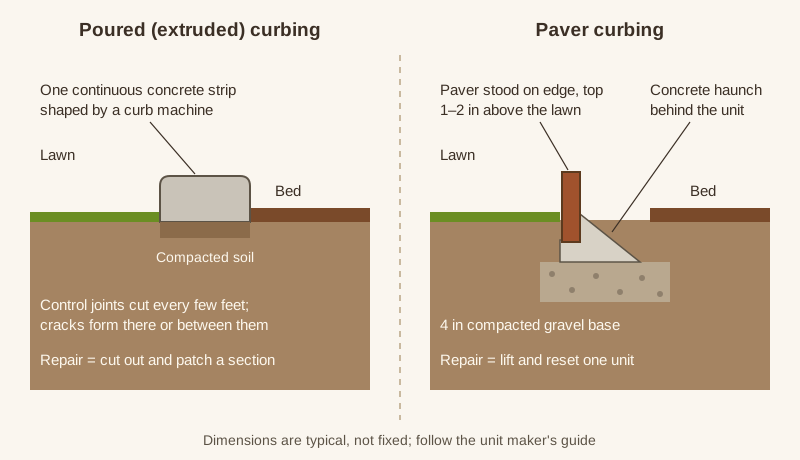
"Landscape curbing" usually means the poured kind: a curb machine extrudes a continuous concrete profile, typically a mower-edge or slant shape, onto compacted soil. Ground Zero, an Arizona curbing contractor, describes a mix of Portland cement, mortar sand and water coming "out of an extruded curb machine." It's fast, it can be colored or stamped, and it has no joints except the control cuts.
Paver curbing uses separate units, in three common versions:
- Pavers stood on edge. Standard pavers or bricks set upright in a concrete bed, forming a raised lip between lawn and bed.
- Curb or edger units. Purpose-made edging pavers sized to sit taller than the patio, such as Belgard's Anglia Edger.
- A flat mowing band. Pavers laid flush with the lawn so the mower wheel runs on them. See paver edging stones for that; this guide covers raised curbs.
Paver curbing versus poured curbing, side by side
| Poured (extruded) curbing | Paver curbing | |
|---|---|---|
| Look | Continuous, uniform color | Individual units; can match patio or driveway pavers |
| Curves | Very smooth, any radius | Smooth with short units; tight curves need cut or tapered joints |
| Installation | Hired crew with a curb machine, usually in a day | DIY-friendly but slower: trench, base, concrete bed |
| Cracking | Cracks at or between control joints over time | Joints absorb movement; single units rarely crack |
| Frost | Can heave and snap in cold climates | Units move slightly and can be reset |
| Repairs | Cut out a section and patch; the patch shows | Lift and reset or replace one unit |
| Grass and weeds | Few gaps for grass to root in | Joints can let grass through unless filled tight |
| Changing the bed line later | Demolition | Lift and relay |
Where poured curbing struggles
A poured curb is a long, thin, unreinforced beam of concrete sitting on soil. When the soil freezes, swells or settles unevenly, it cracks. Control joints only choose where.
Belgard's guide to paver border and edging options warns against poured or hand-troweled concrete curbing, especially in northern or moist climates, because it cracks or chips over time, and recommends edgers and proper restraints instead.
The repair is the other catch. Ground Zero's comparison of concrete curbing and paver borders points out that a damaged poured curb means cutting out a section, often about 2 feet, and patching it. The number on that page that stopped me: many curbing companies set a minimum job size, which it puts around 80 linear feet. So a 2-foot repair can be billed like an 80-foot job, and the new color rarely matches the old.
Mild, dry climates with stable soil shrink those drawbacks.
This is where I land firmly: the cheapest fix is usually the right one, and pavers make it possible. A heaved paver curb is a local problem: lift that stretch, re-tamp the base and reset the units in fresh concrete, in an afternoon. A cracked poured curb offers no such option, and "rip the whole run out" advice usually comes from someone who owns a curb machine.
Where curbing pavers earn the extra work
Paver curbing makes sense when:
- You already have pavers. A matching curb ties the yard together, and patio leftovers cost nothing.
- Winters are hard. Separate units can shift a little and settle back, or be reset.
- Wheels might hit it. Along a driveway, mailbox turnout or a path the mower crosses, you can reset or replace a crushed paver. For a driven-on edge, see our driveway border pavers guide.
- You may change the beds. Paver curbs can be relaid on a new line; poured curbs get broken out.
How to build a raised paver curb
This is for pavers stood on edge; manufacturer curb units go in the same way, per their install sheet for base depth.
- Lay out the line. Hose or marking paint for curves, string for straight runs. Keep curves gentle enough for your unit length.
- Dig the trench. Make it wide enough for the paver plus about 4 to 6 inches on the bed side for the concrete haunch. Depth is 4 inches of base, about 1 inch of concrete, plus the part of the paver that sits below grade.
- Bury enough of the unit. Bury at least half of the paver's height, leaving 1 to 2 inches showing above the lawn. Shallow curbs get knocked over by mowers and frost.
- Compact a gravel base. Spread crushed stone with fines in 2 inch layers, dampen it and tamp each layer hard with a hand tamper (no need to rent a plate for a trench this narrow).
- Set the pavers in concrete. Lay a stiff concrete bed on the base, stand the pavers in it tight together, and tap them to a string line with a rubber mallet, checking level every few units.
- Haunch the back side. Pack a sloped wedge of concrete against the bed side, below the finished soil or mulch line.
- Cure, then backfill. Let the concrete set per the bag, then backfill and tamp both sides.
Curves with a paver curb
Curves open wedge-shaped gaps on the outside. Short units such as half-bricks follow a curve more smoothly than long pavers, which take corners like a sofa on a staircase. On gentle curves, let the outside joints taper slightly. On tight radii, trim each unit into a slight wedge with a masonry blade so joints stay tight on both faces. Grass roots in any open joint, so fill joints on a raised curb with mortar.
Pick pavers where the ground moves, poured where it doesn't
Choose paver curbing when your winters are hard, when the curb has to match existing pavers, or when you want to fix or move it yourself. Choose poured curbing when you want an unbroken line installed fast and live where the soil stays put. And if you're still undecided, stand at the bed line in February and ask the ground what it's planning.
FAQ
Is paver curbing better than concrete curbing?
Paver curbing handles frost movement and repairs better and can match your hardscape. Poured concrete curbing is faster, jointless and cheaper per foot, but it cracks and repairs show.
Can you put pavers on top of concrete curbing?
You can bond thin pavers or caps to a sound curb with masonry adhesive, but the cracks in the curb underneath will still move. If the curb is already cracked, removing it and building a paver curb is the longer-lasting fix.
How deep should a paver curb be?
Allow about 4 inches of compacted gravel, about 1 inch of concrete, and enough depth to bury at least half the height of the paver, leaving 1 to 2 inches showing above the lawn.
Do curbing pavers need concrete?
For a raised curb, yes. A concrete bed and haunch hold each unit upright. Flush mowing bands can be set on compacted gravel alone.