

Last Updated on October 20, 2026 by Umar Farooq
Polymeric sand for concrete cracks is usually the wrong product. Polymeric sand is made for joints between pavers that are at least 1 to 1.5 inches deep, sit on a sand bed that drains, and can be compacted. A crack in a slab is narrow, V-shaped and closed at the bottom by more concrete. The sand can't pack down, the water can't drain away, and the binder never sets properly. For cracks up to 1/2 inch, use a concrete crack filler. For control and expansion joints up to about 1 1/2 inches, use a self-leveling polyurethane sealant over foam backer rod. Polymeric sand only earns a place in gaps that run the full depth between separate slabs or stepping pads, down to gravel or soil. We have a separate page on polymeric sand alternatives if you need the specifics.
Page one of Google for this question is mostly forum threads where someone asks, someone else says they tried it, and nobody reports back a year later. That's telling. I went to the product data sheets on both sides, the polymeric sands and the concrete crack products, to see what each is actually designed to do.
Why polymeric sand for concrete cracks rarely holds
Every polymeric sand data sheet I read sets conditions a slab crack can't meet:
- Depth. Alliance Gator, Techniseal and SEK all call for at least 1.5 inches of joint depth. Dominator accepts 1 inch. Most shrinkage cracks are hairline at the surface and narrower below, so you can get sand into perhaps the top quarter inch.
- A draining bottom. Techniseal says the bedding layer "needs to be able to drain properly" so the sand can dry and cure. A crack's bottom is concrete, so water sits in it and the binder stays soft.
- Compaction. The standard sands require vibration to pack the joint. A crack in one piece of concrete gives a plate compactor nothing to shake.
- Not a mortar. SEK's PolySweep data sheet says outright not to use it "as a substitute for mortar." Polymeric sand is a flexible joint filler that needs two sides that move together, not a crack repair.
The typical result is a thin crust that looks good for a few weeks, washes out after a few storms, and leaves the crack full of loose sand, which is a nice seedbed.
What to use instead, by crack width
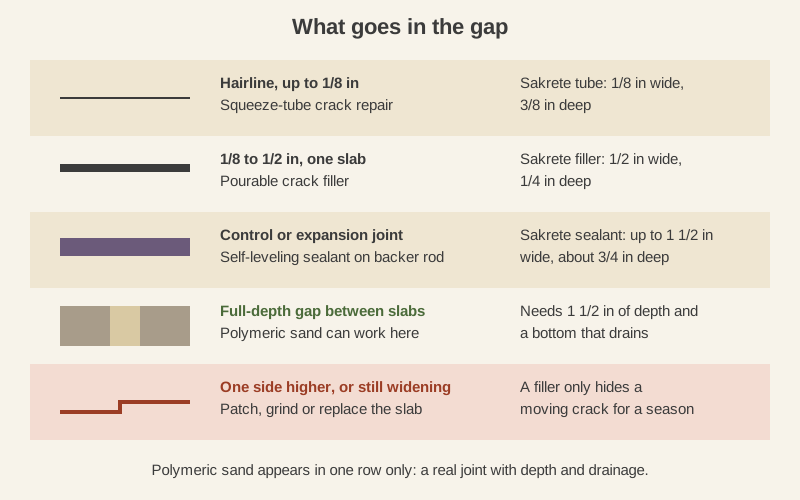
Concrete crack products are rated by width and depth, the same way polymeric sand is. Sakrete's own lineup is a tidy example:
| Gap | Product type | Example limits |
|---|---|---|
| Hairline to 1/8 in | squeeze-tube crack repair | Sakrete Concrete Repair Tube: 1/8 in wide, 3/8 in deep |
| 1/8 to 1/2 in | pourable, self-leveling crack filler | Sakrete Concrete Crack Filler: 1/2 in wide, 1/4 in deep, about 35 linear ft per quart |
| Control and expansion joints to 1 1/2 in | self-leveling polyurethane sealant | Sakrete self-leveling sealant: 1 1/2 in wide, about 3/4 in deep; feet in 24 h, cars in 72 h |
| Broken, spalled or raised edges | cement patcher or repair mortar | a patch, not a filler |
The sealant row covers the most common case, the long straight joint in a driveway or sidewalk that has opened up and filled with weeds. Clean it out, push closed-cell foam backer rod into the joint so the sealant sits at the depth its label calls for, and pour the sealant in a continuous bead. The backer rod also saves you from filling a 4-inch-deep joint with a lot of expensive tube.
Where polymeric sand for concrete does work
There is one situation where it makes sense, and it's the reason the idea keeps coming up. It works when the "crack" is really a joint: a gap between two separate pieces of concrete that runs the full depth down to gravel or soil.
Examples include:
- Stepping pads or square slabs laid with gaps between them.
- A walkway of precast concrete slabs laid on sand.
- Old sidewalk squares where the expansion strip has rotted out and the gap goes right through.
In those, the gap behaves like a wide paver joint. If it's at least 1.5 inches deep, drains at the bottom, and falls inside the product's width range, a wide-joint polymeric sand can hold the gap and slow weeds. Check the bag's maximum width first. Standard sands stop between 1/2 and 2 inches, and only wide-joint formulas reach 4. The polymeric sand bags that mention "concrete pavers" mean paver joints like these, not cracks inside a poured slab.
Some products blur the line. There are polymer concentrates marketed for crack filling, which you mix with dry sand at a stronger ratio. They face the same limits of depth and drainage, so treat them as a cosmetic filler for dormant cracks rather than a repair.
Check whether the crack is still moving
Before filling anything, look at the crack. A filler seals a crack. It doesn't fix whatever caused it.
- Hairline and flush: a shrinkage crack. Fill it to keep water and weeds out, or leave it alone.
- Wider each year: the slab is still moving, often from soil settling or roots. A rigid filler will crack again, so a flexible sealant is the better bet, and it's worth looking for the cause.
- One side higher than the other: a trip hazard and a sign of heave or settlement. No filler levels a slab. That calls for grinding, lifting or replacing the section.
Sealing the whole slab after the repairs helps keep water out of new hairline cracks. That's covered in concrete patio sealing. If a cracked patio has you thinking about pavers instead, the joint-repair side of that world is in paver patio repair.
Use crack filler in slabs, polymeric sand only in real joints
Polymeric sand for concrete cracks fails for simple reasons: the crack is too shallow, there's no drainage, and there's nothing to compact. Use a pourable crack filler up to 1/2 inch. Use self-leveling sealant over backer rod for control and expansion joints up to 1 1/2 inches. Save polymeric sand for full-depth gaps between separate slabs, where it's doing the job it was designed for. If you want to understand why it needs those conditions, what polymeric sand is walks through how the binder works. The bag was never the problem. The crack just isn't a paver joint, however much it looks like one from a standing height. We have a separate page on paver expansion joints if you need the specifics.
FAQ
Can you use polymeric sand to fill driveway cracks?
Not in cracks within a poured concrete slab. They're too shallow, there's no draining bed, and the sand can't be compacted, so it washes out. Use a concrete crack filler for cracks up to 1/2 inch and a self-leveling sealant for wider joints.
Can polymeric sand go in concrete expansion joints?
Only if the joint runs the full depth between separate slabs down to gravel or soil and is at least 1.5 inches deep. Most driveway control and expansion joints are better filled with foam backer rod and a self-leveling polyurethane sealant, which flexes as the slabs move.
What is the best filler for large cracks in concrete?
For gaps up to about 1 1/2 inches, a self-leveling polyurethane sealant over backer rod. Sakrete's version is rated to 1 1/2 inches wide at about 3/4 inch deep. Broken edges or raised sections need a patching mortar or slab repair instead.
Will polymeric sand stop weeds in concrete cracks?
Only briefly. Without enough depth and drainage, the binder doesn't set fully, the sand washes out, and weeds root in what's left. A sealed crack gives weeds nowhere to start.


