


Last Updated on October 20, 2026 by Umar Farooq
Belgard driveway pavers are the lines Belgard rates for "residential vehicular applications", and there are about 30 of them. Most are the standard 2 3/8 inches (60 mm) thick, including Holland Stone, Catalina Grana, Dublin Cobble, Cambridge Cobble, Charlestone and Brooklyn. A few come at 3 1/8 inches (80 mm): Holland Stone 80 mm, Dimensions 12 80 mm, Mega-Stone and the permeable Aqua Dublin, Aqua-Bric and Aqualine. Not rated for cars: Mega-Arbel, the Plaza Paver, Dimensions 12 and 18 at 60 mm, and all Belgard porcelain. The badge alone isn't the full answer, though. Paver shape, base depth and pattern decide whether the driveway stays flat. We have a separate page on ashlar paver pattern if you need the specifics. For the full picture, see paver driveway turnaround.
I checked the driveway rating in Belgard's product data for every paver line on its driveway pavers page and beyond, read Belgard's own driveway paver and pattern guide, and compared the unit sizes against CMHA's aspect-ratio guidance. For driveway basics beyond this brand, start with our paver driveway guide.
Belgard driveway pavers, grouped by look
| Look | Driveway-rated lines | Thickness |
|---|---|---|
| Brick and classic | Holland Stone, Classic Standard, Brick Stone | 60 or 80 mm |
| Cobble | Dublin Cobble, Cambridge Cobble, London Cobble, Old Towne Cobble, Belgian Cobble, Charlestone | 60 mm |
| Smooth and modern | Catalina Grana, Brooklyn, Dimensions 6, Dimensions 12 (80 mm only) | 60 or 80 mm |
| Stone texture | Catalina Slate, Avalon Slate, Origins 6, Origins Antiqued, Quarry Stone, Old Country Stone, Appian-Stone, Old York | 60 mm |
| Tumbled and large | Slaton Plus Tumbled (2 3/4 in), Mega-Stone (3 1/8 in) | 70 to 80 mm |
| Permeable | Eco Cobble, Eco Dublin, Urbana Stone, Aqua Dublin, Aqua-Bric, Aqualine, Turfstone | 60 or 80 mm |
Turfstone is rated only for "light vehicular" use. Aqualine is the one Belgard approves for commercial vehicles. The cobble lines are covered in detail in Belgard cobblestone pavers.
60 mm or 80 mm for a Belgard driveway
Belgard's own guide explains the trade-off plainly. Traditionally, driveways used 80 mm pavers on a 6-inch base. Now it's "more common practice to use a lighter 60mm (2-3/8 inch) paver with a thicker base". That lines up with CMHA Tech Spec 10, which recommends 2 3/8 inches for residential driveways and 3 1/8 inches as typical for pavements with vehicular traffic.
A simple rule from those two sources: 60 mm is fine for a house driveway with cars and the odd delivery van. Go to 80 mm where heavy trucks turn, on a steep drive, or where the base can't be deepened.
The aspect-ratio check Belgard's badge skips
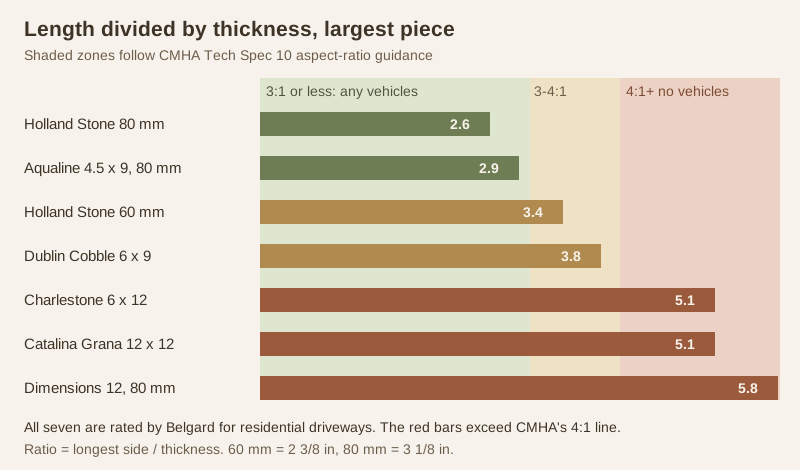
My one strong opinion here: for a driveway, pick the unit by its aspect ratio, not just by the "driveway" badge. Aspect ratio is the longest side divided by the thickness. CMHA Tech Spec 10 says units at 4:1 or more "should not be used where vehicles drive". Between 4:1 and 3:1 suits limited car use such as residential driveways. At 3:1 or less, anything goes.
Belgard rates several units above 4:1 for residential driveways. They include the 6 × 12 Charlestone piece and the 12 × 12 Catalina Grana square (both about 5:1 at 60 mm) and the 12 × 18 Dimensions piece at 80 mm (about 5.8:1). The mechanism is leverage. A long, thin unit under a turning tire gets pushed at one end, rocks about its middle and eventually cracks or tilts. Short, thick units don't give the tire that lever.
In practice:
- At 60 mm, keep units 9 1/2 inches long or less to stay within 4:1. Holland Stone (3.4:1) and the 6 × 9 cobbles (3.8:1) pass.
- At 80 mm, anything up to about 12 1/2 inches passes.
- If you love a large-format line, use its smaller pieces in the drive and the big ones on the patio.
Base depth under Belgard driveway pavers

Belgard's guide gives a range rather than one number. In rainy climates with absorbent clay, "the required base depth can be up to 12 inches". In arid climates, 60 mm pavers "can be successfully used for driveways with only a 4 to 6 inch base". ICPI Tech Spec 2 sets the floor at 6 inches of compacted base under a residential driveway on well-drained soil, with 2 to 4 more inches on wet or weak soil or where the ground freezes.
I'd treat Belgard's arid-climate 4 inches as a regional exception (clay soil doesn't read install guides) and plan on 6 inches as the minimum everywhere else. A geotextile between clay and stone helps, but Belgard's own guide says a thicker base is still recommended. The step-by-step is in our paver driveway installation guide.
Patterns Belgard recommends for driveways
From Belgard's driveway guide:
- Herringbone at 45 degrees to the garage, which it calls "the strongest and most traditional option".
- Ashlar (random multi-size), which is "effective for both residential and heavier traffic".
- Running bond or basketweave, which is acceptable for a standard home driveway. Avoid long straight joint lines where traffic is heavier.
- Permeable installations: stick to ashlar or herringbone, because the wider joints let other patterns shift.
A 90-degree herringbone is a reasonable compromise on a narrow drive, where 45-degree cuts along both edges pile up.
Permeable and overlay options
Permeable Belgard lines such as Eco Dublin list an initial surface infiltration rate above 500 inches per hour, depending on the joint aggregate. They need an open-graded stone base and, per Belgard, site-specific engineering. Some towns offer incentives for them, which Belgard's guide mentions without naming any.
For a sound concrete driveway with no foundation cracks, Belgard describes overlaying it with 30 mm thin pavers. Either mortar-set them, or mud-set the perimeter and sand-set the field where soils shift. Expect the overlay to raise the surface by 2.5 to 3 inches, which can catch the garage door threshold and the street apron.
Choose short, thick and well-based
The best Belgard driveway pavers pass three checks. They carry Belgard's residential vehicular rating, their largest piece stays at or under about 4:1 length to thickness, and they sit on at least 6 inches of compacted base, or more on clay. Holland Stone, the 6 × 9 cobbles and the 80 mm lines pass all three easily. The large-format smooth lines look lovely and belong on the patio next to the drive.
FAQ
Which Belgard pavers can be used on a driveway?
Any line Belgard rates for residential vehicular use, which covers about 30, including Holland Stone, Catalina Grana, Dublin and Cambridge Cobble, Charlestone, Brooklyn, Dimensions 6 and 80 mm Dimensions 12. Mega-Arbel, the Plaza Paver and Belgard porcelain are not rated.
How thick should Belgard driveway pavers be?
At least 2 3/8 inches (60 mm), which is Belgard's standard and CMHA's recommendation for residential driveways. Use 3 1/8 inches (80 mm) for heavier vehicles or where the base can't be deepened.
What is the best pattern for a Belgard paver driveway?
Herringbone at 45 degrees to the garage. Belgard calls it the strongest option. Ashlar patterns also work.
Can Belgard porcelain pavers go on a driveway?
Belgard's FAQ says it doesn't recommend porcelain for driveways. Use a concrete line instead.


