

Last Updated on October 20, 2026 by Umar Farooq
A gravel vs paver driveway is a choice between paying less now and working more later. Fine Homebuilding lists installed gravel at 50 cents to $3 per square foot and concrete pavers at $5 to $20, but gravel needs seasonal regrading, containment and regular weed control, while pavers mostly need sweeping, a refill of joint sand and the occasional wash. Gravel suits a long rural drive, a tight budget or a first stage you plan to upgrade. Pavers suit a short, visible drive where you want to stop thinking about it.
Both surfaces are loose stone pressed into a base. The difference is whether the top layer is held in place by a paver or only by gravity and good intentions.
The price gap, and what it leaves out
Gravel is the cheapest driveway surface there is. Fine Homebuilding lists installed gravel at 50 cents to $3 per square foot, against $5 to $20 for concrete pavers. It is an older article, so use it for the ratio, not for a bid.
On a 600 square foot drive, that is $300 to $1,800 in gravel and $3,000 to $12,000 in pavers. A few things the table does not show:
- Gravel needs a base too, and a good one costs money even before the top stone.
- Edging to hold the stone in costs extra, and without it the surface migrates onto the lawn.
- Topping up stone is a recurring cost. Pavers have no equivalent line item.
For paver prices in more detail, see our paver driveway cost guide.
What the weekends look like
Gravel's maintenance is regular, and Fine Homebuilding names it: seasonal regrading, regular containment and regular weed control. Pavers get semiannual washing and sealing in the same list, plus weed control, though sealing is optional and weeds only find a way in where joint sand has washed out.
Here is how the chores compare in practice:
| Chore | Gravel | Pavers |
|---|---|---|
| Re-level the surface | Rake or regrade each season | Rarely, only where a section sinks |
| Add material | Top up stone as it scatters and compacts | Refill joint sand when it drops |
| Weeds | Pull, spray or fabric under the stone | Pull, and keep joint sand full |
| Snow | A plow blade scrapes stone along with the snow | A plow glides over the surface |
| Repairs | Rake a rut flat | Lift and reset the affected pavers |
That plow row matters in cold country. Anyone who has plowed gravel knows where the stone ends up, and it is not in the driveway.
Where the water goes

Fine Homebuilding rates gravel's permeability as very high and pavers' as high when set in sand and low when set in mortar. That sounds like a tie, but the water behaves differently. Water soaks straight through gravel, and then ruts and washouts show up where it runs downhill across the surface. A paver driveway sheds most of its water across the top, with some going into the sand-filled joints.
If drainage is the whole reason you are looking at gravel, there is a third route. A permeable paver system, such as permeable concrete pavers, is built differently. CMHA's guide specification for permeable pavement calls for No. 8 stone bedding 2 inches deep, over a No. 57 stone base 4 inches deep, over a No. 2 stone subbase. That is a bigger build than a standard paver drive, and it costs accordingly.
Why the stone underneath matters more than the surface
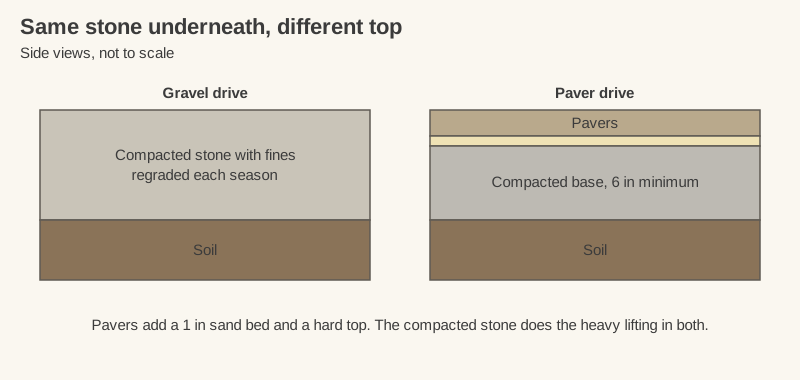
Gravel and pavers share a lesson. ICPI Tech Spec 2 asks for at least 6 inches of compacted base under a residential paver driveway, and 2 to 4 inches more in cold climates or on wet or weak soil. A gravel drive built on the same compacted foundation lasts far longer than one dumped on bare soil.
Fine Homebuilding gives gravel a 90-plus-year life, which is only true if the stone is well compacted, contained and maintained. Loose stone that never locks together rolls under tires, and our guide to how to compact gravel explains why stone with fines packs down where clean stone does not.
There is an upgrade path here. A compacted gravel drive that is well drained and flat can later become the base for pavers, provided you can get it to the compaction and flatness the job needs. CMHA's guide specification asks for a base surface within plus or minus 3/8 inch over a 10 foot straightedge before the sand goes down.
Hybrid drives: strips, grids and a border
You do not have to pick one. Three combinations are worth a look:
- Wheel strips. Two paver ribbons under the tires with gravel or grass between them. They cost less than a full paver drive, and our strip paver driveway guide covers the layout.
- Gravel in a grid. Plastic or concrete cells hold the stone in place so it cannot migrate. They are a good middle ground if gravel is the look you like.
- A paver apron. A paver band at the street end keeps stone out of the road, and the rest stays gravel.
My one strong opinion: if you are choosing gravel on price, spend part of the savings on edging and a proper base. The cheapest gravel drive is the one that is built right once, and a loose pile on topsoil is a tuition payment for that lesson.
Choose gravel for length, pavers for the front door
Pick gravel for a long drive that nobody photographs, a limited budget, or a first stage you can upgrade later. Pick pavers where the drive is short, visible and used daily, or where you plow snow. Either way, build the base first, and our paver driveway installation guide shows how. A hybrid of strips or a paver apron gives most of the benefit for a fraction of the paver bill.
FAQ
Is a gravel driveway cheaper than pavers?
Yes. Fine Homebuilding lists installed gravel at 50 cents to $3 per square foot and concrete pavers at $5 to $20. Gravel also needs regular regrading and weed control, so the gap narrows over the years.
Do gravel driveways need a lot of maintenance?
They need regular work. Fine Homebuilding names seasonal regrading, regular containment and regular weed control. Pavers need less: sweeping, refilling joint sand when it drops, and optional sealing.
Can I put pavers over a gravel driveway?
You can use a well-compacted gravel drive as the base for pavers if it is deep, flat and drains well. The base should be at least 6 inches compacted for a residential driveway and flat to within 3/8 inch over 10 feet. A loose, rutted drive needs to be rebuilt first.
Which is better for drainage, gravel or pavers?
Gravel lets water soak straight through, but heavy rain can wash ruts into it. Standard pavers shed water across the surface and into the joints. A permeable paver system is the option designed for drainage.
Can you plow snow on a gravel driveway?
You can, but the blade drags stone with the snow, so you lose gravel every winter and re-spread it in spring. Pavers handle a plow better, though the blade should ride just above the surface.


