

Last Updated on October 20, 2026 by Umar Farooq
The quickest way to remove weeds from pavers is to pull them by the root with a narrow crack weeder, pour boiling water or run a weed torch over whatever is too small to grip, then scrape the joint clean and refill it with joint sand. The refill is the step that matters. Weeds between pavers almost never come up from under the patio. They sprout from seeds that landed in a joint where the sand has dropped and grit has built up. Kill the weed and leave the gap, and you've prepared a seed bed for next month's crop.
Below is each method, what it's good at, where it goes wrong, and how to stop the regrowth.
Which weed removal method fits your patio
| Method | Works best on | Regrowth risk | What can go wrong |
|---|---|---|---|
| Crack weeder or knife | Anything with a root you can reach | Low if the root comes out | Snapped taproots regrow |
| Boiling water | Seedlings, moss, annuals | Medium | Scalds; wasted on deep perennials |
| Weed torch | Annual broadleaf weeds | Medium, needs repeats | Fire risk near mulch and dry leaves |
| Vinegar (20% acetic acid) | Young leaves only | High on perennials | Corrosive to skin and eyes, can mark pavers |
| Systemic herbicide | Established perennials, grasses | Low | Drift and runoff into beds |
| Pressure washer | Moss and a whole patio of seedlings | Low, once re-sanded | Blasts the joint sand out with the weeds |
If you only read one row, read the first. For a normal backyard patio, the best tool to remove weeds from pavers is a paver weeder tool and a bit of patience. The rest are for when there are too many weeds, or roots too stubborn, to pull by hand.
A paver weeder tool and damp soil
A paver weeder is a hooked or L-shaped blade on a handle, thin enough to slide down a joint and cut or lever the root out. Install-It-Direct's guide puts purpose-built weeders at about $8 to $25, and an old flat screwdriver does the job on a small patio.
Cornell's weed guide for hard surfaces gives the tip that makes this bearable: wet the soil before weeding, especially for weeds with sizable taproots such as docks and dandelions. So hose the joints, wait 20 minutes, then pull slowly and straight up. A dandelion that snaps at the crown will be back in a few weeks, looking unbothered.
- Hold the blade low and work along the joint, not across the paver face, so you don't scratch it.
- Pull the whole plant with its root. Don't leave it lying on the patio to drop seed.
- Scrape out the dark, soil-like layer in the top of the joint too. That grit is what the next seed will root in.
Boiling water and a weed torch

Heat kills top growth without leaving chemicals in the joint, and it reaches weeds too small to grip.
Boiling water. Pour slowly from a kettle, close to the joint, so it runs down into it instead of splashing. Wear closed shoes. It is excellent on seedlings and moss and fairly hopeless on an established dandelion, whose taproot shrugs it off.
Weed torch. Cornell's hard-surface page says flame weeding can be used on pavement, brick and pavers. It works best on annual broadleaf weeds and can work on perennials only with repeated treatments. You don't need to char the plant. A second or two of heat until the leaves turn dark green and limp is enough, and they wilt over the next day. Keep the flame away from mulch, dry leaves, plastic edging and anything that leaks fuel, and have a hose connected before you light it. (The patio won't catch fire. Everything next to the patio might.)
Is vinegar worth it on a patio?
Plain vinegar is the internet's favorite weed killer, so I read what the National Pesticide Information Center actually says about it. Their vinegar fact page is blunt. Household vinegar is 4 to 6% acetic acid. Herbicide vinegar is 20% or more, and registered products at that strength carry the signal word DANGER. It can permanently damage the corneas if it splashes in your eyes. It's also a contact herbicide: it kills the leaves it touches and doesn't travel down to the root.
I would leave the vinegar in the kitchen. For a perennial weed in a joint, that combination is the worst of both worlds. You're handling a corrosive liquid, and the root survives to send up new leaves anyway. The weeder gets the root and costs less than a gallon of horticultural vinegar. The acid can also etch cement paste and lighten some concrete and limestone pavers, so if you use it anyway, test it on a hidden corner first.
Salt and bleach are worse ideas. Salt doesn't break down. It stays in the joint sand and washes into the lawn and beds next to the patio, where you did want things to grow.
Herbicides for weeds that keep coming back
Some perennials and creeping grasses have roots that run under the pavers, where no weeder can reach. For those, a systemic herbicide is the tool, because it moves from the leaves down into the roots, which contact products (vinegar included) do not.
- Choose a product whose label lists patios, walks or hard surfaces. The label is the legal instruction, not a suggestion.
- Spot-spray the weed on a calm, dry day. Don't flood the joint, and don't spray upslope of beds or where runoff heads for a drain.
- Wait the time the label gives before pulling the dead plant, so the product has reached the root.
Moss and power washing
Moss and fine green growth mean the patio stays damp and shaded. Boiling water or a stiff brush clears small patches. For a patio full of it, a pressure washer with a fan tip strips moss, seedlings and the grit layer in one pass, but it strips the joint sand too. Treat any wash as the first half of a re-sanding job, not a cleaning job. Our guide to power washing pavers covers nozzle choice and distance. You can read more in the guide to clean moss off pavers.
If moss keeps returning, the real fix is less shade and faster drying: trim overhanging branches and make sure water isn't pooling on the patio.
Refill the joints or the weeds come back
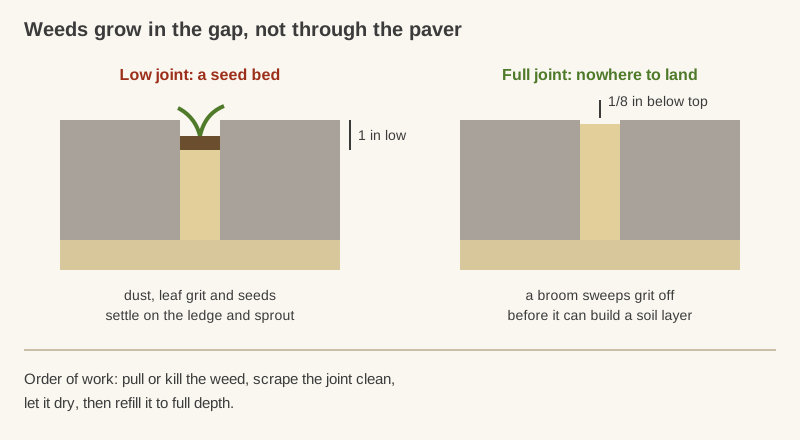
Unilock's weed page makes the point plainly: weeds grow between the stones when the jointing sand washes away. Once the joints are clear and bone dry, refill them:
- Scrape each joint down to clean sand, at least an inch or so, removing all dark organic grit.
- Let the joints dry fully. After washing, that can take a day or two of sun.
- Sweep in joint sand or polymeric sand, vibrate or tap it down, top it up, and leave it about 1/8 inch below the paver top.
- Sweep the patio every week or two in summer, so grit never builds a soil layer again.
Does polymeric sand prevent weeds? It resists them better than loose sand, because the hardened joint gives a seed nothing loose to root in. But dust still settles on top, and a cracked or thin joint grows weeds like any other. If yours is crumbling, polymeric sand problems explains why.
Does sealing pavers prevent weeds? A joint-stabilizing sealer hardens the top of ordinary sand joints and helps a little for the same reason, but it doesn't stop seeds landing in debris on the surface. The details are in sealing paver joints.
Pull the root, then take away the seed bed
To remove weeds from pavers for good, work in this order: pull what you can by the root, use heat on the small stuff and a systemic spot treatment on the perennials, then clean and refill the joints so there's no grit for the next seed. The weeds were only ever renting that gap. Fill it and they have to move out.
FAQ
What is the best tool to remove weeds from pavers?
A narrow paver weeder or crack weeding knife, used after watering the joints so the root comes out whole. For large areas of seedlings, a weed torch or boiling water is faster, and a systemic herbicide handles perennials whose roots run under the pavers.
Does polymeric sand prevent weeds?
It reduces them, because hardened joints give seeds nothing loose to root in. It doesn't stop seeds germinating in dust on top, and cracked or shallow polymeric joints grow weeds like regular sand. Sweeping and keeping the joints full do most of the work.
Does sealing pavers prevent weeds?
Only partly. A joint-stabilizing sealer firms up the top of the sand, which makes rooting harder, but seeds can still sprout in debris that collects on the surface. Sealing doesn't replace sweeping and refilling low joints.
Will vinegar damage pavers?
It can. The acid can etch cement paste and lighten some concrete and limestone surfaces, and the 20% horticultural strength is corrosive to skin and eyes. It also kills only the leaves, so perennial weeds regrow. Test it on a hidden spot if you use it at all.
Why do weeds keep coming back between my pavers?
Usually the joints are low or full of organic grit, so wind-blown seeds have a place to root. Taproots that snap off during pulling also regrow. Remove the whole root, scrape the joint clean, and refill it to about 1/8 inch below the paver top.


