Last Updated on September 23, 2026 by Umar Farooq
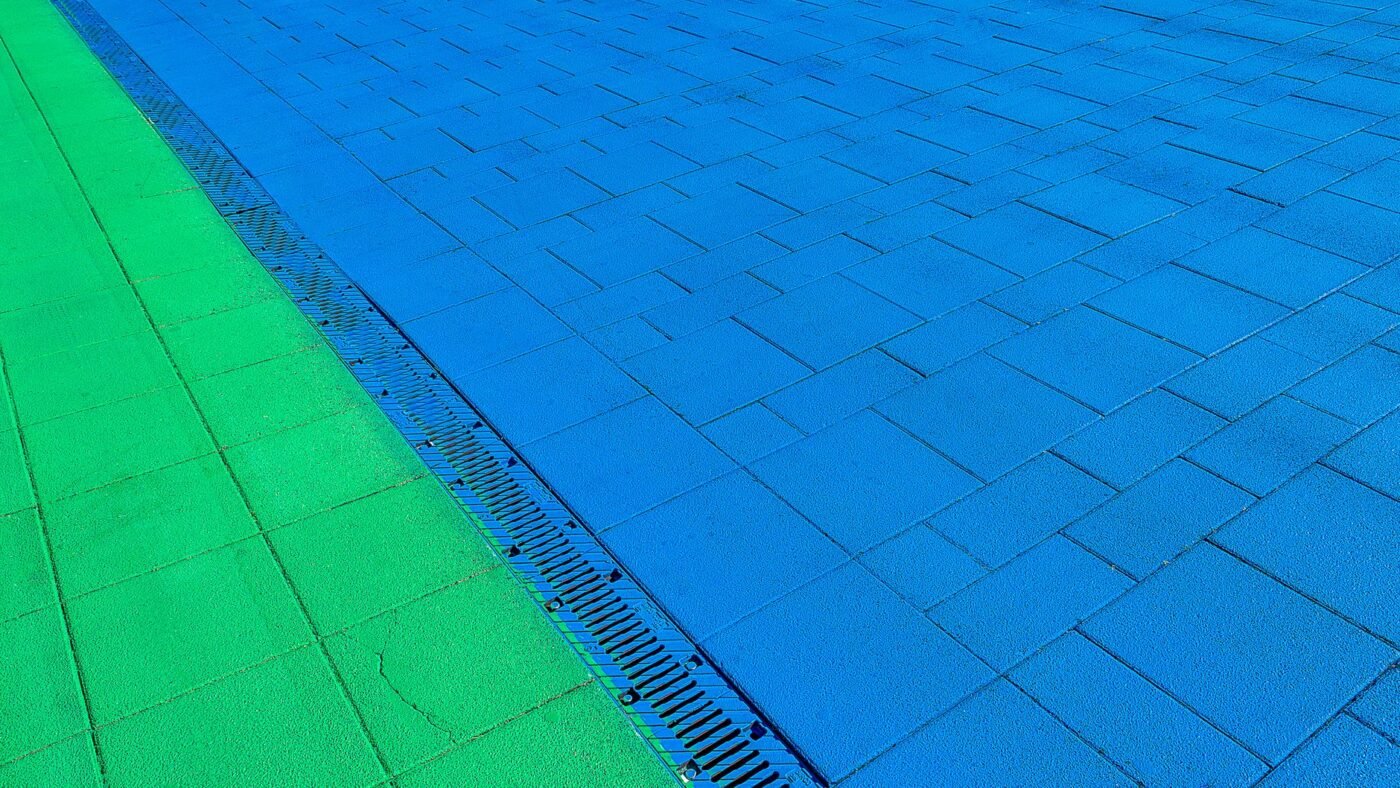
A paver drain is a channel drain, catch basin or point drain built into a paver surface so water has somewhere to go when the pavers can't shed it off an edge. It is also the only part of a patio that is supposed to be lower than everything around it, which makes it the one place where a dip is a feature. The rule that makes it work: after compaction, the finished pavers sit 1/8 to 1/4 inch above the grate, and the surface slopes toward the drain at roughly 1/4 inch per foot. The drain then empties into solid pipe running to daylight, a dry well or an approved storm connection.
If slope, grading or downspout changes might do the job instead, start with our overview of patio drainage. The cheapest drain is the one you didn't have to buy.
Four kinds of paver drain
| Drain type | How it collects water | Where it fits in a paver patio |
|---|---|---|
| Channel (trench) drain | A long, narrow grated channel catches water along a line | Along a house wall, at a garage or door threshold, between two patio levels, across the low edge |
| Catch basin | A square box with a grate collects water at one point, with a sump that traps debris | The lowest point of an enclosed courtyard or a patio surrounded by walls |
| Adjustable point drain | A small grate on a riser you can raise or lower to meet the paver surface | Low points in paver fields, pool decks, small patios |
| French drain beside the pavers | Perforated pipe in a gravel trench catches water in the soil | The uphill edge of a patio, where groundwater or yard runoff keeps the base wet |
Some products are made for pavers. I read the spec page for Pave Tool's Quick-E-Adjustable patio drain: an 8 x 8-inch grate with 3 inches of vertical adjustment, fitting 4-inch SDR 35, triple-wall and S&D pipe, so the grate can be fine-tuned after the pavers go in. Low-profile systems such as Stegmeier's adjustable paver drain come in 5-foot sections that sit on grade. Ordinary plastic channels and basins work too, if set to the paver surface as below.
Setting the drain height against the pavers
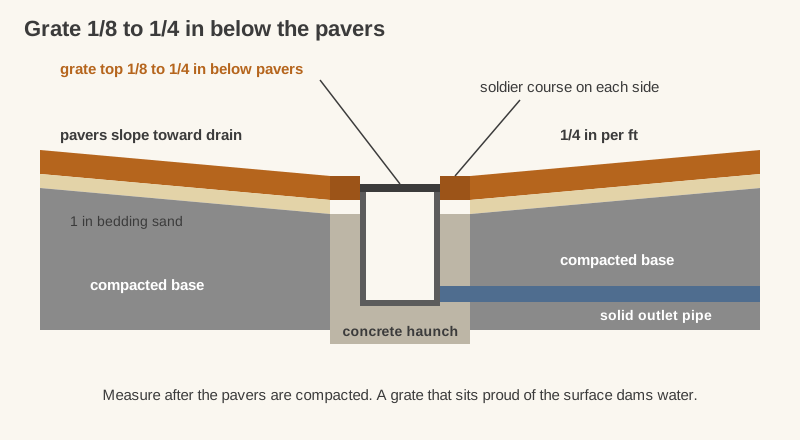
A grate even slightly above the pavers is a dam with slots in it. One set too low is a trip edge and a gutter full of grit.
The target: finished pavers 1/8 to 1/4 inch above the grate, measured after compaction. Two things make that tricky:
- Pavers settle when compacted. The plate drives them into the 1-inch layer of loose bedding sand (concrete sand to ASTM C33, not stone dust), so set the drain to the compacted height.
- The drain is fixed before the pavers. Check it against a string line at finished height, both ends and the middle, before the concrete sets.
An adjustable drain removes most of the guesswork; you wind the grate up or down afterwards. (Fixed drains do not forgive, and concrete does not negotiate.)
Installing a paver drain channel, step by step
On an existing patio, lift a 2- to 3-foot strip first.
- Plan the outlet first. Lower ground where it can daylight, a dry well, or a storm connection if your town allows it. The outlet has to be lower than the channel, with the pipe falling at least 1/8 inch per foot and preferably 1/4. No fall, no drain.
- Grade the base to the drain. Shape the compacted base so both sides of the patio fall toward the channel line at 1/4 inch per foot.
- Dig the channel trench. Dig through the base, wide enough for about 4 inches each side of the channel and deep enough for a concrete bed. Lay the outlet pipe to the discharge point.
- Bed and haunch the channel in concrete. Set the channel sections on a concrete bed, connect them, and attach the end cap and outlet fitting. Check the height against your string line. Then pour concrete up the sides of the channel (the haunch), stopping below the bottom of the bedding sand so the pavers can still sit on sand. Tape over the grates first, a tip Home Fixated's channel drain walkthrough also stresses, or concrete fills the slots and locking hardware.
- Lay a soldier course along both sides. Run whole pavers along each edge and lay the field into them, so cuts land away from the grate.
- Compact carefully, then check. Keep the plate off the grate. Check that the pavers finish 1/8 to 1/4 inch above it along the whole run, then sweep in the joint sand.
The same order works for a catch basin.
Catch basins and point drains in a paver field
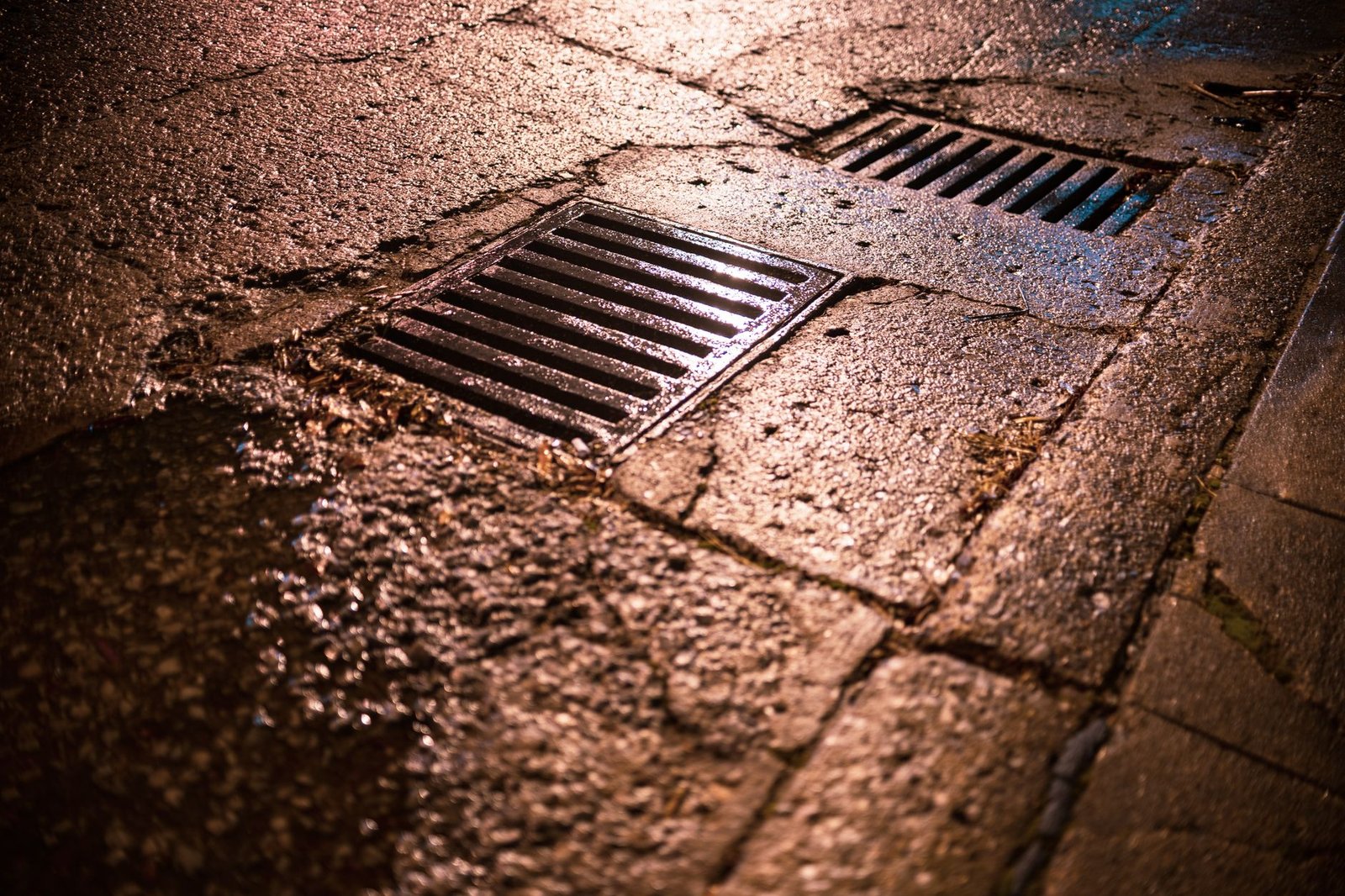
A courtyard enclosed by walls has no edge to drain to, so the surface is warped toward a basin like a shallow funnel. Shape the base that way first, lowest at the basin, then screed the sand in sections that follow it. The sand follows the slope; it never creates it.
A 9- or 12-inch square basin is plenty for a residential patio. A square grate is easier to pave around than a round one, since a soldier course can wrap it.
Cutting pavers around a round drain cover
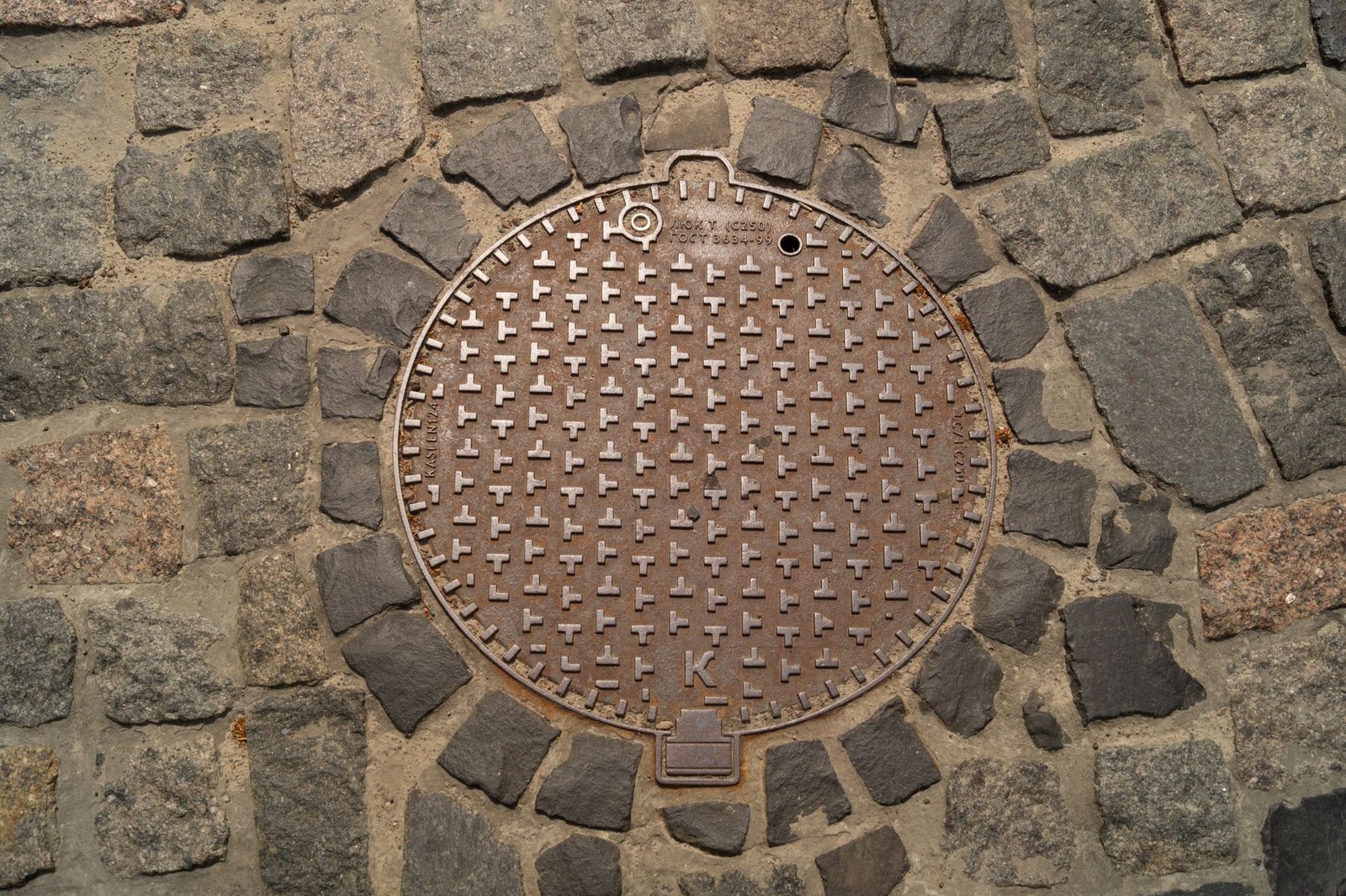
Round grates mean curved cuts. Two tidy methods:
- Frame it square. Lay a square of whole pavers around the round grate and fill the four corner gaps with small cut pieces or a concrete collar.
- Cut a ring. Trace the circle onto the pavers, then cut with a diamond-blade saw, water on the blade, using several straight relief cuts up to the line. Avoid slivers smaller than about a third of a paver; they work loose and then go exploring.
A French drain beside a paver patio
A French drain doesn't collect surface water. It catches water moving through the soil before it reaches the base, so it belongs along the uphill edge or where groundwater keeps the ground soft. Every French drain diagram I pulled up for this, from pipe makers to extension services, puts it on the uphill side for that reason.
Dig the trench outside the paver base and edge restraint, at least 12 inches deep, line it with non-woven geotextile, and lay 4-inch perforated pipe in washed 3/4-inch stone, falling at least 1/8 inch per foot to a solid-pipe outlet. Wrap the fabric over the stone and finish with gravel or sod.
Don't run a French drain under the paver base. Trench backfill never compacts as well as the base around it, and the pavers above will eventually dip.
Patio drain covers and grates
What to weigh:
- Material. Plastic grates are inexpensive; choose UV-stabilized for full sun. Galvanized steel is stronger. Stainless, cast iron and brass look better and last longer.
- Load rating. A pedestrian-rated grate (class A in the European EN 1433 system many manufacturers use) is fine for patios. Anywhere a car might drive, such as a driveway apron, needs a higher class.
- Slot size. "Heel-proof" slots stop narrow heels, cane tips and small wheels from catching.
- Locking. A grate that locks down won't rattle or get kicked out of its frame.
Lift the grates once or twice a year and flush the channel; built-up grit is the usual cause of a failed drain.
Set the outlet before the first paver
My one strong opinion: the pipe is the drain, and the grate is just the part you can photograph. Every catalog I compared leads with the grate finish, but a channel with no fall to an outlet is a trough that holds water in a nicer shape. So find the outlet and the fall first, then fix the channel or basin at the compacted paver height. For building the patio around it, see our paver installation guide. And if the hose test afterwards sends every drop straight into the slots, you have my permission to stand there watching it longer than is strictly normal.
FAQ
How far below the pavers should a drain grate be?
Set the grate so the finished pavers sit 1/8 to 1/4 inch above it after compaction. That small step lets water run off the pavers into the drain without leaving a noticeable trip edge.
Where should a patio drain go?
At the lowest point of the patio, with the surface sloping toward it by about a quarter inch per foot. For a patio that must slope toward the house, run a channel drain along the house edge. For an enclosed courtyard, use a catch basin at the center or at the low corner.
Do you need concrete around a channel drain in pavers?
For a lasting installation, yes. A concrete bed and haunch keep the channel from shifting when the pavers beside it are compacted. Stop the concrete below the bedding sand so the pavers next to the channel still sit on sand. Some low-profile paver drains are designed to sit on grade without concrete; follow the manufacturer's instructions for those.
What size pipe does a paver drain need?
Most residential patio drains connect to 3- or 4-inch pipe. Use solid pipe, not perforated, from the drain to the outlet, and keep it falling at least 1/8 inch per foot.