


Last Updated on October 20, 2026 by Umar Farooq
Pavers sinking after tree removal almost always sit over the old stump and roots, which rot and shrink for years after the saw goes quiet. The ground above them settles as the wood loses its structure, and the base and pavers settle with it. The fix is to lift the bowl, dig out the rotten wood and organic soil, refill with crushed stone in thin compacted lifts and relay the same pavers.
The dip is centered where the tree stood. That, at least, makes it easy to find.
Pavers sinking after tree removal: is it the stump?
Check the shape and the location before you lift anything.
| What you see | Likely cause |
|---|---|
| Bowl-shaped dip where the tree used to be | Stump and roots rotting below |
| Mushrooms near the dip | Decay fungi feeding on old wood (the City of Windsor notes these appear as roots decay) |
| Humps first, then a dip | A living tree's roots lifting pavers, as in pavers around a tree |
| Dip under a downspout | Water, not wood. See paver base washout |
What the stump is doing under there
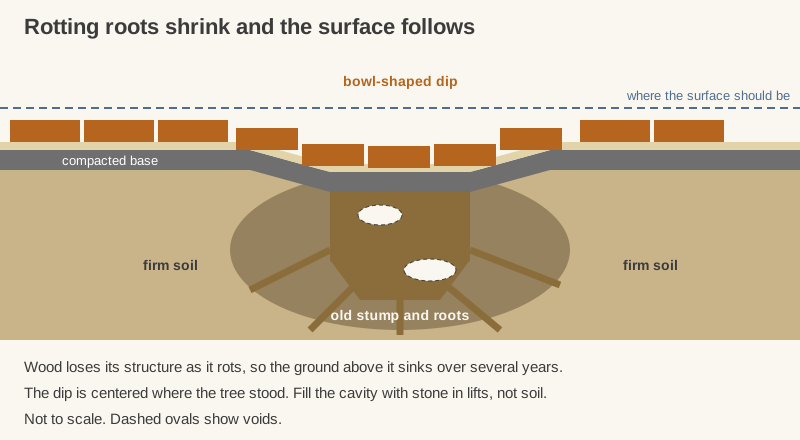
Purdue's extension service says a stump can take several years to decompose unless it was ground very deeply or excavated, and that the ground above it sinks over time as the wood loses its structural fiber. The City of Windsor says grinding takes the stump down about 8 to 12 inches below the soil surface, that the remaining roots decay, and that settling can continue after the tree is gone.
I could not find any source that says when the sinking starts or how long it lasts for a stump under pavers, only "several years" for decomposition. If a site gives you a month-by-month schedule, it did not get it from there.
Lift the bowl and look
- Mark the dip with chalk and add a row of level pavers on each side.
- Lift the pavers with a flat screwdriver or paver puller and stack them in order. Western Interlock's how-to for roots under pavers pulls every paver within 16 inches of the affected area; take a generous margin.
- Dig out the base and soil to firm ground. Look for soft, black organic soil, chunks of rotten wood and voids. Remove all of it. The Agrio repair guide notes that organic matter in excavated soil rots and loses volume, and that loose soil consolidates when it gets wet.
- Leave anything you cannot move. A large stump or root crown that sits below your reach is a job for someone with a stump grinder or excavator, and stumps ground to 8 to 12 inches still leave wood below that depth.
Refill with stone, not soil
My one opinion: fill the cavity with crushed stone in thin lifts, not with the dirt you dug out. Wood rots, soil with organic matter shrinks, and topsoil patches settle again. ICPI's 4 to 6 inch lift figure assumes a 7,000 lbf plate and thinner lifts for smaller plates, so for a deep hole, work in thin, damp lifts and hand-tamp or rent a jumping jack (see jumping jack vs plate compactor).
- Compact the bottom of the hole before adding any stone.
- Add the stone in thin lifts, compacting each one.
- Finish with 1 inch of screeded, uncompacted bedding sand and relay the pavers 1/8 to 1/4 inch proud for settlement (CMHA).
- Sweep in the joint sand.
How to fix sunken pavers has the full relay sequence if you want to check your steps.
When it is not a DIY dip
- Remaining roots belong to a living tree. Do not cut anything thicker than your thumb. Call an arborist.
- The cavity is deep or keeps swallowing stone. Stop and call a hardscape or excavation contractor.
- A utility or drain runs near the stump. Call 811 first, and hand-dig near any marks (see call 811 before digging).
Why topsoil and sand are the wrong fill
- Dumping topsoil in and relaying. It rots and settles.
- More bedding sand. The sand bed is 1 inch.
- Planting over it. Purdue recommends filling the space with soil and mounding a little extra for a lawn; that is advice for grass, not pavers.
If the tree is still standing, take the stump out first
When a patio is planned where a tree is coming out, ask for the stump to be excavated or ground as deep as possible before any base goes down. Purdue says deeper grinding or excavation shortens the decay period. Then compact the fill in lifts and let it sit through a season before paving, so you can see whether it moves. (I found no verified settling time for that wait, so treat one season as a prudent buffer, not a standard.)
Dig out the wood and fill the hole with stone
Pavers sinking after tree removal stop sinking once the wood and organic soil are gone and the cavity is refilled with compacted stone. The tree took decades to grow. Its roots will take years to finish leaving, and there is no reason your patio should wait around for them.
FAQ
Why are my pavers sinking where a tree was removed?
Because the stump and roots left in the ground rot and shrink, and the soil above them settles. Purdue says this can continue for several years.
How long does a stump take to rot?
Purdue says several years unless it was ground very deeply or removed by excavation.
Should I grind the stump before laying pavers?
Deeper grinding or excavation shortens the decay period, according to Purdue. The City of Windsor says grinding reaches about 8 to 12 inches, so wood can remain deeper than that.
Can I just add soil and relay the pavers?
Soil with organic matter rots and settles again. Use compacted crushed stone in thin lifts.
Should I cut the remaining tree roots?
Not if they belong to a living tree. Anything thicker than your thumb needs an arborist.


