


Last Updated on October 20, 2026 by Umar Farooq
The best budget backyard paver ideas all do the same thing: they shrink the paved area, cut the labor you pay for, and protect the three things that decide whether a patio lasts, which are the base, the edge restraint and the bedding sand. Saving money on pavers is easy. Saving money on pavers without ending up with a patio that sinks in two winters is the actual skill.
I read through the top budget-paver guides, and most of them are galleries of cheap-looking ideas with the cost of failure left out. This one sorts the ideas by what they save, and what they risk.
Backyard paver ideas on a budget start by paving less
The single biggest saving is square footage. A patio sized to fit a table, four chairs and room to push them back costs a fraction of one sized to fill the available lawn.
Mark out your furniture on the grass first, and build to the outline. If you are not sure how many pavers that is, the arithmetic is the same one used to count pallets. Every square foot you leave unpaved also skips the excavation, the base stone and the sand.
Gravel around the pavers, pavers where the legs go
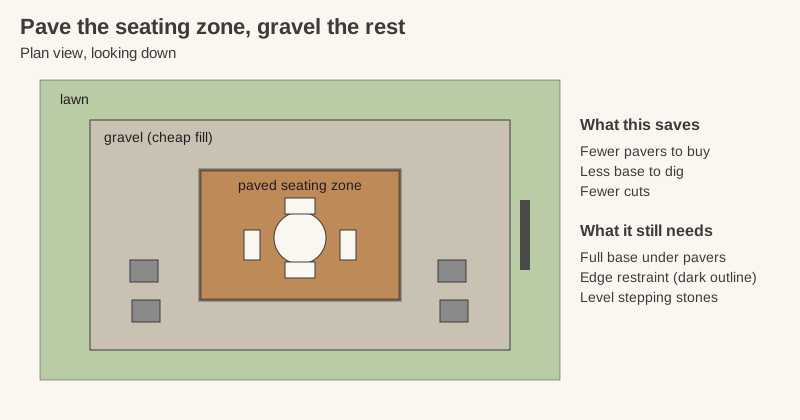
You do not need pavers under the whole space. A paved seating zone surrounded by gravel puts the expensive material where chairs and tables sit and uses cheaper stone elsewhere. This is the idea most of the budget guides land on, and it works.
The one rule is that the paved area still needs a restraint along its edges, because a gravel border pushes sideways. If you want the full gravel-and-paver combination, read pea gravel paver patio before you buy anything.
Stepping stones across a gravel bed
Pavers set one by one in gravel, as stepping stones, use a fraction of the material of a solid patio. They suit a path or a small sitting area, and they are forgiving to lay because each stone is leveled on its own.
Level each stone on a firm bed, not on bare soil, and keep the gaps even. How to lay stepping stones covers the bedding. Stepping stones are not a replacement for a patio base where furniture will sit. A table leg on a lone stone tilts it.
Reclaimed and surplus pavers
Reclaimed pavers, leftover pallets from other jobs and overstock lots usually cost less than new ones. Look for:
- Matched batches. Mixed colors and sizes need a pattern that hides them, and some need more cutting.
- Intact edges. Chipped or crumbling units will not interlock tightly.
- Thickness. Check that they are thick enough for your use. CMHA's Tech Spec 10 recommends 2 3/8 inches for pedestrian areas, and 3 1/8 inches is typical for vehicle traffic.
Our guide to reclaimed pavers goes into where to find them and what to test before you buy.
Buy the pavers the way you would buy anything heavy
Pavers are sold by the pallet, and they are heavy, so delivery is a line item on its own. Three habits keep that line small:
- Order once, with a margin. A second small order later can arrive in a different dye lot, and the color mismatch shows. Add a modest allowance for cuts and breakage to the first order instead.
- Ask about pickup. Yards and home centers that load a trailer for you can undercut a delivered price. Do the pickup in one or two trips, and check the trailer's weight rating first.
- Ask for the leftover and the seconds. Yards often keep partial pallets and discontinued colors that they will sell for less. For a calm, single-color patio, a discontinued color is as good as any other.
None of this lowers quality, and the money you save here is better spent on base stone, which is also sold by weight and also heavy.
Plain pavers, simple pattern, few cuts
Every cut costs time and waste, and a complicated pattern multiplies both. A plain running bond or a simple stack on a rectangular patio produces far less waste than a curved edge with a basketweave.
- Rectangles beat curves when you are cutting by hand.
- Size the patio to the paver, so the last row is a full unit rather than a sliver.
- One color saves you sorting through pallets for matching shades.
None of this requires fancy pavers. A standard concrete paver in a neutral color does the job, and the patio looks deliberate because it is calm.
Do the labor yourself, but rent the machine
Labor is usually the biggest line on a contractor's quote, and digging, base and laying are all learnable. The two jobs worth being careful about are compacting the base and screeding the sand bed evenly.
Do not buy a plate compactor for one patio. Rent one for a day or a weekend, and plan the work so base compaction and the final pass over the pavers both fall inside the rental. If you want to know how much it costs and what size to ask for, see plate compactor rental. For a small job you can also hand tamp in thin lifts, though it takes a lot more time.
Build it in phases
A patio you cannot afford all at once does not have to wait. A phased build gets you using the space sooner.
- Phase one: dig and compact the full base, set the edge restraint, and lay the first section of pavers.
- Phase two: add pavers to the next section when money allows. Because the base and restraint are already in, extending is simple.
- Phase three: add borders, planting beds or a seat wall.
Phasing works because the invisible parts are done once. The mistake is to build phase one on a thin base and plan to "fix it later."
What to leave alone when you cut costs
This is where I would be blunt. Cheap pavers are fine. Cheap base is not. The pavers are the finish; the base is the patio. A mid-range concrete paver on a properly compacted base will outlast a premium paver on a rushed one, because pavers spread the load and the base carries it.
Protect these four things however tight the budget:
- At least 4 inches of compacted base under a patio on well-drained soil, with 2 to 4 inches more on wet, weak or freezing ground (ICPI Tech Spec 2).
- One inch of bedding sand, screeded and uncompacted. Use concrete sand, not stone dust or mason sand: CMHA's guide spec says to use ASTM C33 sand for bedding and not to use stone dust or limestone screenings.
- An edge restraint on every open side. It is a small cost against the price of the whole field spreading.
- A slope for drainage, at least 1.5 percent under ICPI guidance.
These are the specs I checked in Tech Spec 2 and the CMHA guide specification, and I went looking for a source that says any of them can be skipped on a small patio. There isn't one.
For a roundup of the lowest-cost paver types themselves, see our guide on the cheapest pavers for a patio.
Spend on the dirt, save on the decoration
The best backyard paver ideas on a budget are the boring ones: a smaller footprint, gravel around it, a calm pattern, your own labor and a rented compactor. Spend the money you save on a proper base, and the patio will still be flat when the decorative ideas have gone out of fashion.
If you have a pallet of pavers in the driveway and a budget that is already stretched, dig to depth first. The garden furniture can wait; the gravel cannot.
FAQ
What is the cheapest way to pave a backyard?
Pave only where you need it. A small paved seating area with gravel around it and stepping stones to the rest of the yard uses far less material than paving the whole space. The base and edge restraint stay the same.
Can I use cheap pavers for a patio?
Yes. A plain concrete paver in a neutral color is fine for a patio when the base is built correctly. Check that the paver is thick enough for its use, and do not skimp on base or edge restraint.
Is it cheaper to do a paver patio myself?
Usually, because labor is a large share of a contractor's price. Rent the plate compactor, plan the work around the rental, and expect it to take more time than the guides suggest on your first project.
Can I build a paver patio in stages?
Yes. Build the full base and edge restraint first, lay pavers in sections, and extend later. The invisible work is done once, which is why phased patios work and thin-base patios do not.
Where should I never cut costs on a paver patio?
The base, the bedding sand and the edge restraint. These determine whether the patio stays flat, and they are the hardest things to fix once the pavers are down.


