

Last Updated on October 20, 2026 by Umar Farooq
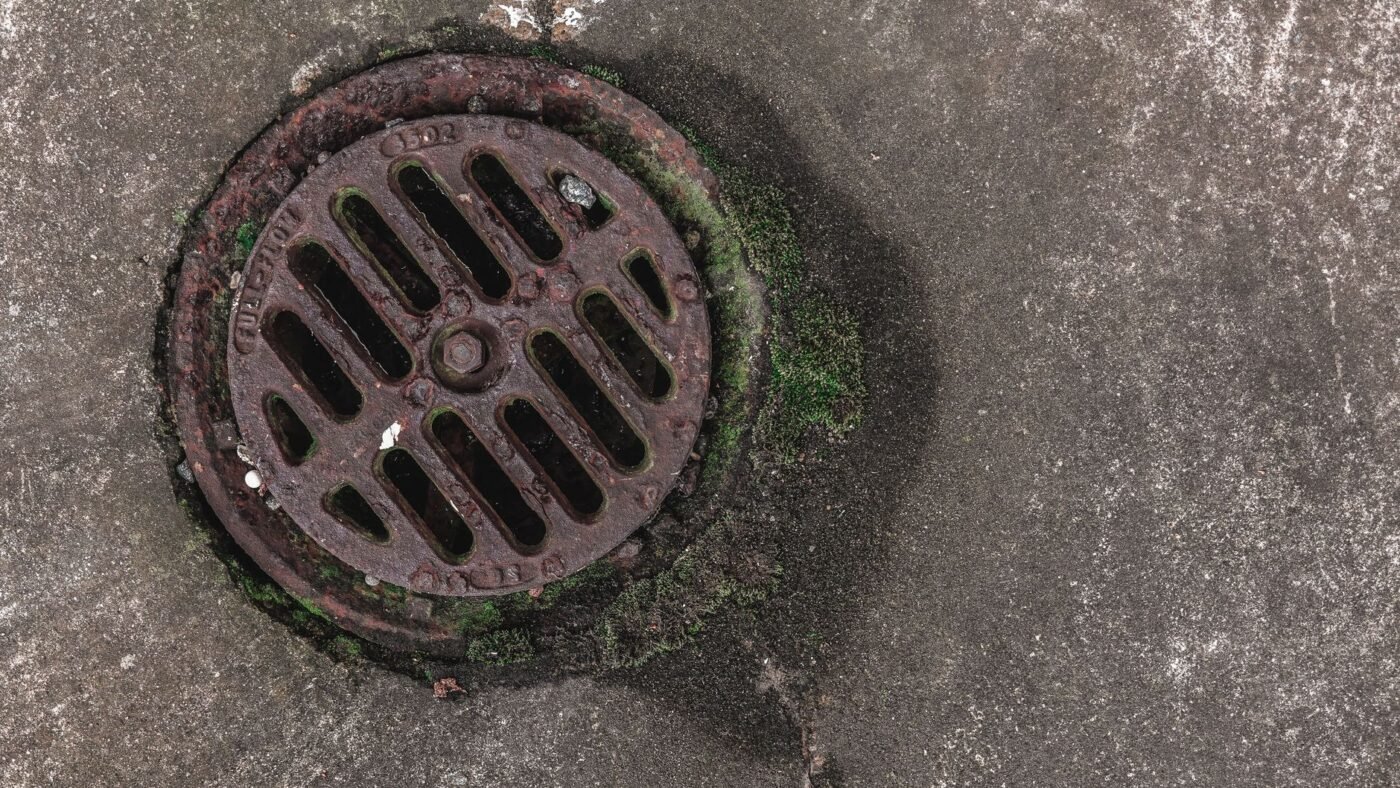
A catch basin patio drain is a boxed inlet with a grate, set at the lowest point of the patio, that collects surface water in a sump and sends it out through a buried pipe. It suits courtyards and patios enclosed by walls, where the surface cannot simply shed water off an edge. To work it needs three things: a surface that slopes toward it, a grate set just below the pavers, and an outlet pipe that falls to somewhere lower. Without that last part it is a bucket in the ground.
Most of what you will read about catch basins is about lawns. A patio changes two details, the grate height and the surface slope, and I flag both below.
When a catch basin is the right drain for a patio
A catch basin collects at one point. Vodaland's patio guide describes it as placed at the lowest point of the patio to collect pooled water and feed it into the underground system (Vodaland). A channel drain collects along a line. So:
- Catch basin: a courtyard (see courtyard pavers) or small patio where everything can be warped toward one low point.
- Channel drain: a long edge, such as a house wall or a garage threshold.
That split matches the existing paver drain guide, which covers the channel and grate details. If slope, grading or a downspout extension can do the job, start with patio drainage, because the cheapest drain is the one you did not buy. And if you are not yet sure where the water comes from, see paver patio flooding.
Size and depth: what the guides agree on
The NDS installation guide lists basins in 6, 9, 12 and 18 inch sizes and suggests 12 inches for most residential uses (NDS). Typical basin depth is 18 to 24 inches. For a single patio I would not go bigger than the 12-inch unless the roof runoff also feeds it; a 9-inch is common on small patios. NDS suggests considering extra basins for drainage areas over 2,500 square feet, which is a lawn number rather than a patio one, but it shows where the scale tips.
Use a square grate if you can. A soldier course of pavers wraps a square frame cleanly, where a round one forces curved cuts. The paver-drain guide has the cutting methods.
A catch basin patio build, step by step

The steps blend the NDS and Vodaland guides with the paver details this site already uses.
- Choose the outlet first, and call 811. The pipe must fall to a point lower than the basin: daylight, a dry well or an approved storm connection. NDS also flags permits.
- Warp the base toward the basin. Shape the compacted base so every side falls to the low point, then screed the sand to follow. The sand follows the slope; it never creates it.
- Dig the basin hole. NDS says about 6 inches wider than the basin on each side, deep enough for the basin plus 2 to 4 inches of 3/4-inch crushed stone beneath it. Vodaland goes 6 to 12 inches deeper and uses a gravel pad of 6 to 12 inches. Those differ, and both are for lawn use, so on a patio match the pad to your compacted base.
- Set the basin level on the pad, with the grate where the pavers will finish.
- Connect 4-inch pipe, which NDS calls the standard residential size, in a trench with 12 to 18 inches of cover and a minimum 1% fall (1 inch per 8 feet).
- Backfill, then lay the pavers around the grate and compact carefully. Test with a hose before sealing anything.
NDS itself gives the 1% two ways in different sections, one inch per 100 feet and one inch per 8 feet. One inch per 8 feet is correct, since 1% is about one inch per 8.3 feet. I flag it because the 100-foot version is easy to copy and would leave you with a nearly flat pipe.
Grate height: lawn rule versus paver rule
NDS sets the grate about 1/4 to 1/2 inch above the surrounding grade to keep debris out. That is for lawns. On a patio, the paver surface runs the other way: the finished pavers sit 1/8 to 1/4 inch above the grate, after compaction, so water runs into the grate. Follow the paver rule. A grate that stands proud of a paver surface is a dam with slots in it.
Sump, weep holes and the outlet pipe
The bottom of a catch basin collects sediment and debris. NDS calls this the sump and says to clear it during seasonal maintenance. Keep the outlet above the sump floor so silt settles instead of washing down the pipe.
Vodaland's how-to says to drill weep holes in the base of the basin. I would not on a patio unless the soil under it drains well. Water leaking into clay beside the base is exactly what you are trying to avoid, and the outlet pipe is there to carry the water away. That is my reasoning, not a cited rule, and the two guides do not agree with each other.
Where the pipe should end
The outlet decides whether the basin works, so it deserves as much thought as the grate. Vodaland's patio guide lists the destinations: a dry well that stores heavy stormwater underground and lets it disperse slowly, with discharge at least several meters from the house, or a lower part of the yard. A dry well needs soil that absorbs water, so on heavy clay it fills and stays full. Vodaland also notes that clay soil absorbs water poorly in general, which pushes more runoff onto the patio in the first place.
If the lot has no lower ground and the soil will not take a dry well, a storm connection may be the only option, and that usually needs a permit. NDS flags code compliance and permits in its planning section. Ask your local building or public works department before you trench.
Do not point the pipe back toward the house. The IRC wants impervious surfaces within 10 feet of the foundation to fall at least 2% away from the building, and a basin that dumps beside the wall defeats the point (the IRC is a model code, so check your local adoption). If your patio is near the wall, see pavers around house foundation for clearances.
Roof water and a catch basin
Vodaland suggests routing downspouts into a catch basin or a trench drain, either by extenders or by buried pipe. That works if the basin and the outlet pipe are sized for the extra load. A roof sends water in bursts: my own arithmetic says an inch of rain on 1,000 square feet of roof is roughly 620 gallons, delivered in a short time. A flat or undersized pipe will back up and turn the patio into the overflow. When in doubt, keep downspouts out of the patio basin and give them their own pipe.
Keeping it from clogging
NDS recommends a monthly visual check, a deep clean at least twice a year (spring and fall), a pipe check annually, and a professional cleaning every few years. Vodaland's advice is similar: clean the grate and the debris basket and check for standing water. Patios under trees need it more often.
A flooded basin after a storm usually means the sump is full or the outlet is blocked, so lift the grate and scoop before assuming something bigger has failed. NDS puts materials for a basic installation at roughly $200 to $500; it is a vendor figure, so treat it as a ballpark.
Fix the fall first, buy the grate second
The basin is the cheap, visible part. The warped surface, the grate height and the pipe fall are what make it work. Get those right and it will quietly empty after every storm without anyone thinking about it, which is the highest compliment a drain can earn. (It is also the only structure in your yard that gets better the less often you look at it.)
FAQ
What is a catch basin on a patio?
A boxed drain inlet with a grate, placed at the lowest point of the patio. It collects surface water in a sump and sends it through a buried pipe to an outlet.
How deep should a catch basin be?
NDS says typical basin depth is 18 to 24 inches, with the hole dug about 6 inches wider than the basin on each side and 2 to 4 inches of crushed stone below it.
How much slope does the drain pipe need?
At least 1%, which is about 1 inch of fall per 8 feet. NDS gives the figure both correctly and as one inch per 100 feet in different places, so use the 8 feet version.
Catch basin or channel drain for a patio?
Use a catch basin where the patio can be shaped toward one low point, such as a courtyard. Use a channel drain along a line, such as a house wall or a threshold.
How often should I clean a patio catch basin?
NDS recommends monthly visual checks and at least two deep cleans a year, in spring and fall. Under trees, check more often after leaf drop.


