

Last Updated on October 20, 2026 by Umar Farooq
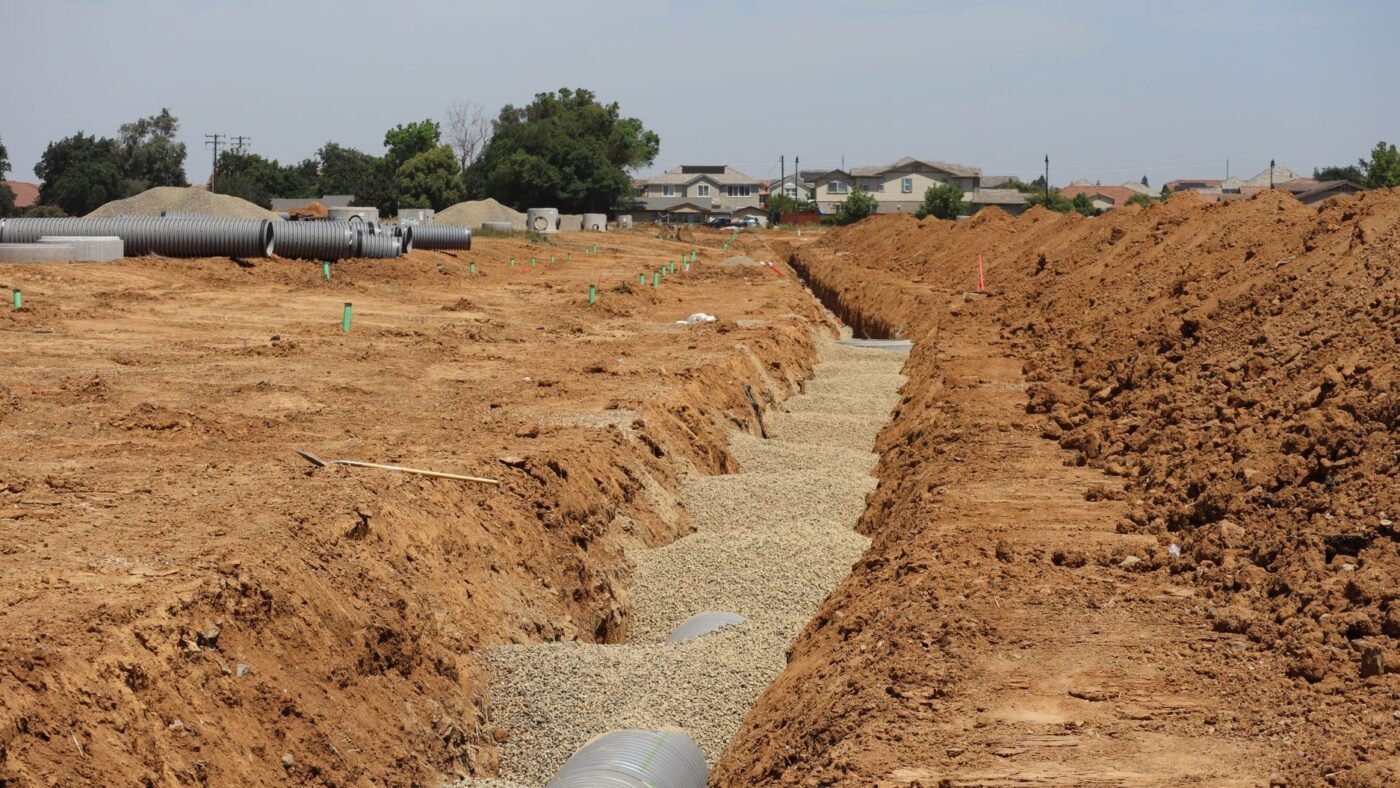
A French drain around patio edges is a gravel-filled trench with perforated pipe that catches water moving through the soil and carries it to an outlet. It does not drain the patio surface, so it only helps when the problem is wet ground beside or under the patio, and it belongs on the uphill side where the water arrives. Dig it outside the paver base and edge restraint, wrap it in non-woven fabric, lay 4-inch pipe with the holes facing down, and give it a fall of about 1 inch per 8 feet to somewhere the water can leave.
Only two how-to pages loaded for me, so the numbers below come from those two guides. Where they disagree, I say so.
Do you actually need a French drain around your patio?
Probably not, at first. If water sits on top of the pavers, the cause is slope, a downspout or a low spot, and no pipe in the soil will fix it. Paver patio flooding walks through the hose test that separates those from ground water. The cheaper fixes also come first in patio drainage: slope, grading, downspout extension.
A French drain earns its place when:
- the ground beside the patio stays soft or soggy after rain,
- water seeps in from a slope above the patio and runs through the soil under it,
- or you have already fixed the surface and still see wet bases and sunken edges.
It is also a tool people reach for too early. A French drain carries water in the ground, not sheets of water across a surface. That is the same distinction the existing paver drain guide makes between channel drains and French drains.
Where the trench goes: uphill, outside the base

Water follows gravity, so the drain goes on the side water comes from. For most patios that is the uphill edge, and sometimes a second run along one side where a slope funnels water. I did not find any source that calls for a full ring around a patio, and a ring needs an outlet at its lowest corner anyway. The guides I read place the drain where water collects and run it to a lower point.
Two placement rules matter more than the rest:
- Stay outside the base. Dig beyond the paver base and edge restraint. Backfill in a trench never compacts as well as the base beside it, so a drain under the patio edge invites a dip above it.
- Keep away from roots. Hunker warns that tree roots and woody shrubs can grow into the pipe. If a tree is close, read pavers around a tree first.
Call 811 before you dig. It is free, and a drain trench alongside a patio is exactly where house service lines run.
Trench, fabric, stone and pipe: the numbers
Both guides agree on most things and disagree on depth.
| Part | Lawnlove | Hunker |
|---|---|---|
| Trench width | 9 to 12 in | at least 12 in |
| Trench depth | at least 18 in | about 8 to 12 in at the high end, deeper at the low end |
| Fall | 1% (1 in per 8 ft) | at least 1 in per 8 ft |
| Pipe | 4 in perforated, holes down | 3 or 4 in perforated, holes down |
| Fabric | 4 to 6 oz non-woven, 10 to 12 in overhang | filter fabric, 12 in beyond the trench edges |
| Stone | washed 3/4 to 1.5 in (such as No. 57) | angular drain rock, 2 to 3 in below and above the pipe |
The depth difference is real. Hunker builds up from the pipe and stone you need; Lawnlove starts at 18 inches and slopes from there. A longer run on flat ground needs more depth at the low end whichever number you use, since the fall has to come from somewhere. Hunker puts the extra at more than 12 inches over a 100-foot run on flat ground. Pick the deeper figure when in doubt, and match it to your outlet.
Use non-woven fabric, not woven. Landscape fabric for paver patio explains why the two types behave differently. Both guides tell you to avoid pea gravel and unwashed stone, which clog the fabric.
Seven steps, in the order that avoids rework
- Choose the outlet first. The exit must sit lower than the start.
- Mark the route and the depth. Lawnlove suggests marking target depths every 4 feet so the fall stays steady.
- Dig the trench to the width and depth above, with the bottom falling toward the outlet.
- Line it with fabric, leaving enough to fold over the top.
- Lay a few inches of washed stone on the fabric.
- Set the pipe, perforations down, and use solid pipe for the run out to the outlet. Plug the highest end.
- Cover the pipe with stone, fold the fabric over it, and finish with a little soil or sod.
Where the water ends up
Both guides rank the same options: daylight at a lower part of the yard (with a pest-blocking grate on the pipe end), a pop-up emitter, a rain garden, or a dry well. Both say never to discharge onto a neighbor's property or a public sidewalk. A dry well only works where the soil absorbs water, so it is a poor choice on heavy clay.
One site-specific rule: do not tie a roof downspout into the perforated drain pipe. Downspouts go in solid pipe past the patio, as the drainage guide above says. Otherwise the roof's whole load leaks back into the soil you are trying to dry.
Mistakes that turn a French drain into a ditch
From the two guides, and the ones that matter for a patio:
- Pipe holes facing up. They belong down.
- Skipping the fabric or using woven fabric. Fines clog the stone.
- No fall. A flat French drain is a long, narrow pond.
- Cutting major tree roots to get the trench in.
- Routing it onto a neighbor's lot.
- Treating a leak as a drainage problem. Lawnlove notes a soggy yard with no recent rain may be a broken pipe.
On cost, Lawnlove puts materials for a 25-foot DIY drain at about $528 and professional installation at $10 to $75 per linear foot. That is one source's figure, so treat it as a ballpark.
Dig it where the water is, not where it is tidy
A French drain is a precise tool for one problem: water in the ground. Confirm that is your problem, put the trench on the uphill side outside the base, give it a fall and an outlet, and stop there. The rest of the patio's drainage is still slope. Digging a trench gives you a very satisfying hole in the yard, which is probably the main reason people overdo it.
FAQ
Where should a French drain go around a patio?
On the uphill side, outside the paver base and edge restraint, where water arrives through the soil. Run it to a lower outlet. A full ring around the patio is not something the guides I read call for.
How deep should a French drain be next to a patio?
Sources differ. Lawnlove says at least 18 inches deep and 9 to 12 inches wide; Hunker builds about 8 to 12 inches at the high end and deeper where the fall demands it. Either way the trench needs about 1 inch of fall per 8 feet.
Can a French drain go under pavers?
It is better outside the base. Trench backfill does not compact as well as the base around it, so the pavers above can dip.
Do I need landscape fabric in a French drain?
Yes. Non-woven fabric keeps soil out of the stone and pipe. Skipping it or using woven fabric is one of the common mistakes both guides list.
Where does the water from a French drain go?
To daylight, a pop-up emitter, a rain garden or a dry well, never onto a neighbor's yard or a public sidewalk. The outlet must be lower than the start of the drain.


