

Last Updated on October 20, 2026 by Umar Farooq
A heated paver driveway melts snow from underneath, using electric heating cable, a hydronic loop of warm glycol-and-water tubing, or portable mats, so you do not shovel and do not spread salt. It works, and it is expensive. Bob Vila's cost guide puts finished heated paver driveways at $19 to $50 per square foot, the highest of the three materials it compares, with the heating system itself running $3,200 to $5,800 for electric and $4,200 to $8,700 for hydronic, before excavation.
This guide covers how the systems differ, what the heating layer looks like under the pavers, what the sources say about cost and running expense, and the cheaper options to weigh first. If the idea is still in the "what is this" stage, start with paver driveway basics and come back.
How a heated paver driveway works: electric, hydronic and mats
There are three ways to put heat under pavers, and Unilock's heated driveway page describes all of them:
- Electric. Heating cables sit on the bedding layer beneath the pavers and switch on when the surface temperature drops. Large installations may need a separate or upgraded power supply.
- Hydronic. Flexible plastic tubing carries a water-and-antifreeze mix from a boiler, usually in the garage. It costs more up front and uses less energy to run, and it can burn propane, oil or natural gas.
- Portable mats. These plug into an outlet and go down in pairs for tires or a walkway. They cannot cover a full driveway, must be positioned before each snowfall, and the cords do the curb appeal no favors.
The ICPI's technical write-up on snow-melting systems under interlocking pavers frames the electric-versus-hydronic trade the same way. Electric has the lower installation cost and the higher operating cost, because it draws current continuously while on. Hydronic costs more to install and maintain, but less to run, because the fluid is reheated and recirculated.
Where the heating layer sits under the pavers
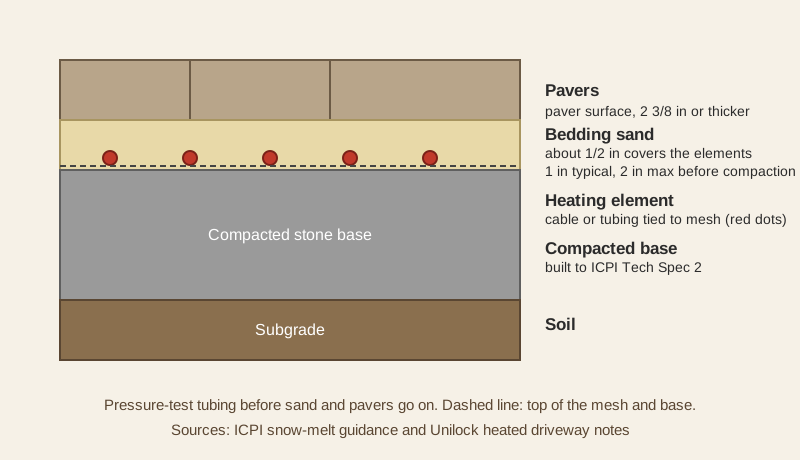
The heating element lives just under the pavers, inside the bedding layer, so heat does not have to travel through a thick base. The ICPI's layout guidance for residential and pedestrian areas runs like this:
- Compact the base as for any paver job (see how much paver base do I need).
- Lay galvanized wire mesh over the base and stake it down.
- Attach the heating cable or tubing to the mesh with plastic zip ties.
- Pressure-test hydronic tubing for leaks before any sand or pavers go on.
- Cover the elements with 1/2 inch of sand. Bedding sand is normally 1 inch, and the ICPI says it can reach a maximum of 2 inches before compaction, depending on the wire or tube diameter.
The ICPI also describes an alternative: set the wires or tubing in the top inch of the base with no mesh, compacting around them so they sit flush, which makes screeding easier.
Unilock gives a tighter limit than the ICPI's 2 inches. Its winter care page says cables or tubing go in the sand bedding directly under the pavers, in no more than 1.5 inches of sand. Both numbers are conservative versions of the same idea: keep the bedding thin. A thick sand bed over a heating layer is how a surface settles unevenly.
The vehicle question
A driveway carries cars, and the ICPI draws a line here. For crosswalks and roads, it says heating elements need to be embedded in concrete or asphalt rather than sitting on the base, to prevent tire damage. For permeable pavers, it says to reduce wire or tube spacing to offset heat loss to air voids in the aggregate bedding layer, and to consult the manufacturer on durability when elements sit against bedding aggregate under tire loads.
Where a residential driveway falls between "pedestrian" and "road" is a question for the installer, not a guess. The ICPI also says it does not recommend insulation below the bedding sand in residential driveways, though that is acceptable for pedestrian-only patios and sidewalks. Ask for the system manufacturer's installation manual and the ICPI's Tech Spec 12 on snow-melting systems, and ask the installer to show how the design handles tire loads. The base is the driveway; see paver driveway installation.
Heated paver driveway cost: per square foot, system and running
Cost guides are loose with their numbers, so here are the ones from one source I opened, Bob Vila's heated driveway cost guide:
| Item | Figure |
|---|---|
| Heated driveway, concrete | $13 to $28 per sq ft |
| Heated driveway, asphalt | $12 to $27 per sq ft |
| Heated driveway, pavers | $19 to $50 per sq ft (highest) |
| Electric system | $3,200 to $5,800, before excavation |
| Hydronic system | $4,200 to $8,700, before excavation, typically 30 to 50 percent more than electric |
| Portable mats | about $1,600 on average, or $5 to $10 per sq ft |
| Automated controls | $500 to $3,500 more than manual controls |
| Running cost | $120 to $600 per winter for a 1,000 sq ft driveway |
The guide uses an average national electricity price of $0.14 per kilowatt-hour, and says the system's average life is up to 20 years. A new boiler or water heater for hydronic may cost extra, and an electric system may need a panel upgrade. Treat all of these as planning figures and get local quotes. Our own paver driveway cost page covers the unheated version, which is the baseline you are paying a premium over.
Electric or hydronic: pick by area, not by brochure
- Electric generally needs less maintenance, per the ICPI. Bob Vila says it heats quickly and runs silently, and that it stops working in a power outage.
- Hydronic has lower operating cost but higher upfront cost, and needs an indoor mechanical room (Bob Vila). Unilock's page adds that heated fluid loses temperature as it travels from the boiler, so cold spots can develop, and it recommends an annual boiler inspection before the first snowfall.
- Repairs are the unpleasant part for both. Unilock says repairs may mean tearing up sections of the driveway, and it says heated systems suit new builds better than retrofits.
The ICPI says design comes down to three things: snowfall rate, snow temperature and wind exposure. A common target is melting 1 inch of snow per hour. That may be enough for a house and not enough for a shop sidewalk. Buying a bigger system than your climate needs, or a smaller one, is a very hard mistake to reverse once the pavers are laid.
Cheaper things to try before you heat the driveway
My opinion: price the shovel first. A heated paver driveway is a $19 to $50 per square foot decision, and for a 1,000 square foot driveway that is $19,000 to $50,000 on Bob Vila's figures (paving and heating together). Against that:
- A plastic shovel and a snow blower with plastic blade covers cost a few hundred dollars. See snow removal on pavers.
- Portable mats, at about $1,600 on average, handle the tire tracks or the front walk.
- Sand and a careful amount of de-icer deal with the rest; salt on pavers covers the chemistry.
Heating makes sense where the slope is steep, where nobody can shovel, or where the budget is already set and snow is a daily fact. If you live where winter is long, the broader build advice is in pavers in cold climates.
Do the shovel math first, then decide if heat is worth it
Heated paver driveways work, last a long time on paper and take the shoveling and the salt out of winter. They also cost more than any other driveway surface, need to go in with the pavers rather than after them, and cannot be repaired without opening up the paving. Decide on the system type by area and running cost, keep the bedding sand thin, ask how the design handles tire loads, and get the system manufacturer, not just the paver installer, involved before the base is dug. If the numbers do not beat twenty winters of a plastic shovel, spend the money on a good base and a better snow blower.
FAQ
How much does a heated paver driveway cost?
Bob Vila's guide gives $19 to $50 per square foot for a heated paver driveway, including materials and installation, and $3,200 to $5,800 for an electric system or $4,200 to $8,700 for hydronic, before excavation. Local quotes will vary.
Can you add heating to an existing paver driveway?
Not easily. Unilock says heated systems suit new builds better than retrofits. Because the elements sit in the bedding layer under the pavers, adding them to a finished driveway means lifting the pavers first.
Is electric or hydronic better for a heated driveway?
Electric costs less to install and more to run. Hydronic costs more to install and less to run, and needs a boiler and an indoor space for it. The ICPI and Unilock describe both trade-offs.
How much does it cost to run a heated driveway?
Bob Vila estimates $120 to $600 per winter for a 1,000 square foot driveway, based on an average electricity price of $0.14 per kilowatt-hour. Actual cost depends on area, climate and controls.
Can you use portable heated mats on pavers?
Yes, though Unilock says they cannot cover a full driveway and must be put down before snowfall. They suit tire tracks or a walkway.


