

Last Updated on October 20, 2026 by Umar Farooq
How to clean sealed pavers comes down to one rule: be gentler than you would on bare ones. Sweep them, wet them, scrub with warm water and a mild non-acidic cleaner or dish soap using a soft nylon brush, then rinse with a hose and let them dry. Skip acids, wire brushes and a pressure washer on full power, because the sealer is the thing you are trying to keep. Sealed pavers are easier to clean than bare ones, which is the whole point of sealing them, and the quickest way to lose that advantage is to scrub as if they were not.
Check the seal is still there before you pick a cleaner
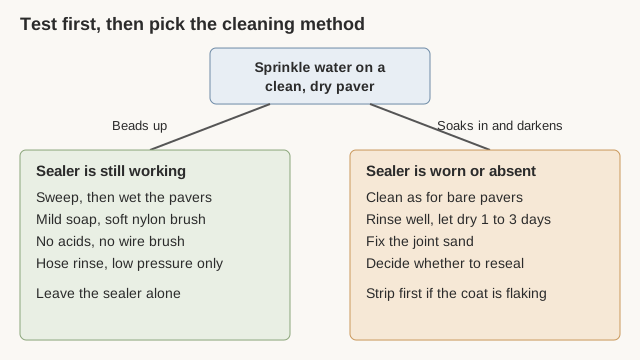
Sprinkle a few drops of water on a clean paver in a spot that sees traffic. North Valley Stone Supply's version: if water beads up and sits, the seal is working, and if it soaks in within a minute and darkens the stone, the protection is gone (North Valley). The same test appears in paver sealing and how often pavers should be sealed, where it decides when to reseal.
Two more things matter. First, the sealer type. A film-forming sealer sits on the surface and can be scratched or dulled, while a penetrating sealer soaks in and leaves no film. I could not find a single manufacturer guide that gives different cleaning rules for each, so the gentle routine below is the safe default for both. Second, some pavers come factory-sealed: Unilock says its EasyClean pavers carry a proprietary sealant that makes spills easier to clean up (Unilock). Check your product page before assuming.
How to clean sealed pavers: the mild routine
Start with what the sealer will not mind.
- Sweep off leaves and grit with a soft broom. Pull weeds from the joints.
- Wet the pavers with a hose so the cleaner stays on the surface. North Valley's guide says to rinse thoroughly afterwards, and wetting first is standard in the cleaning guides I opened.
- Mix the cleaner. A DIY mix of warm water and a mild degreasing dish soap works. Peacock Pavers also names non-acidic, light-duty concrete cleaners.
- Scrub with a soft or stiff nylon brush, or a push broom on a big patio. Work in sections so nothing dries on the surface.
- Rinse with a hose and nozzle, and avoid dislodging the joint sand.
Let it dry fully before you judge the result. A paver can look dry on top and hold water below, so give it a day in good weather.
Acids, wire brushes and pressure: the three ways to harm a sealer
- Acids. Peacock Pavers says plainly: "Do not use acid-based cleaners as this can damage the seal." That includes vinegar. I cover the details in cleaning pavers with vinegar, which comes down to: not on sealed surfaces.
- Wire brushes and scouring pads. They scratch pavers and can damage sealants. Unilock adds that wire bristles can leave metal particles that rust.
- Bleach. Peacock warns it can discolour coloured or stained pavers. If you must use it, test first and keep the mix weak.
What the sources say about pressure washing sealed pavers
They disagree, and I would rather show you than pick a number at random.
| Source | What it says |
|---|---|
| Peacock Pavers | Avoid a pressure washer entirely; it can damage the seal |
| Clean My Pavers | 1,000 to 1,500 PSI, a fan tip, wand at least 12 inches away, keep it moving; older or unsealed pavers may be damaged |
| North Valley Stone Supply | Avoid high pressure; if you use any, low pressure, wide fan tip, never aim into a joint |
| Unilock | Spray at no more than a 30-degree angle and use a low setting to avoid washing out joint material |
My opinion: leave the pressure washer in the shed. A garden hose and a brush do this job, and North Valley's warning that a concentrated stream strips joint sand in seconds is the cost you actually pay. If a stain needs more than a brush, treat the stain. Power washing pavers has the gentlest settings, and then you re-sand.
Stains on a sealed surface: act while they sit on top
A sealer buys you time. Sealed pavers are meant to hold a spill on the surface for a while, so blot it, wash it with soap and water and do it the same day. For stains that are not spills, paver stain remover shows how to match the cleaner to the stain, and the same logic applies: mildest product first, one test paver, and no acids on a sealed surface unless the label says so. Acid-based rust removers are the usual exception; see the rust stain guide for why you should expect to touch up the sealer there.
After cleaning, the sealer tells you what is next
Cleaning is the best moment to test the seal. If the water test now shows the coat is gone, plan a reseal, not a stronger cleaner. Reseal only when water stops beading, not on a calendar. If the sealer is flaking or cloudy, strip it first, which is covered in paver sealer stripper. If white haze appears after sealing, that is a different problem, described in white haze after sealing.
Check the joints too. A scrub and a rinse can lower the sand, and joint sand should not be left low. If it needs topping up before the next coat, re-applying polymeric sand is the next job.
Soap, a nylon brush and a hose are enough
To clean sealed pavers, treat the sealer as part of the paver. Test with water, sweep, wet, scrub with soap and nylon, rinse and let it dry. Leave acids, wire brushes and pressure for bare pavers. A clean patio and an intact sealer is a better outcome than a very clean patio and a bill from the stripper.
FAQ
How do you clean sealed pavers?
Sweep, wet the pavers, scrub with warm water and mild dish soap or a non-acidic cleaner using a soft nylon brush, then rinse with a hose and let them dry. Avoid acids and wire brushes.
Can you pressure wash sealed pavers?
Sources disagree. Peacock Pavers says avoid it, while Clean My Pavers allows 1,000 to 1,500 PSI with a fan tip held 12 inches or more away. A hose and brush is the lowest-risk option.
Does cleaning remove paver sealer?
Gentle cleaning should not, but acids, wire brushes and hard pressure can wear or damage it. Run the water test afterwards; if water no longer beads, the sealer is worn.
Can I use vinegar on sealed pavers?
It is better avoided. Vinegar is an acid, and Peacock Pavers warns that acid-based cleaners can damage the seal.
How long should pavers dry before resealing?
North Valley Stone Supply says one to three dry days depending on humidity and sun, and longer after rain. Sealing over moisture can cause a milky haze.


