
Last Updated on September 23, 2026 by Umar Farooq
Here is how to cut pavers without a saw, which is how masons managed long before anyone bolted an engine to a blade. For straight cuts on standard concrete pavers, use a paver splitter, a lever-operated guillotine that snaps the paver along a line. For a few cuts, a club hammer and a wide brick chisel work: score a groove on all four faces, then strike the line hard until it breaks. Score-and-snap is the same idea, finished over a hard edge. All three leave a rougher face than a diamond blade, and none handles curves or thin slivers well.
What hand-cut paver edges look like
A saw leaves a flat, square face. A split paver leaves a rough face that can wander 1/8 inch or so from the line. On tumbled pavers that looks deliberate. On crisp modern ones it looks like exactly what it is. Two habits help:
- Put the cut edge where no one sees it. Against the house, under a border course or beside the edge restraint, it's hidden.
- Leave a sliver of margin. Mark the line 1/8 inch proud of where the paver must end, then nibble the last bit off with the chisel if the break lands long.
If you need clean faces on a visible border, or many cuts in a hard material, use a saw instead. Our paver cutting tools comparison covers which one.
Paver splitter: the best way to cut concrete pavers without a saw
A paver splitter (also called a paver guillotine or block splitter) has a hardened blade above the paver and another below it. Pull down a long lever and the blades pinch the paver until it snaps. Larger models use a hydraulic ram for thick wall block.
How to use one:
- Mark the cut on the top and one side with a pencil or crayon.
- Set the paver flat on the bed with the mark under the top blade. Most splitters have a fence so repeat cuts match.
- Lower the blade to the line, check alignment once more, then pull the handle down in one firm stroke.
- Trim any lip on the broken face with a brick chisel.
What it does well: straight cuts across standard 2 3/8-inch concrete pavers and clay brick, fast and dust-free. Most models also make angled cuts.
Where it struggles: curves, very narrow strips (the thin piece tends to shatter), very thick driveway pavers on small models, and dense natural stone.
Rent it; don't buy it. A splitter is a heavy, single-purpose machine, and one patio perimeter is a day's work for it. After that, a bought one mostly cuts into your garage floor space. Batch every straight cut into one rental day and spend the savings on base gravel, which is where a patio actually lives or dies.
Hammer and chisel: cutting pavers by hand, one at a time
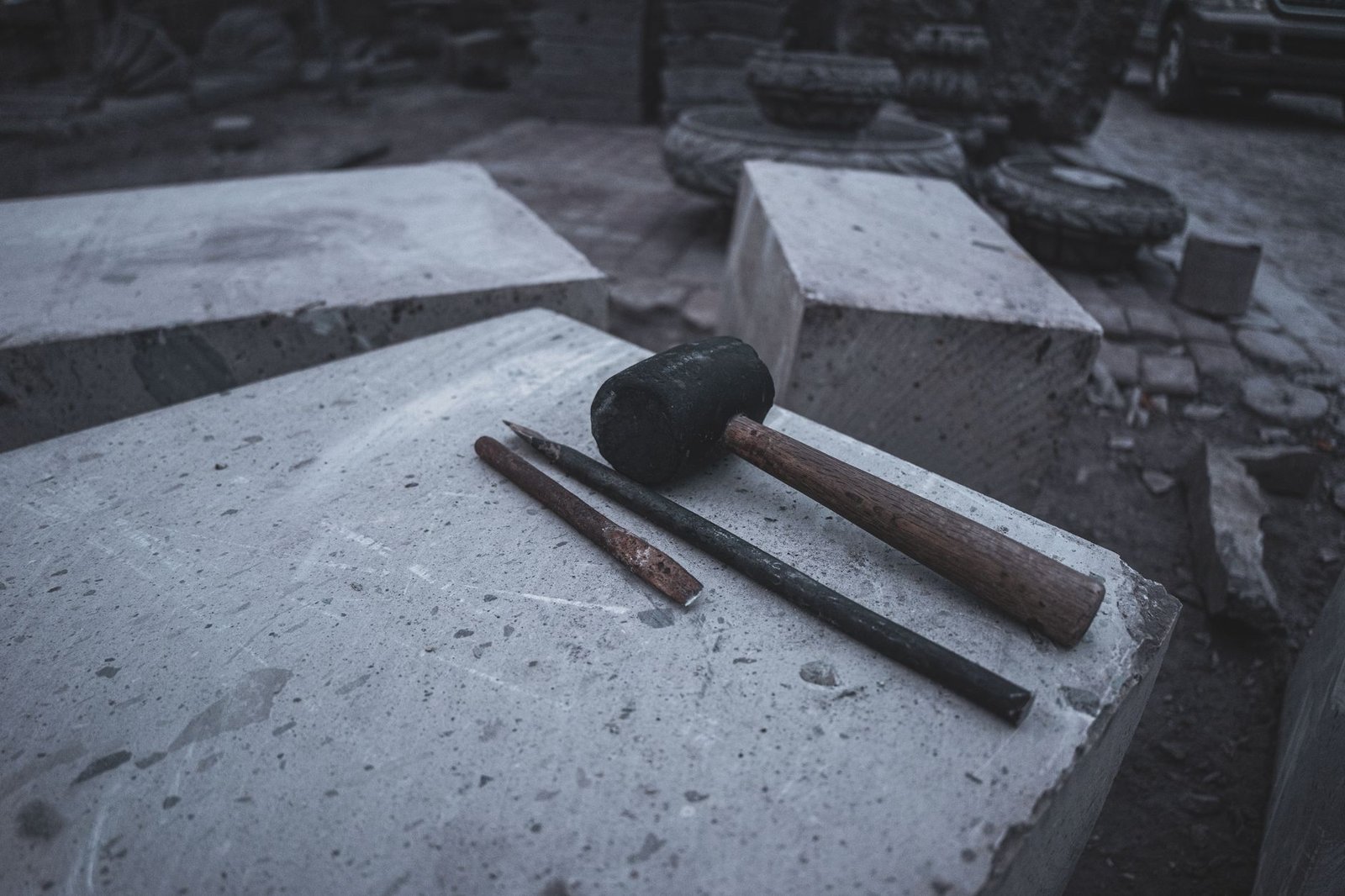
A hammer and chisel costs almost nothing. It suits a handful of cuts or a repair, but is too slow for a whole patio perimeter.
You need:
- A brick set (bolster chisel) with a wide blade, typically 3 to 4 inches, which spreads the blow along the line so the paver cracks straight. A narrow cold chisel tends to punch a hole and crack it sideways.
- A club hammer (a short-handled 2 1/2 to 4 lb sledge). A claw hammer is too light; save it for the fence.
- Safety glasses and gloves. Concrete chips fly fast. A dust mask helps too; chiseling throws some silica dust.
- A firm, slightly giving surface such as sand, lawn or plywood. A paver on hard concrete tends to crack in the wrong place.
The method:
- Mark the line all the way around the paver: top face, both sides and the bottom. Use a square so the lines meet.
- Score the top. Tap the chisel lightly along the line until you have a groove about 1/16 inch deep from edge to edge.
- Score the sides and bottom the same way. The paver now has a weak line around its whole perimeter.
- Split it. Put the paver back face-up, set the chisel in the middle of the scored line and hit it firmly. A standard concrete paver usually breaks after one to three hard blows. If it doesn't, score all four faces again before hitting harder (hitting harder first is tempting, and it is how pavers break diagonally).
- Clean up the edge by chipping off any lumps with the corner of the chisel.
I checked this against Family Handyman's paver cutting walkthrough, which reaches the same verdict: the cut works, but the edge comes out somewhat ragged.
Score-and-snap pavers over a hard edge
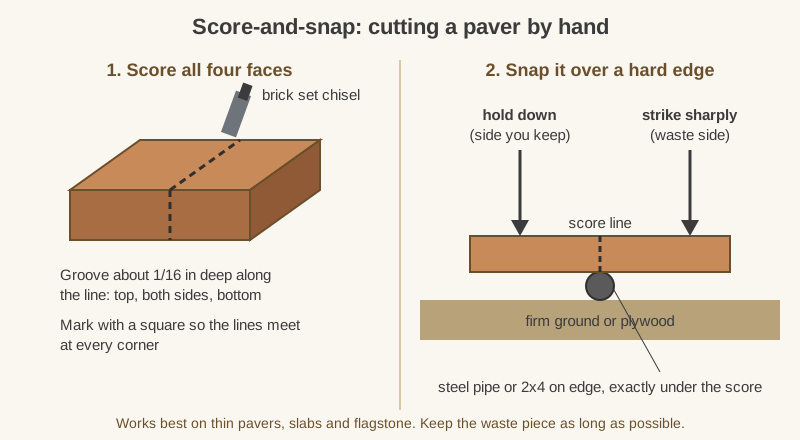
Score-and-snap is the hammer-and-chisel method with a different finish. It works best on thinner units: patio slabs, 1 1/4 to 1 1/2-inch thin pavers and some natural stone flags such as bluestone and sandstone.
- Score the line on the face with the brick set. On thin pieces, one pass along the top and a light pass underneath is often enough.
- Support the paver on a hard edge. Lay a steel pipe, a 2×4 on edge, or a step edge exactly under the scored line.
- Snap it. Hold down the side you're keeping with a knee or gloved hand, then strike the overhanging side sharply, or press down with your weight. The paver breaks along the score.
With the score over a pivot, the break follows the groove instead of wandering. Keep the waste side as long as possible. Snapping a 1-inch strip off a slab rarely works; snapping a slab in half usually does.
Which pavers split cleanly and which won't
Hand methods depend on the material cracking predictably. Some cooperate. Some have opinions.
| Material | Splitter | Hammer and chisel | Score-and-snap |
|---|---|---|---|
| Standard concrete paver, 2 3/8 in | Very good | Good | Fair |
| Concrete driveway paver, 3 1/8 in | Good on a large splitter | Slow, often breaks unevenly | Poor |
| Clay brick paver | Very good | Good | Fair |
| Thin paver or patio slab, 1–1 1/2 in | Good | Fair | Very good |
| Bluestone, sandstone flags | Fair | Good | Good |
| Granite setts, hard stone | Fair on a hydraulic splitter | Slow | Poor |
| Porcelain pavers | Not recommended | Not recommended | Not recommended; use a wet saw |
| Permeable pavers with spacer nubs | Good | Fair | Poor |
Porcelain is the one material to rule out. It shatters when struck and needs a wet saw with a porcelain blade.
Limits no hand method gets around
- Curves. A splitter or chisel breaks along a straight line. You can rough out a gentle curve with short straight splits, but the result is lumpy. Our guide to cutting pavers for curves covers the saw method and patterns that avoid curved cuts altogether.
- Small pieces. A piece under roughly one-third of a paver's length is fragile when split, and it tends to work loose in service anyway. Shift the layout so the last course is at least a half paver wide. Or cut two pavers to share the gap.
- Notches and L-cuts. Two cuts meeting at a corner, around a downspout or post. By hand, the second blow often cracks the piece; use a grinder or saw.
- Volume. A patio with a curved or angled edge can need dozens of cuts. Chiseling that many is a long day with variable results. Rent a splitter or a saw.
If the job runs past those limits, rent a saw for a day. The step-by-step cutting procedure, including marking cuts in place and dust control, is in our how to cut pavers guide.
Why learn how to cut pavers without a saw?
Dry-cutting concrete with a saw throws a cloud of silica dust; a splitter makes almost none. That matters more than it sounds. Respirable crystalline silica scars the lungs, and the scarring doesn't reverse. I read CDC's MMWR report on it: silicosis was an underlying or contributing cause of 1,437 US deaths from 2001 to 2010, and 28 of them were people aged 15 to 44, the youngest 19 (MMWR, 2015). That is occupational data, from people exposed for years. A one-weekend patio is a far smaller exposure, and I won't pretend otherwise. But the mechanism is the same, and a splitter removes it. It is also nearly silent, a chisel costs little, and a split face suits tumbled pavers better than a crisp sawn edge. Devour Tools' guide to cutting without a wet saw states the trade-off plainly: the chisel works but is imprecise and labor-intensive, and a wet saw gives the cleanest cut.
Split straight cuts, saw the rest
If you want to cut pavers without a saw, use a splitter for straight cuts across standard concrete and clay pavers. Keep a brick set and club hammer for trims and repairs, and use score-and-snap on thin slabs and flagstone. Hide the split faces against walls and restraints, keep every piece at least a third of a paver, and don't try it on porcelain. When the plan calls for curves or dozens of cuts on a visible edge, rent the saw for that part. Otherwise, mark it, score it, and hit it like you mean it. Just not before you've scored all four sides.
FAQ
Can you cut pavers with a hammer and chisel?
Yes. Score a groove about 1/16 inch deep along a marked line on all four faces with a wide brick chisel. Then strike the center of the line firmly with a club hammer. It works well on standard concrete and clay pavers, but the edge comes out rough and a few pavers will break in the wrong place.
What is the easiest way to cut concrete pavers without a saw?
A paver splitter. Line the mark up under the blade, pull the lever, and the paver snaps with almost no dust. Rental stores and some paver suppliers keep them, and it's the fastest hand method for more than a few cuts.
How do you cut a paver in half without a saw?
Mark the center line on every face, score it with a brick chisel, then support the paver on a pipe or a 2×4 directly under the line. Strike the overhanging half sharply. Halving a paver is the easiest hand cut because both pieces are large.
Can you cut pavers with an angle grinder instead of a saw?
Yes. An angle grinder with a diamond blade cuts pavers, including curves and notches. It is still a power saw in practice, though: dry grinding makes a lot of silica dust and needs a respirator, eye protection and a firmly held paver.