Last Updated on September 23, 2026 by Umar Farooq
Here's how to cut pavers the way installers do, which is mostly about not cutting them until the very end. Lay the whole field with full pavers first, letting them run past the finished edge. Snap a chalk line where the edge should be, then cut along it with a diamond-blade saw, wet, to keep dust down. Cut through in one pass if the saw is deep enough; if not, cut from the top, flip the paver and cut from the bottom. At the edge, no cut piece should be smaller than a third of a whole paver. Install the edge restraint after the cuts and before you compact.
I compared the installation guides and a trade-magazine piece for this, and the cutting advice barely differed. This guide covers the cutting procedure itself. For choosing between a cut off saw, wet saw, grinder or splitter, see our comparison of paver cutting tools.
Lay the field whole, then cut the edges
The biggest time-saver is the least intuitive: don't cut as you go. Lay full pavers across the whole area from a straight starting line such as the house wall, and let them overhang the planned edge like a patio that forgot where to stop. Then mark and cut every edge at once.
This works for three reasons:
- The pattern stays true. Cutting as you reach the edge tends to creep the joints out of line.
- The cuts come out straight. One continuous line gives a cleaner edge than dozens of individually measured pieces.
- You rent the saw once. All the cutting, dust and slurry happen in one session.
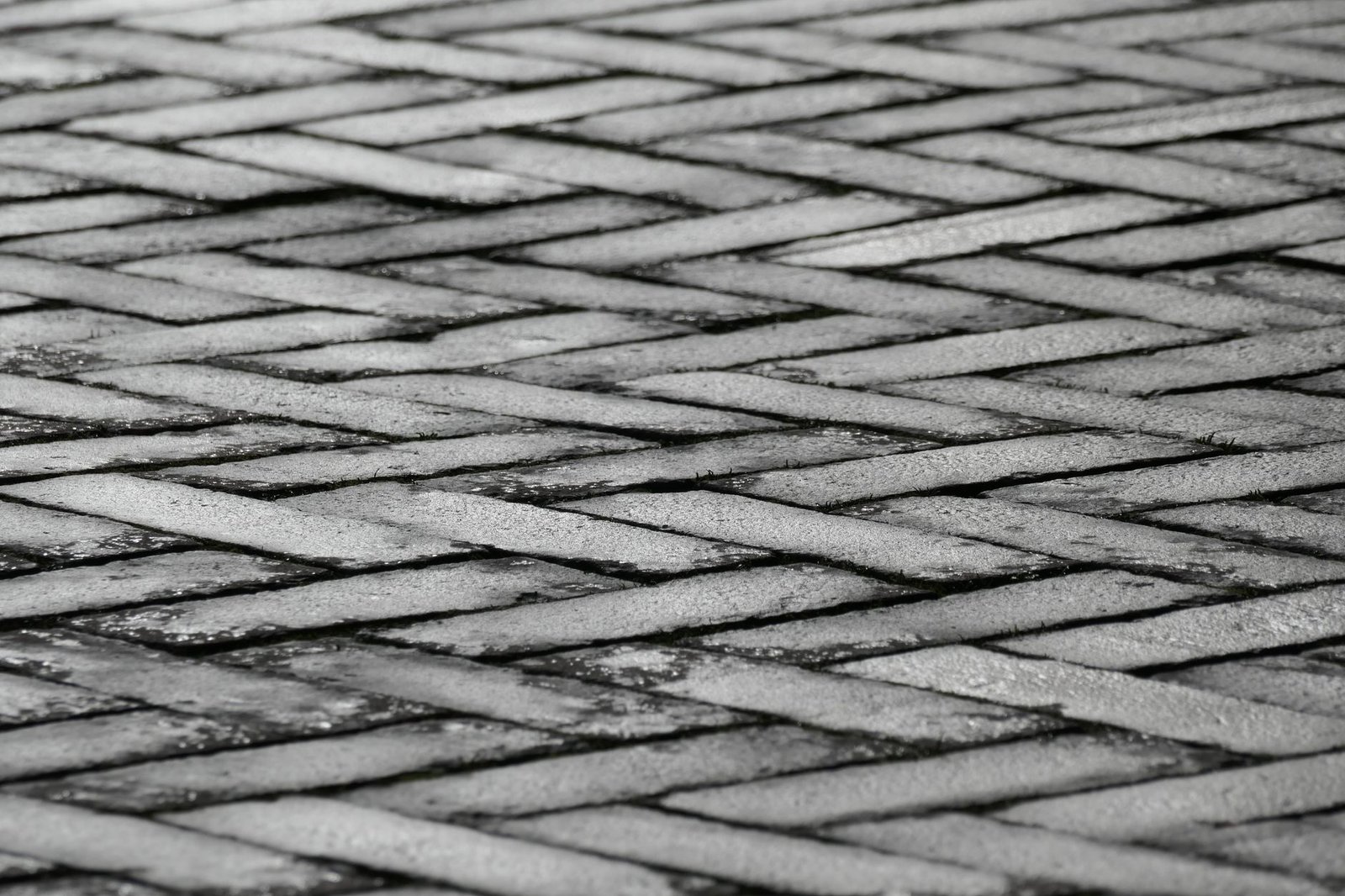
Herringbone, especially at 45 degrees, needs a cut on almost every edge paver. Running bond and stack bond on a straight edge may need very few. Choose the pattern with that in mind before you order (the herringbone photos online rarely show the pile of offcuts).
Marking cut lines you can trust
On a straight edge, snap a chalk line across the overhanging pavers where the finished edge (and the edge restraint) will sit. Measure it off your layout strings or the house, not off the pavers, which can be slightly out of line.
A few marking habits prevent most bad cuts:
- Use a visible mark. Chalk works on dry pavers; on wet or dark ones, go over it with a lumber crayon or paint marker.
- Check the line before cutting. Sight down it and confirm it's parallel to the house, or to the string on a sloped edge.
- Use a straightedge. A straight 2×4 or aluminum screed board along the line gives the saw something to ride against.
- For single pieces, mark in position. Set the paver over the gap it has to fill, mark where it overlaps, then square the line around the paver if you'll cut from both faces.
- Allow for joints. Leave the normal joint gap between the cut piece and its neighbour. A cut that fits too tight will chip or push the pattern out.
Curved edges use the same idea, with a garden hose laid out as the line and sprayed with marking paint. Curve cutting is its own technique.
In place or at a cutting station?
Most jobs use both methods.
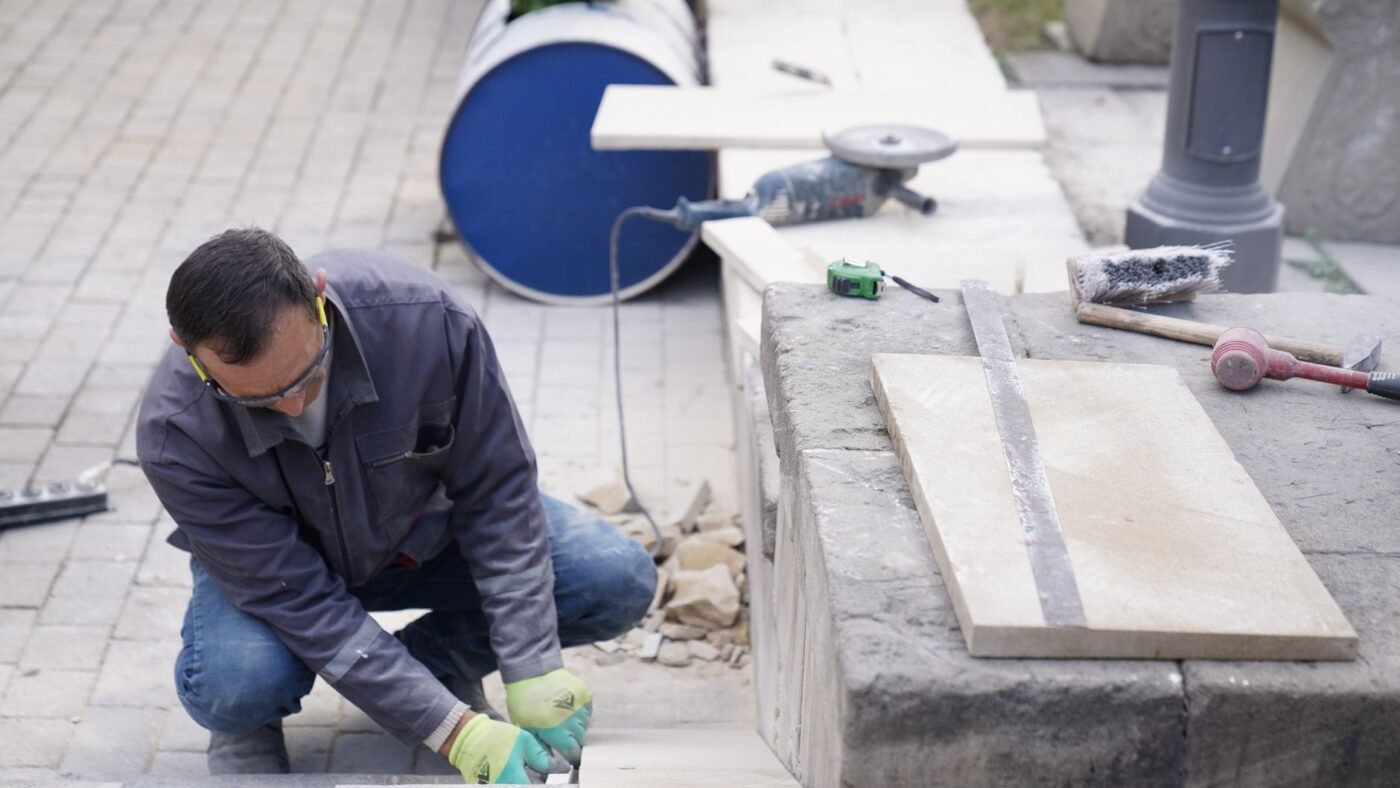
Cutting in place. You cut the pavers where they lie with a handheld cut off saw. It's the fastest way to trim a whole edge, and what most crews do. Hardscape Magazine's article on cutting pavers and block notes the trade-off: it saves labor, but the saw cuts into the bedding sand under the pavers, which dulls blades faster. It also puts slurry right on the new surface, so you have to rinse as you go.
Cutting at a station. You mark each paver, carry it to a wet tile saw, masonry saw or a firm spot on the ground, cut it, and set it back. Slower, but more precise: the better choice for porcelain, natural stone, notches, odd shapes and cuts close to walls.
If you cut on the ground, support the paver on a bed of sand, a sheet of plywood or two boards so it sits flat and the offcut can drop away. Never cut a paver resting on concrete or another paver, where it can rock and pinch the blade. The saw technique, including kickback control, is covered in our guide to the cut off saw.
Cutting concrete pavers, one clean pass at a time
The best way to cut concrete pavers is a single wet pass with a diamond blade that clears the full thickness. First, it is a masonry saw, not a general-purpose saw. I read a hand-surgery study from Brazil that followed 104 patients treated for upper-limb power-saw injuries (Sabongi et al., 2019). Kickback caused 47.1% of them. Masonry saws were involved in 55.8%, and 86.2% of those injuries came from someone using the masonry saw to cut wood. In that study, masonry saws carried 15 times the kickback risk of the other saws. So the diamond blade cuts pavers and nothing else, both hands stay on the saw, and the blade is spinning before it touches the paver. Here's the sequence:
- Gear up. Safety glasses, hearing protection, gloves and boots. Wear a respirator if you might cut dry or for a long time.
- Turn the water on and bring the saw to full speed before the blade touches the paver.
- Make a light scoring pass along the line, about 1/8 to 1/4 inch deep. The score keeps the blade from wandering.
- Cut to full depth in the scored line with steady forward pressure. Let the blade's speed do the work; don't twist or force the saw.
- Support the offcut so it doesn't drop halfway and snap the last bit of the cut off-line.
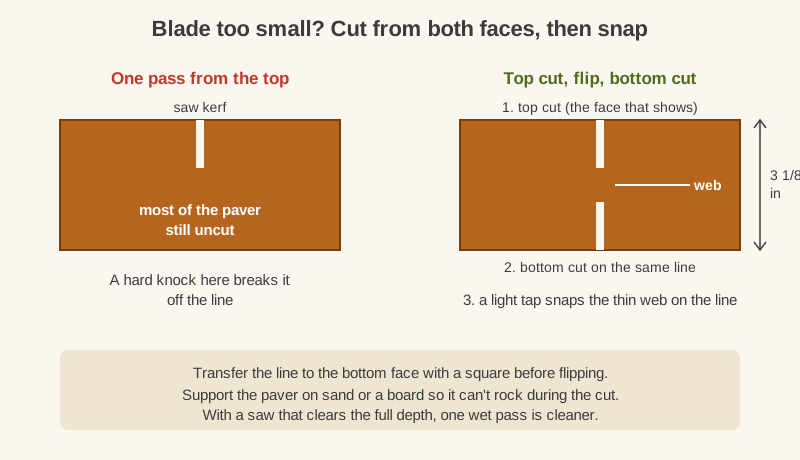
- If the blade can't reach full depth (a grinder, or a small saw on a driveway paver), cut from the top, transfer the line to the bottom, flip the paver and cut from the bottom. Then snap the thin web left in the middle with a light tap.
- Check the fit before moving on. Chip off any lip on the bottom edge with a chisel so the paver sits flat.
Benchmark Abrasives' guide to cutting pavers with a circular saw uses the same top-and-bottom technique when the blade is too small to cut through in one go.
The last row: no slivers against the edge
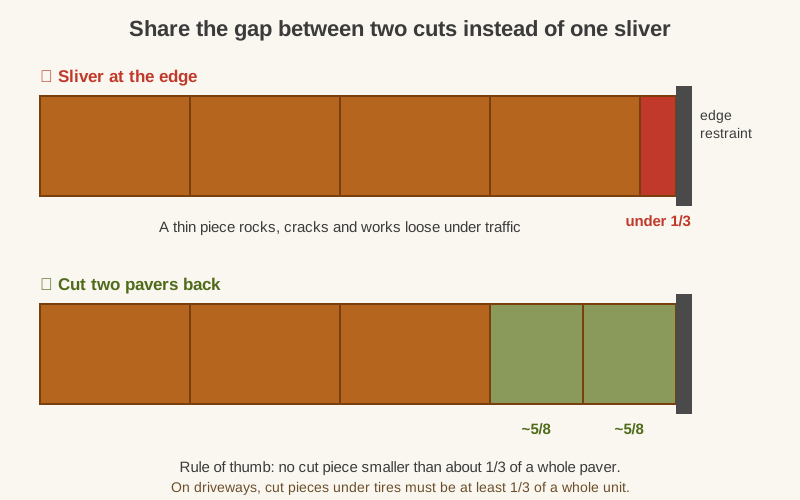
The last row is where most DIY patios go wrong. If the chalk line falls just past a full paver, the cut leaves a thin sliver. It looks bad, has almost no surface to lock with its neighbours, and tends to rock, crack and quietly leave.
The rule of thumb is that no cut piece should be smaller than about one third of a whole paver. Industry installation specs set the same one-third minimum for cut pavers exposed to vehicle tires, so on a driveway treat it as a firm limit.
When you see a sliver coming, fix it with one of these:
- Cut two pavers back. Remove the last full paver and split the combined gap between two cut pieces, each around half to two-thirds of a paver.
- Shift the pattern. On a straight edge you can sometimes slide the whole pattern half a paver sideways before compacting, so the edge lands on a better size.
- Add a border course. A soldier or sailor course of full pavers along the edge moves the cuts inward, against the border, where they're less visible and better locked in.
- Use the stronger direction. On herringbone edges, set pieces so the longest side runs along the edge wherever the pattern allows.
Once the edge is cut, install the edge restraint tight against it. Here I have no two sides to present: a freshly cut edge with nothing solid behind it is the weakest row on the patio, made of the smallest pieces. The pavers grip each other only while the field is contained, and the lawn is not a restraint. Then run the plate compactor, add joint sand and compact again. Our guide to paver installation walks through that sequence.
Stone, porcelain and driveway pavers need a different touch
How to cut stone pavers. Natural stone (bluestone, travertine, limestone, granite) chips more easily than concrete and varies in hardness piece to piece. Cut it wet on a masonry or tile saw with a blade matched to the stone, and slow the feed near the end so the far edge doesn't spall. Cut face-up on sawn stone so chipping ends up underneath.
Porcelain pavers are hard, brittle and usually thin, often around 3/4 inch. Use a wet tile saw with a continuous-rim porcelain blade, feed slowly, and support the whole slab; a segmented blade chips the glazed face.
Driveway pavers are thicker, usually 3 1/8 inches. Use a saw that clears the full depth, or cut from both faces, and respect the one-third minimum in the wheel paths.
Notches and inside corners (around posts, drains and downspouts) are grinder work. Cut both legs of the notch just to the corner from the top face, then finish from the bottom so you don't over-cut into the visible face.
Keeping slurry and dust off the new patio
Cutting creates two messes, and both leave marks.
Silica dust from dry cutting gets into lungs, windows and the neighbours' patio furniture, in roughly that order of importance. Wet cutting controls it at the source. If you must cut dry, work downwind of the house, keep people and pets away, and wear a respirator.
Slurry from wet cutting is thinned-down cement paste. Left to dry, it becomes a gray film that is far easier to prevent than remove:
- Cut off the finished surface where you can, on the lawn, the base beyond the edge, or a sheet of plywood.
- When cutting in place, rinse as you go. Hose off the slurry trail right behind the saw, before it dries.
- Clean up before the joint sand goes down. Sweep and rinse the whole surface, and let it dry. Wet slurry mixed into joint sand, especially polymeric sand, causes haze.
- Protect nearby plants, siding and windows with a tarp before you start, and rinse them after.
Cut last, cut wet and never leave a sliver
Knowing how to cut pavers well comes down to sequence and discipline, not fancy tools. Lay the field whole, snap a line you trust, and cut the edges in one session, wet. Cut thick pavers from both faces, share an awkward gap between two cuts, and keep slurry off the finished surface. Measure twice, cut once, rinse immediately. The first two are old advice; the third is the one your patio will thank you for.
FAQ
What is the best way to cut concrete pavers?
A diamond-blade saw that clears the full paver thickness, used wet: a gas cut off saw for trimming an edge in place, a masonry or wet tile saw for precise pieces. Score first, then cut to full depth in the same line.
Can you cut pavers after they are laid?
Yes, that's the normal method. Lay full pavers past the edge, snap a chalk line and cut them in place, before you compact and before you sweep in joint sand.
How small can a cut paver be?
No smaller than about one third of a whole paver. Smaller pieces rock and work loose, and industry specs set one third as the minimum under vehicle traffic. Cut two pavers back to share the gap.
Do you cut pavers before or after compacting?
Before. Cut the edges, install the edge restraint, then compact, sweep in joint sand and compact again. Cutting after compacting risks loosening the edge pieces.
How do you cut paver stones in a straight line?
Snap a chalk line, lay a straightedge along it as a guide, make a shallow scoring pass first, then cut to full depth in the scored groove at a steady pace.
How do you cut patio pavers without making a mess?
Cut wet, cut off the finished surface where possible, and rinse slurry away immediately when you cut in place. Clean and dry the whole patio before sweeping in joint sand.