


Last Updated on October 20, 2026 by Umar Farooq
How to lay out a paver patio comes down to this: mark the footprint on the ground about 6 inches wider than the pavers, run stakes and strings parallel to the house wall, square one corner with the 3-4-5 method, then measure both diagonals. When the two diagonals match, the rectangle is square and you can dig. The measurements take an hour, and an error here follows you all the way up to the last row of pavers.
Layout is not complicated. It is the one step where a quarter inch of laziness turns into a wedge-shaped gap along the house wall.
How to lay out a paver patio: pick the line you trust
Every layout hangs off one reference line. For a patio that touches the house, that is the wall. Western Interlock's advice is to get the string lines as close to the structure as possible and run them parallel to its walls (Western Interlock, base guide). For a freestanding patio, pick a straight edge you can find again, such as a fence line or a paved walk.
I could not find a source that says what to do when the house itself is out of square. All of them assume it is fine. My own suggestion, and it is only that: check one house corner with the same 3-4-5 trick below before you trust it.
Mark the footprint wider than the pavers
Spray the outline with white marking paint. Western Interlock specifically wants white, so the marks do not interfere with the utility locates, then extends the paint 6 inches on every side for the pavers and the edge restraint. Unilock gives a different rule: the base should extend past the paved edge by a distance equal to the base depth (Unilock). With a 4 inch base that is 4 inches. The sources differ, so mark the larger of the two, and read paver edging before you decide where the restraint sits.
For a 12 x 16 foot patio, 6 inches each side makes the marked area 13 x 17 feet (my arithmetic).
Square the first corner with the 3-4-5 rule
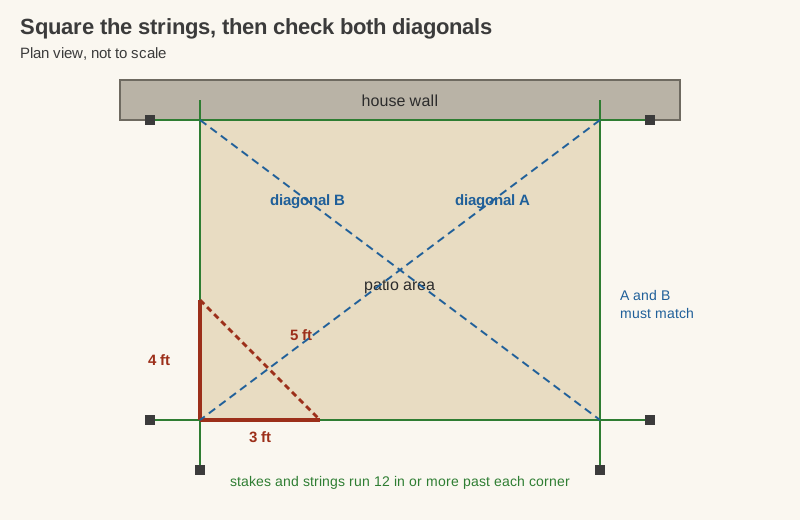
Skip this if your tape measure is already in your hand. Western Interlock breaks the 3-4-5 method into three moves:
- Run the first string along one side of the patio, with the stake at least 12 inches past the end of the side.
- Run a second string as close to perpendicular as your eye can manage, crossing the first. Where they cross is the corner.
- Measure 3 feet along the first string from the corner and mark it. Measure 4 feet along the second and mark it. The distance between the marks must be exactly 5 feet. If not, slide the second string and measure again.
Use multiples on a bigger patio, such as 6-8-10 or 9-12-15, because a longer triangle exposes smaller errors (buildrefs lists both).
Check both diagonals, not just one corner
A square corner proves only one corner. Run the strings for the other sides, then measure corner to opposite corner both ways. Buildrefs, which is written for building layout rather than patios, says the diagonals must be equal, and wants them within 1/4 inch before you go on.
A 12 x 16 patio is the 3-4-5 triangle multiplied by four, so both diagonals should read exactly 20 feet (my arithmetic). If one reads 20 feet and 1 inch, move a string and check again. Buildrefs adds a plain warning that is worth repeating: an error over 1/4 inch only gets worse downstream.
Protect the lines from your own shovel
Strings get kicked and stakes get dug out. Mark each string position on its stake or crosspiece with a permanent marker so you can restore it, and photograph the full layout before digging (both are buildrefs' tips).
Batter boards are two stakes joined by a crosspiece, set outside each corner so the strings survive digging. Buildrefs puts them 3 to 4 feet outside each corner, which is a building-foundation rule. My paver installation guide says a foot or so for patios. A patio dig is far shallower than a foundation, so either works.
You will also set the slope with these same strings later. Paver patio slope has the drop table, and how to level ground for pavers covers measuring down from them.
Walk a dry row of pavers around the edge first
Before the first spade goes in, lay a row of pavers along the two edges you will see most, without any base. You are checking how the pavers fall against the string. Cutting is where the hours go, and a patio sized to whole pavers needs fewer cuts. If the pavers land half a unit short, change the size now, when it costs a string.
Start laying from the straight edge, not the middle
The paver-installation guide's rule is to start at a straight, fixed edge, ideally the house or a right-angle corner, and work outward so you are always standing on laid pavers. The corner you squared today is the row every other row follows.
Square the strings, match the diagonals, then dig
Mark wide, square one corner with 3-4-5, make both diagonals match, then guard the strings until the pavers are down. That hour of measuring is the cheapest hour of the project.
If your diagonals disagree by more than a quarter inch, pull the stakes and try again. The strings forgive you. The pavers do not.
FAQ
How do you square a corner for a paver patio?
Use the 3-4-5 method. Measure 3 feet along one string from the corner and 4 feet along the perpendicular string. If the distance between the two marks is 5 feet, the corner is square. Adjust a string and measure again until it is.
What is the 3-4-5 rule for a patio?
It is the right-triangle ratio 3:4:5. A triangle with sides of 3, 4 and 5 feet always has a 90 degree corner. Bigger multiples such as 6-8-10 or 9-12-15 give the same angle and show errors more clearly on a larger patio.
How do I know my patio layout is square?
Measure both diagonals. In a true rectangle they are equal. Buildrefs, a construction layout reference, wants them within 1/4 inch. A 12 x 16 foot patio has diagonals of exactly 20 feet.
How much bigger than the patio should I mark the area?
Western Interlock extends the marking 6 inches on all sides for the pavers and edge restraint. Unilock says the base should extend past the paved edge by the base depth, so 4 inches for a 4 inch base. Mark the larger number.


