

Last Updated on October 20, 2026 by Umar Farooq
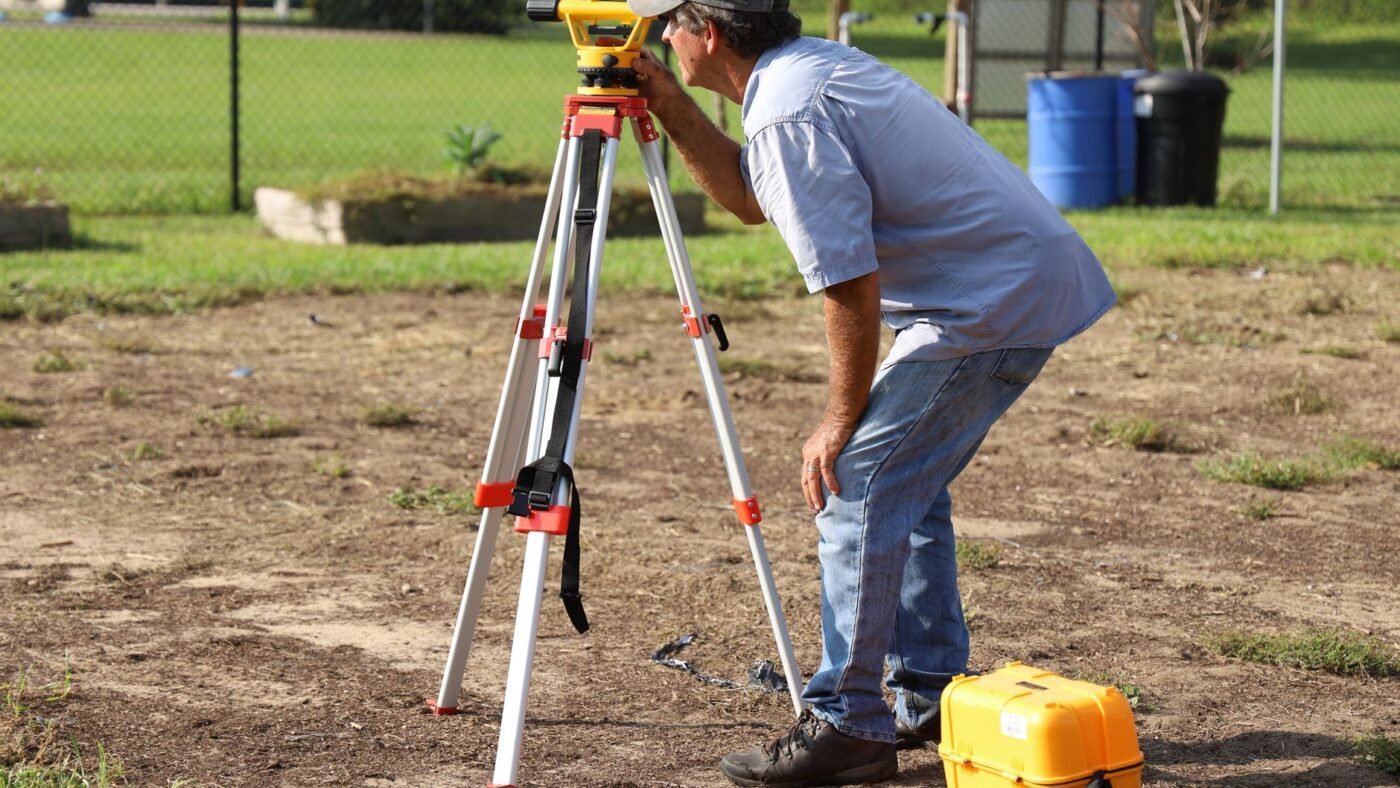
A laser level for pavers is a rotary laser on a tripod with a receiver clipped to a grade rod. It throws a level (or tilted) plane of light across the yard, and the receiver beeps when it finds the beam, so you can read the height of any spot against one reference. Use it to set excavation depth, base height and the fall of a patio. For a small backyard patio, a string line does the same job for free. A laser pays off on long driveways, big terraces and patios with more than one slope.
The tricky part is not turning the laser on. It is knowing what the numbers on the rod mean, so that is where most of this page goes.
Rotary, line or single-slope: which laser level for pavers is worth renting

Journeyman HQ's roundup of lasers for grading sorts them into a handful of types. Three matter for a paver job:
| Type | What it does | Fit for pavers |
|---|---|---|
| Self-leveling rotary | Levels itself and spins a 360-degree plane | The workhorse for most patios and walkways |
| Single-slope | Tilts the plane on one axis while the other stays level; you set a percentage | Best for patios and walkways that must drain |
| Line or cross-line laser | Projects lines; range is limited to about 50 to 100 feet with a receiver | Good for squaring up layouts and short checks, not grading |
The same article calls a dual-slope laser overkill for most DIYers. A manual-leveling rotary uses bubble vials and has no automatic out-of-level sensor, so a bump goes unnoticed. For a rental, get a self-leveling rotary that comes with a receiver and a grade rod. If your patio has to fall in one direction, ask whether the rental counter has a single-slope model, because it saves doing arithmetic on every reading.
Reading the grade rod: the bigger the number, the lower the ground

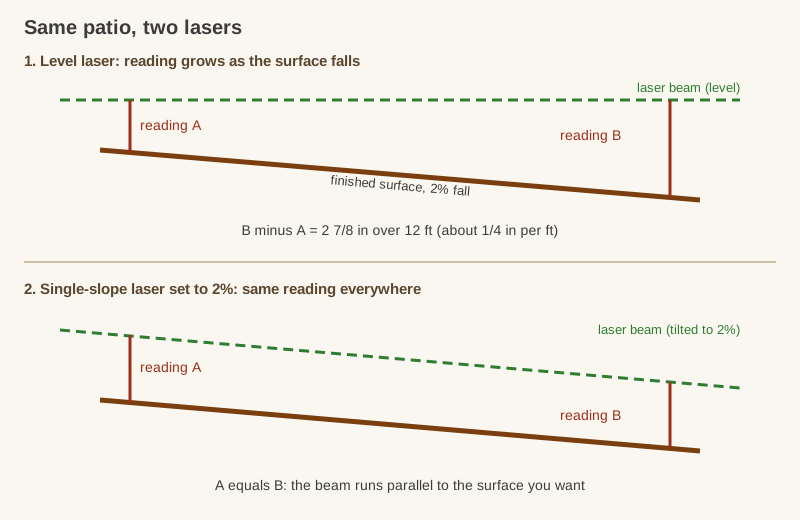
The beam is a fixed height in the air. You hold the rod on the ground, slide the receiver until it beeps, and read the number. That reading is the distance from the beam down to the ground at that spot. A bigger number means the spot is lower, and a smaller number means it is higher. Kaiweets puts it simply: a longer distance to the ground means the spot is low and needs fill, a shorter one means it is high and needs removing.
Now do the patio math. ICPI sets a minimum surface slope of 1.5%, and the IRC calls for at least 2% on impervious surfaces within 10 feet of a foundation (R401.3). Two percent is about 1/4 inch per foot. Over a 12-foot patio that is 12 x 12 x 0.02, or about 2 7/8 inches of fall. With a level laser, the reading at the far edge must be about 2 7/8 inches larger than the reading at the house. With a single-slope laser tilted to 2%, the beam runs parallel to the finished surface, so the reading is the same everywhere. The second is easier to work with, because you compare two identical numbers instead of doing fractions on a hot afternoon. (Check with your local building department, because the IRC is a model code.)
Turn the numbers into an excavation depth
A patio on well-drained soil needs at least 4 inches of compacted base, with 1 inch of bedding sand on top (ICPI Tech Spec 2). A paver is at least 2 3/8 inches thick. Add them up:
- Pick the finished surface at the house or the fixed edge, and set the beam to a known reading there.
- Add paver thickness plus sand plus base: 2 3/8 + 1 + 4 = 7 3/8 inches below the finished surface at that point. Add 2 to 4 inches of base for wet or weak soil or cold climates (ICPI).
- Grade the subgrade until the reading at every spot equals the finished-surface reading plus 7 3/8 inches, adjusted for the fall.
- Repeat after the base goes in, checking the reading at the top of the compacted base: it should be 3 3/8 inches (sand plus paver) below the finished surface.
That is a lot of numbers. A laser is useful here because it is a single reference, so errors do not add up from one string line to the next. For the dirt side of this job, see how to level ground for pavers, and if your yard falls away steeply see paver patio on a slope.
Set up the tripod, then check it before you trust it
Kaiweets recommends mounting the laser on a sturdy tripod away from foot and vehicle traffic, with all locks tightened. After that:
- Use the receiver outdoors. The beam may not be visible in bright sunlight, and Kaiweets recommends a receiver for distances over 30 to 50 feet.
- Pick a reference that does not move, such as the house slab or a stake driven well outside the dig.
- Check the laser itself. Journeyman HQ warns that a small error at the source grows to inches over a long lot, and suggests a two-peg test: take a reading, rotate the laser 180 degrees and compare the readings at the same spot.
- Recheck now and then. Tripod drift, wind and vibration all add error.
Kaiweets quotes accuracy of up to 1/8 inch over 100 feet, but that varies by model, so read the rental's spec.
A laser sets height; the straightedge checks flatness
A laser tells you the height of a point. It does not tell you whether the base between two points is bumpy. CMHA's guide specification wants the base surface within 3/8 inch over a 10-foot straightedge, and ICPI limits lippage between pavers to 1/8 inch on pedestrian routes. Use the laser for slope and depth, then a straightedge for flatness. Both checks and the tools behind them are in paver leveling tools.
String line for a backyard patio; rent a laser when the string runs out
The cheaper option comes first. A mason's string, two stakes and a line level are as accurate as a laser on a single-slope backyard patio, and they never need batteries. Rent a rotary laser only when the job has long runs where string sags, several slopes, or drains and inlets to hit. Take the receiver and rod, test the laser against the two-peg check, and return it the same day you finish grading. If you ever buy one, buy it for the third project, not the first. (A laser is precise about being exactly as wrong as the benchmark you gave it.)
FAQ
Do you need a laser level to install pavers?
No. A string line and line level are enough for most patios. A laser saves time on large areas, driveways, and patios with multiple slopes.
What type of laser level is best for pavers?
A self-leveling rotary laser with a receiver and grade rod is the usual rental. A single-slope laser suits patios and walkways that must drain, since you set the grade once and read the same number across the surface.
Can I use a cross-line laser for pavers?
It works for squaring a layout and short checks, but its range is limited to about 50 to 100 feet with a receiver. It is not a good grading tool.
How do you set a slope with a laser level?
With a single-slope laser, set the percentage on the unit, such as 2%, so the beam runs parallel to the finished surface. With a level laser, drop the receiver down the rod by the fall you need, about 1/4 inch per foot for 2%.


