Last Updated on September 23, 2026 by Umar Farooq
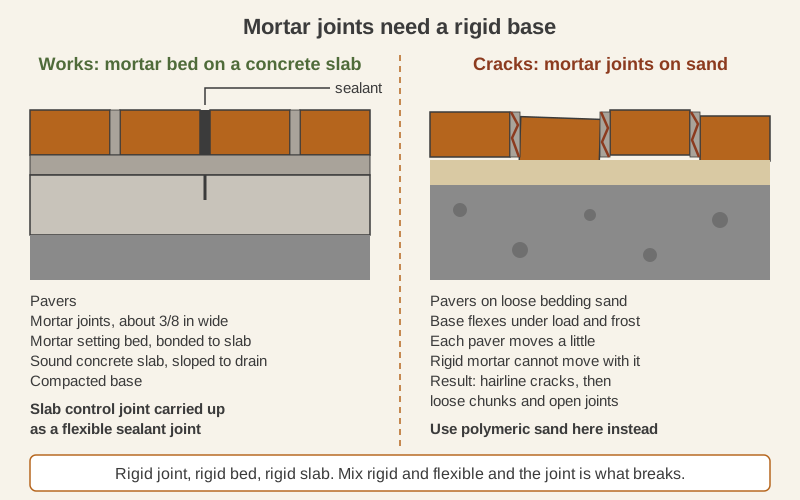
Mortar paver joints are joints filled with a cement-based mortar instead of sand, and they only last when every layer underneath is rigid: pavers set in a mortar bed on a sound concrete slab. On a standard sand-set patio over gravel, the pavers move slightly under load and frost, and rigid mortar joints crack within a season or two. Mortar there is a rigid answer to a flexible question, and the patio answers back. For those patios, polymeric sand is the right joint filler. Use mortar where the pavers are bonded to concrete, such as stoops, steps, porches and natural stone laid on a slab, and plan movement joints where the slab has them.
Below: where mortar belongs, how it compares with polymeric sand, why mortared joints crack, and how to mortar joints between pavers so they stay put.
Rigid or flexible: the choice behind every paver joint
Paving comes in two families.
Flexible (sand-set) paving is how most interlocking concrete paver patios and driveways are built: pavers on 1 inch of ASTM C33 bedding sand over a compacted gravel base. The pavers lock together through the sand in their joints, and the whole surface flexes a little under a car tire or a winter freeze, then settles back. A joint filler here has to move with the pavers. That's sand or polymeric sand.
Rigid (mortar-set) paving puts the pavers in a mortar setting bed bonded to a concrete slab. Nothing below the pavers moves, except where the slab itself has joints. A mortar joint suits this system because it is as stiff as everything around it.
Most problems with mortar paver joints come from mixing the two: mortar packed between pavers that sit on sand. If you're overlaying an old patio, our guide to pavers over concrete compares sand-set, mortar-set and adhesive-set methods.
Where mortar paver joints make sense
- Front stoops, steps and landings. A loose paver here is a trip hazard, and sand washing off the edges looks untidy. Mortar-setting pavers over concrete steps keeps every unit fixed.
- Natural stone on a slab. Irregular flagstone, bluestone and travertine often have joints of 1/2 inch to well over an inch. Mortar fills them solidly, and the stone is usually set in mortar anyway.
- Clay brick paving on concrete. I read the Brick Industry Association's technical note on mortar-set clay pavers so you don't have to. It describes brick pavers in a mortar bed on a concrete base, with mortar joints typically 3/8 inch wide.
- Pool copings and wall caps. They are bonded to a rigid structure, so the joints are mortared too.
Where mortar joints don't make sense: interlocking pavers on sand, any driveway on a gravel base, and anything built on soil that heaves.
Polymeric sand vs mortar for paver joints
| Polymeric sand | Mortar | |
|---|---|---|
| Base it needs | Flexible: sand bed over compacted gravel, or sand-set over concrete | Rigid: mortar bed bonded to a sound concrete slab |
| Joint width | Narrow joints, typically up to about 1 inch for standard formulas | About 3/8 inch and wider, including irregular stone joints |
| Movement | Stays slightly flexible and moves with the pavers | None, so it cracks if anything below moves |
| Water | Some water passes through the joint to the bedding sand | Sheds water, so the slab must be sloped to drain |
| Repair | Lift a paver, replace it, re-sand the joint | Grind out and repoint, and the units often break on removal |
| Skill | Sweep, compact, blow off, mist | Mixing, pointing and tooling, plus careful cleanup |
| Main risk | Haze or washout if installed badly | Cracking and staining the paver face |
The short version: mortar vs polymeric sand isn't a question of which is stronger. My view, and I hold it on every paver topic, is that the base decides and the joint follows. Mortar is the stronger material, and on a base that flexes that is exactly its problem: each paver rocks a fraction, and a joint that can't bend breaks. For the sand side of the comparison, see what polymeric sand is and when it is the wrong choice.
Why mortared paver joints crack
Not one paver maker's install guide I read allows mortar joints on a sand-set patio. When a mortar joint cracks, one of these is almost always the reason:
- The base isn't rigid. Mortar between sand-set pavers is the classic failure. Each paver rocks a fraction under traffic, and the mortar breaks at its weakest line, usually where it meets the paver edge.
- The slab cracked. The pavers are bonded to the slab, so every crack in the slab travels up through the bed and the joint. A heaving or broken slab should be replaced, not paved over.
- Movement joints were covered up. Concrete slabs have control and expansion joints for a reason. If the paving runs straight over them in mortar, the paving cracks along the same line. Carry each slab joint up through the paving as a flexible sealant joint.
- The mix was too wet. Extra water makes mortar easy to pour (easy in the way most shortcuts are), but it shrinks as it dries and leaves hairline gaps along the edges.
- Shallow or dusty joints. A thin skim of mortar over a hollow joint, or mortar pressed against dusty, bone-dry paver edges, has little to grip.
- Freeze-thaw and curing. Mortar that freezes before it cures, or dries in hot sun and wind, loses strength and fails early.
Hairline cracks in mortar paver joints on a sound slab are mostly cosmetic. Loose chunks, or pavers that move, mean the bond has failed underneath and the paver needs lifting and resetting.
How to mortar joints between pavers on a slab
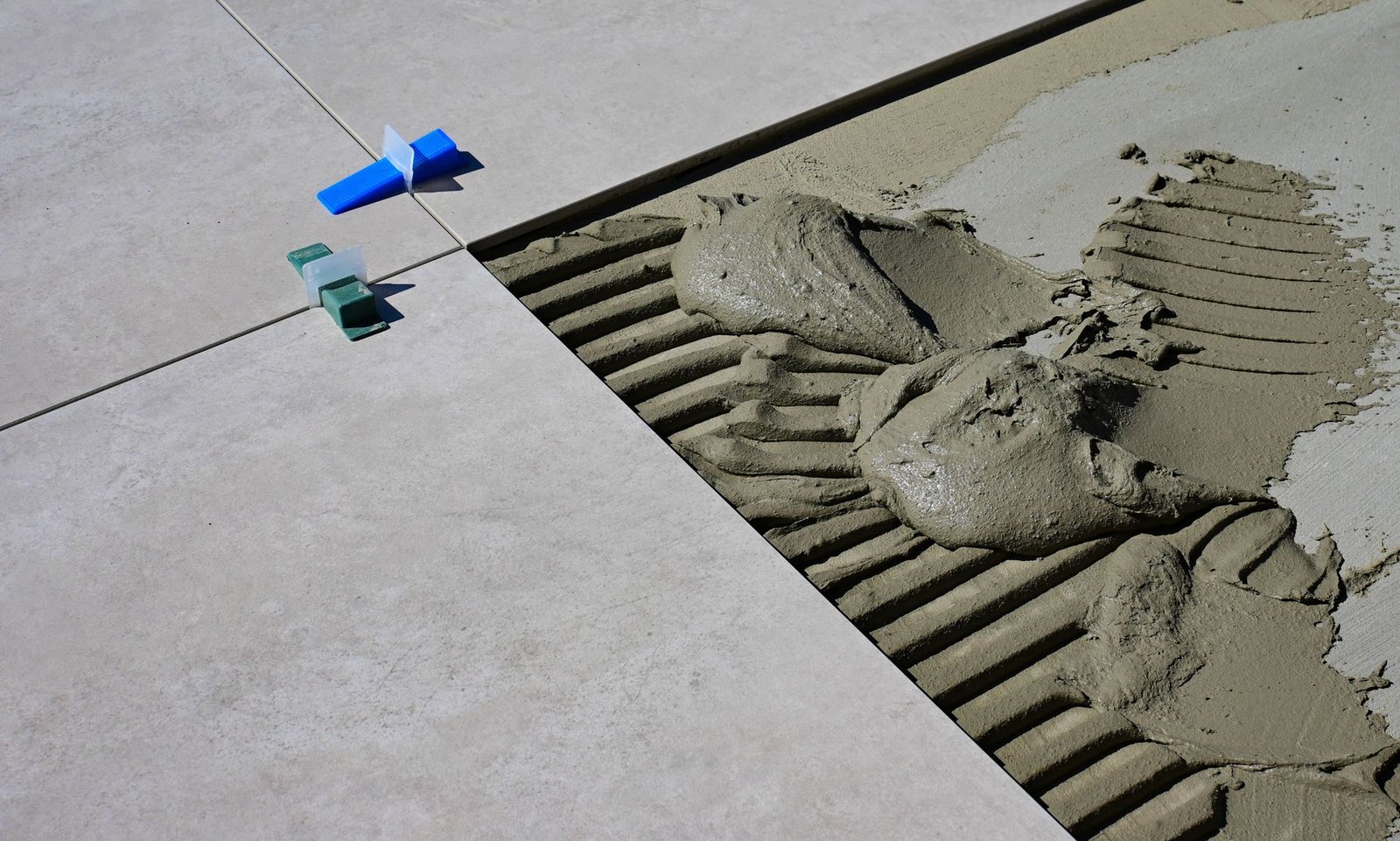
This assumes the pavers are already set in a mortar bed on a clean, sound, sloped slab that has cured enough to walk on. Check your mortar supplier's timing.
- Clean out the joints. Remove bedding mortar that squeezed up, loose debris and dust. The joint should be open to its full depth.
- Protect the paver faces. Porous stone and textured pavers stain easily. Some installers pre-seal porous stone or mask the edges; at the least, dampen the pavers so mortar slides off rather than soaking in.
- Mix the joint mortar stiff. Use a Type S mortar or a bagged pointing mortar made for paving. Mix it to a stiff, moldable consistency, not a pourable slurry, and mix only what you can place in about an hour.
- Dampen the joints lightly so the dry paver edges don't pull water out of the mortar. They should be damp, not wet.
- Fill the joints. Use a grout bag for narrow joints and a pointing trowel for wide stone joints. Pack the mortar in firmly to full depth, in layers for deep joints. Keep it off the paver faces.
- Tool the joints when thumbprint-hard. Once the mortar holds a thumbprint without sticking, strike it with a jointer to a smooth, compact finish, flush or slightly recessed. This compresses the surface and closes shrinkage gaps along the edges.
- Clean up as you go. Brush off crumbs once they are dry enough not to smear, and wipe any film with a barely damp sponge. Mortar left to cure on a paver face becomes a permanent feature.
- Cure it slowly. Keep the joints lightly damp and shaded for a few days. Don't work when temperatures will drop below about 40°F before the mortar sets, and cover it if rain is coming.
Leave a sealant joint wherever the slab has a control or expansion joint underneath, and where the paving meets a wall or step. Fill those with a flexible exterior sealant in a color close to the mortar.
Repointing cracked mortar joints
If the slab and bed are sound and only the mortar paver joints have failed:
- Rake or grind out the loose mortar to a depth of at least 2 to 2 1/2 times the joint width, and no less than about 3/4 inch. A grinder with a tuckpointing blade is fastest, but take care not to chip the paver edges.
- Blow out the dust and dampen the joint.
- Repoint with the same method as above, matching the color with a test batch first.
If the pavers themselves are loose or ring hollow when tapped, repointing won't hold. A hollow ring is the paver telling you, politely, that nothing is holding it. Lift those units, clean off the old bed, and reset them.
Resin and modified mortars for wide joints
Traditional cement mortar isn't the only way to fill wide paver joints. Pavingexpert's page on polymer sands and modified mortars covers ready-to-use modified mortars that are poured or pumped into joints and take foot traffic within hours, as well as resin-bound jointing products that brush in and cure in the air. They are popular for natural stone patios with wide joints, and some tolerate a slightly flexible, free-draining base better than cement mortar. Our guide to paver joint compound compares those options.
Mortar only on concrete, sand everywhere else
Mortar paver joints are the right call when the pavers are bonded to a sound concrete slab. That covers stoops, steps, pool copings and natural stone overlays. They are the wrong call on sand-set pavers over gravel, where they will crack no matter how carefully they are pointed. Pick the joint to match the base. On a slab, use stiff mortar, pack it to full depth, tool it, cure it slowly and honor the slab's movement joints. On a flexible patio, use polymeric sand, keep the trowel in the shed, and let the pavers do the gentle shuffling they were designed to do.
FAQ
Can you put mortar between pavers?
Yes, if the pavers are set in a mortar bed on a concrete slab. On a sand-set patio over gravel, mortar joints crack because the pavers move slightly under load and frost. Use polymeric sand there instead.
Is polymeric sand or mortar better for pavers?
For interlocking pavers on a sand-and-gravel base, polymeric sand is better because it moves with the pavers and is easy to repair. For pavers or natural stone mortared to a concrete slab, mortar is better because the whole system is rigid.
Why do mortar joints between pavers crack?
Usually because something underneath moves: a flexible sand base, a cracked slab, or a slab control joint covered by mortar. Wet mixes that shrink, shallow joints and frost before curing also cause cracks.
What type of mortar is used for paver joints?
A Type S mortar or a bagged paving or pointing mortar mixed stiff is typical for exterior paver joints on a slab. Follow the product label for joint width, depth and curing.
How wide should mortar joints be between pavers?
About 3/8 inch is typical for mortar-set brick and concrete pavers. Natural stone joints are often wider and irregular. Very narrow joints, under about 1/4 inch, are hard to fill solidly with mortar.
Can you mortar over old sand joints?
No. Mortar needs a rigid base below the paver and a clean, full-depth joint. Putting mortar over sand-set pavers creates a rigid cap on a flexible system, and it cracks. Refresh those joints with polymeric sand instead.