

Last Updated on September 27, 2026 by Umar Farooq
Paver adhesive is a tube adhesive rated for outdoor masonry, used where a paver or block has to stay put without interlock: wall caps, step treads, border pavers on a concrete slab, and thin pavers over concrete. Run it from a caulking gun in two continuous beads, set the unit, and let it cure before loading it. It doesn't belong under a normal sand-set patio, where the pavers are meant to move slightly and drain, and "glue sand" is something else entirely (polymeric joint sand).
Where paver adhesive belongs
The common thread: adhesive holds pieces that sit on top of something rigid, and that nothing else will hold.
- Wall and seat-wall caps. The top course has nothing above it to pin it down. Choosing the caps themselves is covered in paver caps.
- Step treads and risers on block or concrete steps, where a loose tread is a trip.
- Border pavers on a concrete slab. When pavers go over concrete, the edge course is often glued down as the restraint for the sand-set field inside it.
- Thin pavers over concrete, bonded directly where there's no sand bed.
Where it doesn't belong
My one firm line on this page: don't glue a sand-set patio. A sand-set field works because each paver sits on loose sand and locks to its neighbours through the joint sand and the edge restraint. Glue under a few pavers turns those into hard points in a flexible surface, and water that gets under glued pavers has nowhere to go. If pavers are moving, the fix is the edge, joints or base, not a tube of adhesive.
Nor will glue fix a failing base. A glued paver on a sinking bed just sinks with glue on it.
"Paver glue sand" is polymeric sand
Many searches for paver glue are really about joint sand with a binder. That's polymeric sand: sand mixed with a polymer that hardens when watered, locking the joints and resisting washout and weeds. It doesn't stick pavers to anything underneath. How it works is covered in what is polymeric sand.
Types of adhesive for pavers
| Type | Best for | Watch for |
|---|---|---|
| Landscape / hardscape tube adhesive | Caps, treads, block walls, borders | Must say exterior, masonry-rated |
| Polyurethane hardscape adhesive | Caps and borders in cold or damp weather | Check temperature range on the tube |
| Thinset or veneer mortar | Porcelain and stone slabs on concrete | Needs full coverage, not beads |
| Dry mudset with a fortifier | Border pavers on a slab | Mix and cure per the product |
I compared two tube adhesives' published specs, and the useful differences were weather and cure. SEK's SB-10 Paver Bond listing rates it for 0 to 100°F, even on wet or frozen block, with an initial set in 10 to 15 minutes and full cure in 2 to 7 days. A 28 oz cartridge runs about 86 linear feet at a 1/4-inch bead. Check your own tube for its range, because general-purpose construction adhesive usually has a narrower one. (A tube that grips frozen block is having a better January than most of us.)
For porcelain or stone slabs bonded to a slab, Belgard's guide to laying pavers over concrete points to exterior thinset or veneer mortar, and a dry mudset with a fortifier for borders, rather than tube adhesive.
How to apply paver adhesive to caps and borders
- Dry-fit first. Lay out and cut every cap or border paver.
- Clean both surfaces. Brush off dust and sand, and scrape off old mortar or efflorescence.
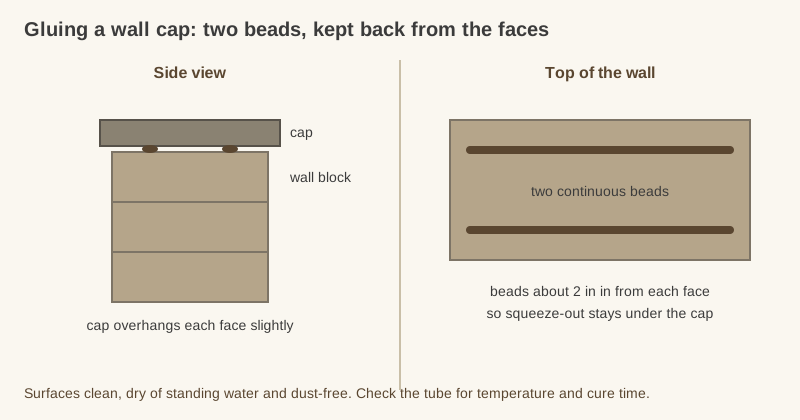
- Run two continuous beads along the length, kept back about 2 inches from each face, so squeeze-out stays hidden. Homesteady's construction adhesive how-to uses two 3/16-inch beads about 2 inches in from the edges. Loctite's landscape adhesive guide spaces beads about 4 inches apart on wider units.
- Set, don't slide. Lower the unit straight down and press or tap it level. Sliding smears the beads thin.
- Weight it if the product says so. Some adhesives expand as they cure, and an unweighted border paver can rise out of line in the first few minutes.
- Leave it alone until the tube's cure time has passed.
Where it goes wrong: the bead is too close to the face and oozes down the wall, the surface was dusty, or the temperature was outside the tube's range and it never grabbed. Scrape fresh squeeze-out off immediately; cured adhesive on a textured face is there for good.
Glue the caps, not the field
Use paver adhesive for the pieces that sit on top: caps, treads, glued borders and thin pavers on a slab. Choose an exterior masonry adhesive whose temperature range covers your day, run two beads back from the faces, and give it the full cure. Leave the sand-set field alone; it holds together better without help.
FAQ
What is the best adhesive for pavers?
An exterior, masonry-rated landscape or hardscape adhesive for caps, treads and borders. For porcelain or stone slabs bonded to concrete, use an exterior thinset or veneer mortar with full coverage instead of beads.
Can you glue pavers to concrete?
Yes, for border courses, steps and thin pavers bonded directly to a sound slab. For a full patio over concrete, most installs sand-set the field and glue only the border, with drain holes at low spots.
How long does paver adhesive take to cure?
It depends on the product and weather. SEK's SB-10 sets in 10 to 15 minutes and fully cures in 2 to 7 days. Follow the tube before loading or sweeping sand against glued units.
Does paver glue work in cold weather?
Some do. SEK rates SB-10 down to 0°F on wet or frozen block, but many general construction adhesives need warmer conditions. The tube states its range.


