


Last Updated on October 20, 2026 by Umar Farooq
Mud coming up between pavers almost always means water is moving through the patio and carrying fine soil or sand up with it. A smear of dirt after a splashy storm is one thing. Brown water that returns to the same joints after every rain is another, and the cause sits under the pavers, not on them.
I went looking for a page that deals with this directly and did not find one. The search results for this phrase are mostly weed guides. The useful material is scattered across a trade-association maintenance note, an installer's repair guide and a drainage article, so this page stitches those together and says where each claim comes from.
Mud coming up between pavers: splash or pumping? A two-minute test
Sweep or rinse the muddy joints clean, then wait for the next rain or run a hose on the spot for a few minutes. Watch where the mud returns and when.
- Mud only near a planting bed or bare soil, and only where rain splashes. That is splash. Soil is arriving from outside, not rising from below. Fix the edge of the bed.
- Mud in low spots or along one edge, after the whole area has been wet for a while. That points to water sitting in the bedding sand or base.
- Mud that squirts or oozes when you step on a paver. That is pumping. CMHA's maintenance note lists "joint sand loss/pumping" as a distress and says saturated bedding sand can pump under traffic, and that stains on the pavers can indicate a saturated bedding layer (CMHA PAV-TEC-006).
- A paver that rocks. One drainage guide (Mulch Mound) says a rocking paver means the bedding sand beneath has washed or shifted, and that it keeps pushing water into the base each time it is stepped on. Treat that as a claim from one installer, not a measured figure.
Four routes the mud can take
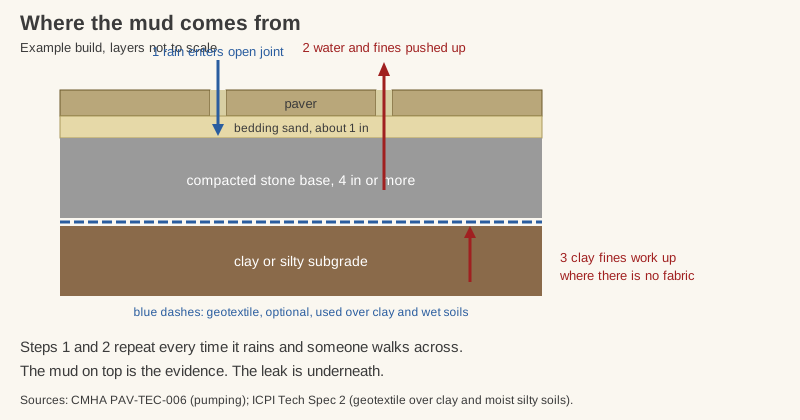
The picture shows the usual route. Rain enters the joints, soaks the bedding sand and base, and under foot traffic the water is pushed back up with whatever fine particles it picked up. One installer puts the first half neatly: "A full joint sheds water. An empty joint is a funnel" (Mr. Suds).
| Cause | Clue | What to do |
|---|---|---|
| Splash from a bed or bare soil | Mud only near the soil, only during rain | Raise the bed edge or mulch lower, refill the joints |
| Empty or washed-out joints | Joint sand well below the paver chamfer, often after pressure washing | Refill the joints. CMHA says to top up as soon as sand drops more than 1/2 in. |
| Saturated bedding sand and base | Mud in low spots, spongy feel, water standing after rain | Find the water source, then lift and rebuild that section |
| Clay subgrade working into the base | Muddy water on a patio built over clay with no separation fabric | Lift, add fabric under the base, rebuild |
On the last row: ICPI says geotextile may be used where soil stays saturated part of the year, where it freezes and thaws, or over clay and moist silty soils, because it stops soil migrating into the stone base under load, especially when saturated (ICPI Tech Spec 2). Note the word "optional" in that heading. Plenty of patios have none, and plenty of them are fine. Over clay, the ones without are the ones I would worry about.
Trace the water before you lift anything
Re-sanding a muddy patio without finding the water is rinsing a leaking bucket. Ask where the water comes from first.
- Downspouts discharging onto or beside the patio, or runoff from a slope or the lawn: patio drainage covers the layout and the minimum slopes.
- The whole patio flooding in heavy rain: paver patio flooding walks through four sources and a hose test.
- Groundwater, or a base sitting in a wet hole: pavers in high water table.
The cheapest first move costs nothing. Rinse the joints, refill any that are low, and watch one more rain. If the mud does not come back, it was splash or a shallow joint problem and you are done. If it returns in the same spot, the water has a route and you have a rebuild.
Lift, dig out the muddy layers and put fabric where the clay is
A section that pumps cannot be fixed from the surface. One installer's article says lifting and resetting is "the honest answer" when the base has failed, and that shimming low pavers with extra sand fails within a season (Mr. Suds, above). That matches the site's own repair guide, how to fix sunken pavers.
- Lift the pavers over the affected area and a row beyond it. Stack them in order.
- Dig out the muddy bedding sand and any base stone that is contaminated with fines.
- Look at the bottom of the hole. If it is soft, wet clay, deal with that now: add the water fix (drain, regrade) and consider fabric under the base. ICPI's overlap guidance is at least 12 inches down slope, and the fabric turns up the sides with no wrinkles on the bottom.
- Rebuild the base in thin lifts, damp and compacted. ICPI's 4-to-6-inch lift assumes a 7,000 lbf plate, and it calls for thinner lifts with smaller ones.
- Spread 1 inch of clean concrete sand, screed it and leave it loose, then relay the pavers and refill the joints.
Do not put fabric between the base and the bedding sand. The Mulch Mound guide warns against it, and it matches how ICPI describes the fabric: under the base, on the soil. Our landscape fabric for paver patio page covers where it belongs.
What makes it worse
Pressure washing close up is the most common self-inflicted cause. CMHA's note says joint sand loss can occur from pressure washing, and Mr. Suds describes narrow tips blasting the sand out and etching the surface. Keep the nozzle high, use a wide fan or a surface cleaner, and refill the joints afterwards.
Stop the water and the mud stops
Mud coming up between pavers is the symptom, and water is the cause. Sweep, refill and watch one rain first, since that is free. If the same joints turn brown again, find the water, then lift, rebuild and, over clay, fabric the base. The pavers will go back exactly where they came out, which is the quiet advantage of pavers over a poured slab. If you are standing in the yard with a brown puddle and a screwdriver, put the screwdriver down and go and check the downspout.
FAQ
Is mud between pavers normal?
A little soil washed in by rain splash is normal and sweeps away. Mud that keeps returning to the same joints after rain is not, because it means water is moving through the sand and base and carrying fines with it.
Why is muddy water coming up through my patio?
The usual reason is that the bedding sand and base are saturated and the water has nowhere to go. When someone steps on a paver, the water and fine particles are pushed up through the joint. CMHA calls this pumping of saturated bedding sand.
Can I fix it by adding more sand?
Only if the cause was empty joints. Adding sand on top of a saturated base does not remove the water, and shimming sunk pavers with extra sand is described as a shortcut that fails within a season.
Does landscape fabric stop mud coming through pavers?
Fabric under the base, over clay or moist silty soil, keeps subgrade fines out of the stone. ICPI lists it as optional and says it helps in those soils. It does not fix water that has no way out, so you still need drainage.
Should I call a pro?
If a large area pumps, the patio is dipping, or the water source is groundwater, yes. A small, local patch is a manageable weekend lift-and-reset.


