


Last Updated on October 20, 2026 by Umar Farooq
The best patio privacy ideas start with one question: where is the stare coming from? A neighbor's window above the fence, a path along the side and a street out front each need a different fix, and the cheapest fix is nearly always a screen close to your seat rather than a tall fence at the boundary. Outdoor curtains, a row of tall planters, a lattice panel or a few climbing plants can cost a fraction of a fenced yard. Save the fence, pergola or shade sail for the problem the small fix cannot solve.
Work out where the stare is coming from
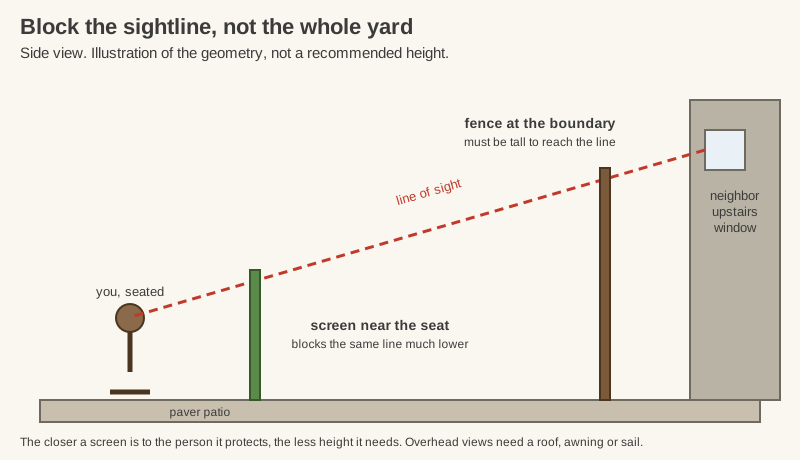
Every privacy list I read, and I read four, is ordered by style. None starts with geometry, which is where the money is. This diagram is my own reasoning, not a sourced rule: a sightline is a straight line from their eyes to yours. A screen at the boundary has to reach that line far away from you, so it must be tall. A screen two steps from your chair meets the same line much lower. Moving the barrier closer to the person is why a six-foot fence can fail where a four-foot screen next to the table works.
Sort your problem before you shop:
- Side views (a path or a neighbor at ground level): a screen, hedge, trellis or fence.
- Views from above (a second-story window or an uphill yard): a roof. Bob Vila points to a shade sail or a retractable awning for neighbors who are higher than you, and says a pergola's posts and beams give some obstruction.
- Sound, not sight: water. Bob Vila suggests a fountain against a shared fence to mask conversation.
Cheap patio privacy ideas: curtains, planters, umbrellas and screens
My opinion, and I will stand on the cost numbers: do the small thing first. BudgetDumpster puts fence material at $1,500 to $8,000 or more, plus installation at about $35 an hour, while lattice panels run about $24 and wooden posts as low as $9. If your problem is one window and one corner of the patio, an $8,000 fence is a very expensive way to block it. (Prices are BudgetDumpster's estimates and will have moved, so use them for scale, not for budgeting.)
The movable options, cheapest first:
- A large umbrella. Trex lists it among its most accessible privacy ideas, with adjustable coverage as the benefit. It helps most against views from above and does little against a side view.
- Outdoor curtains. Bob Vila and Trex both recommend them on a pergola, porch or custom frame, and Bob Vila says curtain rods are the easiest way to hang them. They make an outdoor room in an afternoon and come down for storms.
- Tall planters. BudgetDumpster suggests oversized planters as a cheap screen, and Bob Vila suggests privacy planters, which you can string together into a longer screen. You can move them if the sightline changes. Our paver planter box guide covers building planters on a paver patio.
- A freestanding screen. Bob Vila notes that townhome and apartment dwellers can use ready-made screens, or a DIY one built to size.
- A lattice panel on posts. Bob Vila describes a trellis as a screen that interrupts sight lines while admitting breezes and dappled sunlight, and the cost above makes it the cheapest permanent screen I found.
Build a nook so you need less screen
A wide-open patio is the hardest to make private, because there is nowhere to hide. Bob Vila suggests building an intimate corner into an expansive yard by bordering the patio with small trees and shrubs and anchoring the furniture with a simple open structure, which lets light and wind pass through while still breaking the view. Trex makes the same point from the deck side: set the seating where a house wall or an existing fence already blocks some of the view, and you have less to screen.
In paver terms, that is a layout decision, and it is free. Putting the table in the corner where two walls meet, rather than in the middle of the patio, can do more than a screen. The sources do not give a number for how much a corner helps, so test it: sit in the spot at the time of day you use it and see who can see you.
Plants: slower, softer and surprisingly picky
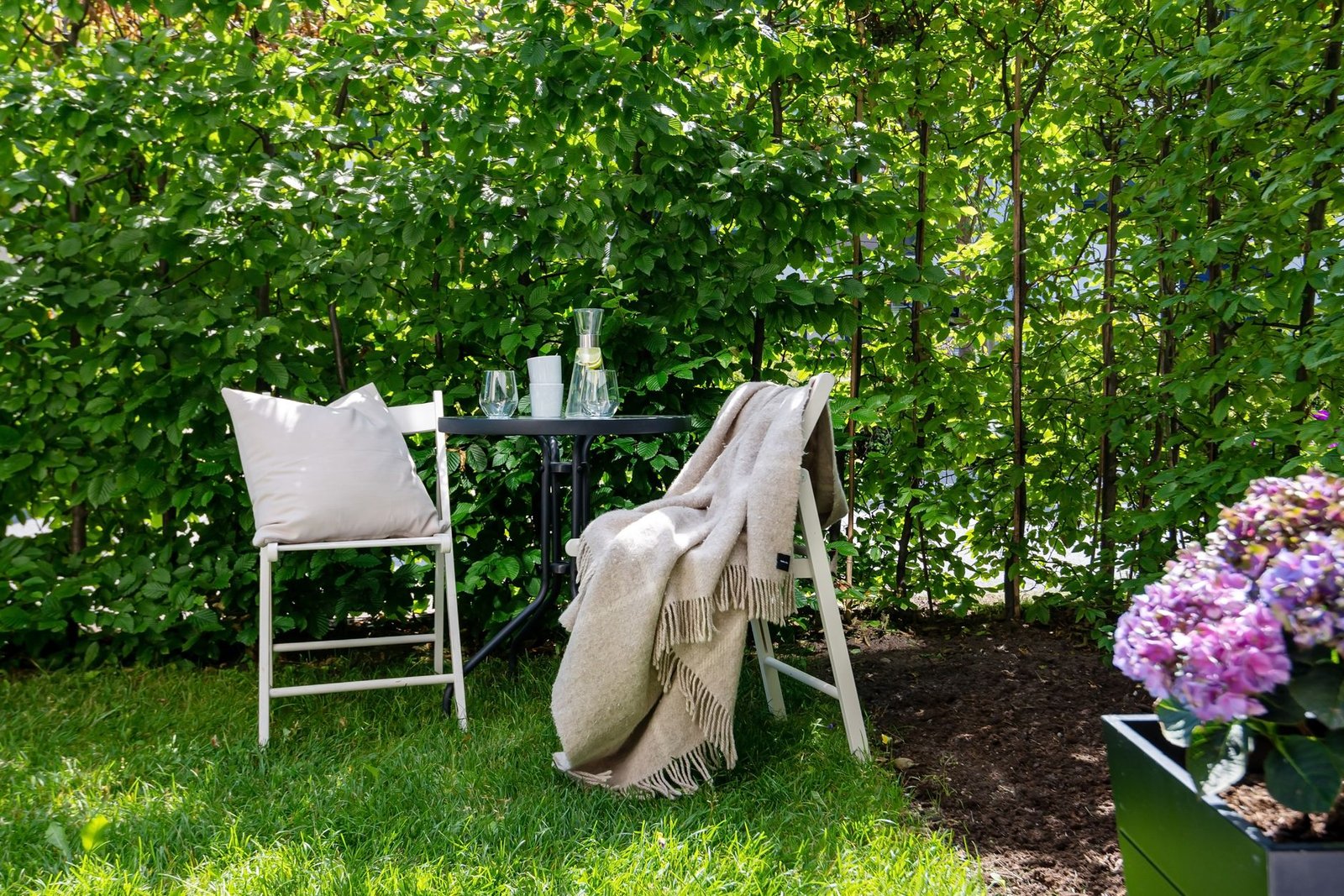
Plants are the best-looking screen and the slowest. BudgetDumpster says emerald arborvitae reach up to 15 feet and can be trimmed to 2 feet wide, and that north privet can grow up to 3 feet a year, reaching 8 to 12 feet tall. Its cost range for north privet is $8 for a bare-root plant to $40 for a 3-gallon size. Those are the Arbor Day Foundation's growth numbers as BudgetDumpster reports them, so check what suits your zone.
Three cautions from the sources:
- Bamboo can run. Bob Vila says it can be invasive and should be planted only in beds or containers with strong barriers, and names 'Gracilis' and 'Seabreeze' as less likely to run.
- Choose evergreens if you want year-round cover (Bob Vila).
- Vines need something to climb. Bob Vila recommends native vines and asking your county extension agent which suit your area. A trellis or pergola gives them a place to climb.
Our landscaping around a paver patio guide covers what to plant where, and how close is too close.
Fences, walls and the paperwork
A fence is the only option that gives complete privacy within days, which BudgetDumpster calls its main benefit, and cost is the downside. It adds that you may need a permit and/or a survey, plus HOA approval. Trex adds that fence height rules often relate to visibility at street corners. Check with your city and HOA before you order boards, because asking first is cheaper than moving a fence.
If you already have a fence that is too short, Bob Vila suggests adding lattice on top to make it taller, and BudgetDumpster suggests privacy slats or climbing vines on a chain-link fence. Both cost far less than starting over.
Overhead privacy: pergola, shade sail or awning
If the stare comes from above, you need a roof of some kind. Trex warns that open-roof pergolas do not provide complete privacy or protection from the elements, and Bob Vila suggests filling in the sides with twining plants or roller shades. A shade sail or awning blocks more of the view from above.
The choice between those two is a real one, and it is more than a privacy question. I compared them for a paver patio in pergola vs shade sail, and the short version is that both need their posts on concrete footings. Our paver patio with pergola guide covers the footing sequence.
Putting a screen on a paver patio without wrecking the base
This is the part the lists skip. On a paver patio, anything tall and fixed has the same problem: the posts need to go into the ground, not onto loose pavers.
- Footings before pavers. On a new patio, set posts in concrete first and lay the pavers around them. It is much easier than doing it afterward.
- Existing patio: lift the pavers at each post, dig and pour a footing, and relay the pavers around it. Paver patios are forgiving this way.
- Edge restraint matters. Do not put a post footing where it cuts through the edge restraint or the base shoulder.
- Water must still get out. Solid screens along a low edge can trap runoff. Keep the patio sloping away from the house, as covered in our patio drainage guide.
- Movable things first. Planters and curtains do not need footings at all, which is one more reason they are the sensible first step. (Heavy stone planters are an exception, so check the weight against the base, as in our planter guide.)
I could not find a source for a safe height or weight limit for freestanding screens on pavers, so I will not invent one. Follow the product's instructions.
Which fix suits which problem
This table is my summary of the sources above, with their cost figures where they gave one.
| Fix | Best against | Cost signal | Footings on a paver patio? |
|---|---|---|---|
| Umbrella | Views from above | Lowest | No |
| Curtains | Side views, wind | Low | Only if you add a frame |
| Planters | Side views | Low | No (check weight) |
| Lattice on posts | Side views | About $24 a panel, $9 a post (BudgetDumpster) | Yes |
| Hedge or vines | Side views, noise | $8 to $40 a privet plant (BudgetDumpster) | No |
| Fence | Complete side privacy | $1,500 to $8,000 or more (BudgetDumpster) | Yes |
| Pergola | Some overhead cover | $2,000 to $6,000 or more (BudgetDumpster) | Yes |
| Shade sail or awning | Views from above | Lower than a pergola (vendor claims) | Yes, for sail posts |
Block the sightline you have, not the yard you imagine
Pick the stare, then pick the cheapest barrier that meets it near your seat. Curtains, planters and a lattice panel cost less than a fence and can be moved when a neighbor builds an addition. If all of those fail, the fence or the roof is waiting. And if the real problem was one upstairs window, a curtain was the answer all along, and I will pretend I did not mention that earlier.
FAQ
What is the cheapest way to add privacy to a patio?
Outdoor curtains, large planters, an umbrella or a lattice panel on posts. BudgetDumpster lists lattice panels from about $24 and wooden fence posts from about $9, which makes lattice the cheapest permanent screen I found.
How do I get privacy from a neighbor's second-story window?
You need a roof, not just a screen. A shade sail, retractable awning or a covered pergola blocks views from above. A fence at the property line has to be very tall to reach a high window, so a screen close to your seat or a roof works better.
Do I need a permit for a privacy fence?
Often, yes. BudgetDumpster says you may need a permit and/or a survey, and HOA approval. Trex says fence height rules often relate to visibility at street corners. Check with your city and HOA.
Can I put a privacy screen or pergola on pavers?
Not directly. Posts should sit on concrete footings in the ground, with the pavers cut around them. Planters and freestanding screens need no footings, but check their weight.
What plants give fast privacy?
BudgetDumpster says north privet can grow up to 3 feet a year and reach 8 to 12 feet, and emerald arborvitae can reach 15 feet and be trimmed to 2 feet wide. Bob Vila recommends evergreens for year-round privacy and warns that bamboo can be invasive.


