Last Updated on September 23, 2026 by Umar Farooq
The main paver cutting tools are a gas cut off saw, a wet tile saw or masonry table saw, an angle grinder with a diamond wheel, a paver splitter, and a hammer and brick set chisel. For most DIY patios the best combination is a rented 14-inch cut off saw for trimming edges in place, plus an angle grinder for notches. Use a wet saw when cuts must be precise or the material is porcelain or natural stone. A splitter or chisel is fine for a few rough cuts with no dust at all.
I read enough tool roundups for this to notice that every one ends with the most expensive machine. This one ends with the cheapest combination that does the job. Each tool trades speed, edge quality, dust and cost differently; the table puts them side by side.
Paver cutting tools compared side by side
| Tool | Cut quality | Speed | Dust and mess | Depth in one pass | Best for | Rent or buy |
|---|---|---|---|---|---|---|
| Gas cut off saw (14 in) | Clean, straight | Fastest | High dry, slurry wet | About 5 in | Trimming whole edges in place, wall caps | Rent |
| Masonry table saw (14 in) | Cleanest | Fast | Slurry, contained | Clears standard pavers | Precise cuts at a set-up station | Rent |
| Wet tile saw (7 to 10 in) | Very clean | Medium | Slurry, contained | Limited on bigger models, small on 7 in | Porcelain, thin stone, patio pavers | Buy or rent |
| Angle grinder (4 1/2 to 9 in) | Good, freehand | Slow on full-depth cuts | High dry | About 1 in (4 1/2 in wheel) to about 3 in (9 in) | Notches, curves, around drains | Buy |
| Paver splitter | Rough, straight only | Fast per cut | None | Full thickness | Rustic pavers, lots of straight cuts | Rent |
| Hammer and brick set | Rough | Slow | Chips only | Full thickness (score and snap) | A few cuts, repairs | Buy |
| Circular saw with masonry blade | Fair | Slow | Very high, dry | About 2 1/2 in (7 1/4 in saw) | Occasional cuts when nothing else is available | Already owned |
Depths are typical for the blade size; check your tool's spec. Patio pavers are usually 2 3/8 inches thick, driveway pavers 3 1/8. A tool that can't get through in one pass cuts from both faces, or scores and snaps.
Gas cut off saw: fastest through a whole edge
This is the tool most crews reach for. A 14-inch gas cut off saw with a diamond blade cuts about 5 inches deep, so it goes through any paver in one pass. Lay the field with full pavers running past the edge, snap a chalk line, and walk the saw along it, cutting everything in place.
Strengths: speed, depth, and the power to cut wall caps and block too. Weak points: it's heavy and loud, it makes a lot of dust unless the water kit is running, and kickback is a real risk.
That last one deserves more than a bullet point. When the blade binds or hits something harder than expected, it climbs back toward whoever is holding it. I went through CPWR's fact sheet on cut-off saw safety, which draws on OSHA's severe-injury reports: 39 cut-off saw kickback injuries in construction from 2015 to 2023. In May 2020 a saw cutting concrete hit rebar and kicked back onto a worker's foot. In October 2023 a worker's shirt caught in the blade while he was cutting pipe; he was pulled in and killed. These were professionals, on the same machines rental yards hand homeowners. Tuck everything in, keep the upper front quarter of the blade out of the cut, and let the saw reach full speed before it touches the paver.
Gas, battery and corded models, blade sizes, silica rules and safe operation are all covered in our guide to the cut off saw.
Wet tile saw vs masonry table saw

When people search for a "paver cutting machine," they usually mean one of these two bench-style wet saws. Both push the paver (or the blade) along a fixed track with water pumped onto a diamond blade, which gives the straightest, cleanest edges of any paver cutting tool.
Wet tile saw. Tile saws use 7- to 10-inch blades. Small ones lack the depth for a 2 3/8-inch paver; larger 10-inch sliding-table saws often have it, but check the maximum cut depth first. Tile saws are the right tool for porcelain pavers, which are hard, brittle and chip under a segmented blade, and for thin stone or any cut where a chipped edge would show.
Masonry table saw. A heavier machine, typically with a 14-inch blade, a rolling cart that carries the paver through the blade, and a water pump and tray. It's a true saw for cutting pavers, block and brick, with the depth for thick concrete pavers and wall units, and it handles dozens of identical cuts, such as 45-degree herringbone edge pieces, without tiring your arms. Professionals use one when cuts are marked and carried to a station instead of cut in place.
Downsides of both: every paver gets marked, carried to the saw and carried back, which adds up to a surprising number of laps of the yard. You need a water supply, and slurry has to stay off the finished surface. Tile saws also wear out quickly if pushed through too many thick concrete pavers.
Angle grinder for notches and curves
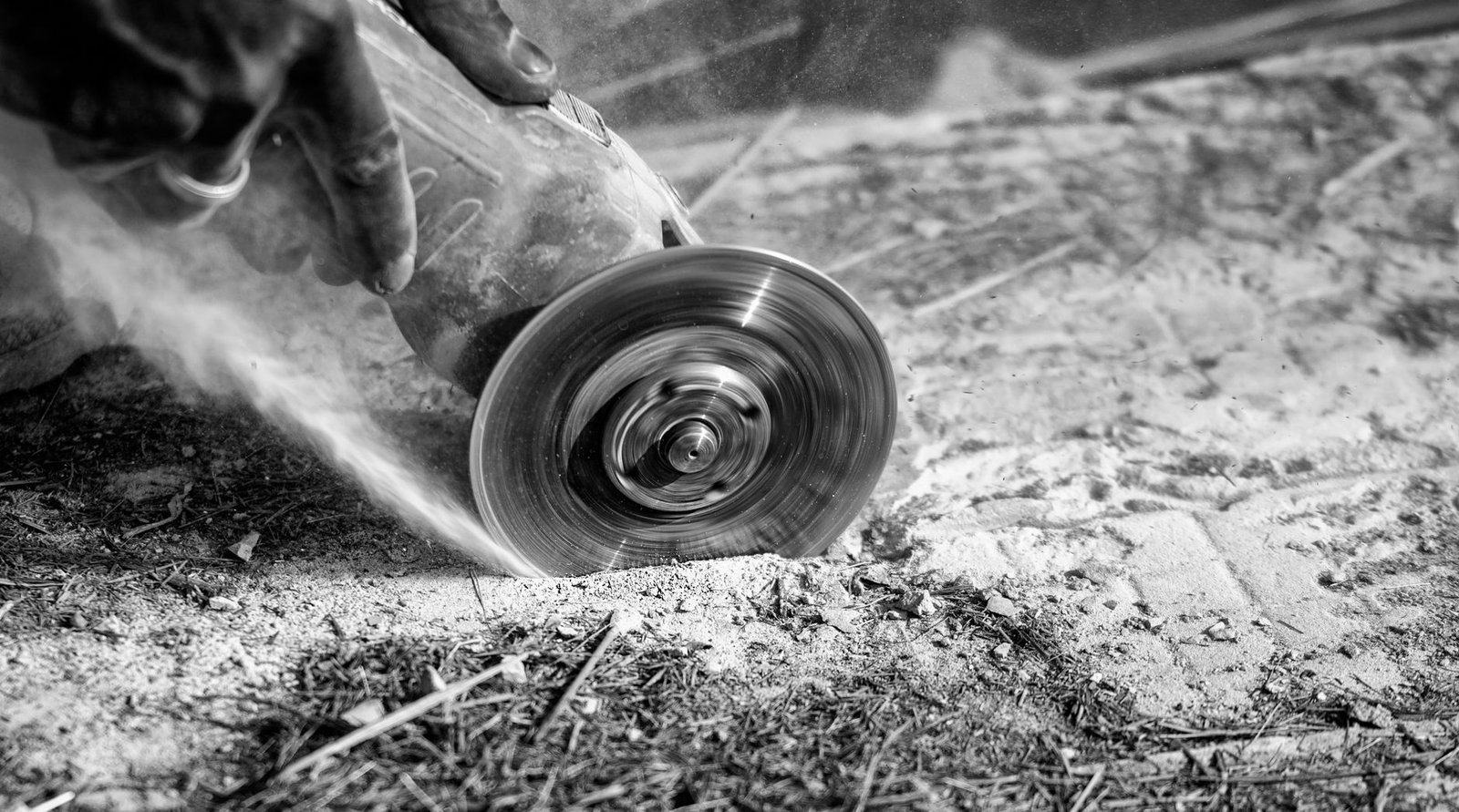
A grinder with a 4 1/2- or 5-inch diamond wheel is the tool every paver installer owns and nobody photographs. It's rarely the main cutter, but it's light and precise, so it handles the cuts the big saws can't:
- Notches around posts, downspouts, gas meters and hose bibs.
- Curves. Score the curve, then remove the waste with a series of straight relief cuts.
- Drain and cleanout openings, and cuts right up against a wall.
- Scoring a line for a splitter or chisel, or to guide a bigger saw.
The limit is depth. A 4 1/2-inch wheel reaches about an inch, so a 2 3/8-inch paver needs cuts from top and bottom, or a scored line and a snap. Larger 7- and 9-inch grinders cut deeper but are heavy and awkward freehand.
Grinders throw a lot of silica dust. I read OSHA's Table 1 for handheld grinders looking for a homeowner loophole and didn't find one. It calls for either water fed to the wheel, or a shroud connected to a dust collector with at least 25 cfm of airflow per inch of wheel diameter and a 99% efficient filter. For a homeowner, a shroud and a shop vacuum with a good filter plus a respirator is the practical version. A turbo-rim wheel gives cleaner edges than a segmented one on a grinder. Our guide to the diamond blade for pavers explains the differences.
Paver splitter: dust-free straight breaks
A paver splitter, also called a guillotine or block splitter, has a hardened blade above the paver and one below. Pull the lever (or pump the hydraulic handle on bigger units) and the paver snaps along the line. No spinning blade, no water, no noise, almost no dust. The neighbours won't notice.
Where it fits:
- Tumbled and rustic pavers, where a slightly rough edge blends in.
- Wall block and caps on units designed to be split.
- Lots of straight cuts when you want to avoid dust near the house or neighbors.
Where it doesn't: straight lines only, and the edge is never as crisp as a saw cut. Thin slivers shatter, and angled herringbone pieces are hard to get right. Splitters are sized by blade width, so check the unit handles your largest paver (one widely sold homeowner model lists a 10-inch capacity). Rental yards stock bigger hydraulic splitters for thick block.
Hammer and brick set: the no-power fallback
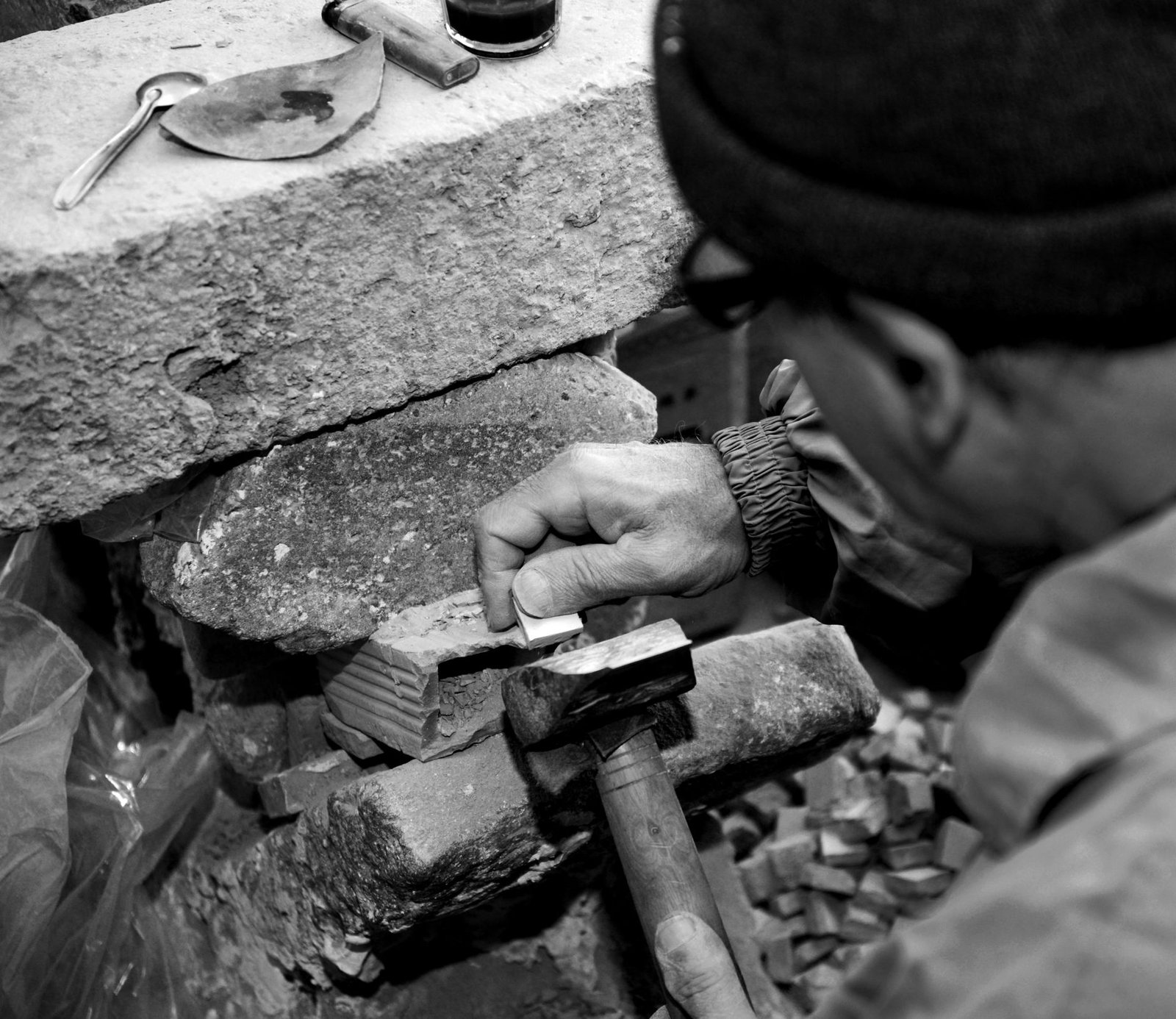
A brick set is a wide, flat masonry chisel. Score a line all the way around the paver with light taps, then one firm blow on the line snaps it. It's slow and the edge is rough, but it costs almost nothing and makes almost no dust, which makes it realistic for a small repair or a walkway with a handful of cuts.
It works best on thinner concrete pavers and clay brick. It's frustrating on thick driveway pavers and dense stone, and wastes more pavers than any other method. Wear safety glasses; chips fly.
Can a circular saw cut pavers?
Yes, with a diamond masonry blade, but it's the least suitable of the common paver cutting tools. A 7 1/4-inch saw reaches only about 2 1/2 inches at full depth, barely enough for a standard paver. It cuts dry, so the dust is heavy, and that grit gets into a motor built for two-by-fours. Use one for a few emergency cuts on a small job if it's what you have. For anything bigger, rent the right saw.
Matching tools to the size of the project
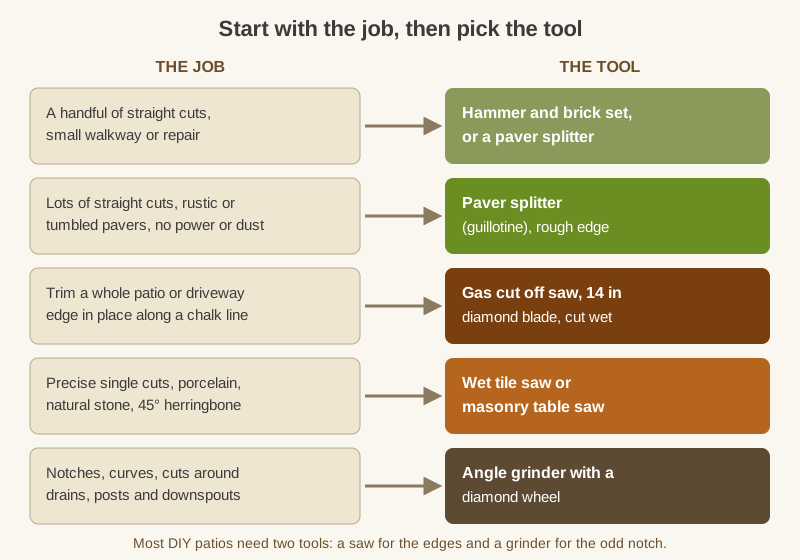
Here's how that plays out on typical jobs:
- Small walkway, running bond, 10 to 20 cuts. A splitter or brick set for straight cuts, a grinder for notches. No saw rental.
- Patio of a few hundred square feet in herringbone. Every edge paver needs a cut. Rent a gas cut off saw for a day and trim the edges in place along a chalk line. Keep the grinder for the notches around downspouts and posts.
- Driveway. Thicker pavers and long edges make the cut off saw the only practical choice, with a masonry table saw if you'd rather cut pieces one at a time.
- Porcelain or natural stone patio. Use a wet tile saw or masonry saw with the right blade. A cut off saw and a segmented blade will chip the edges.
- Tumbled or rustic pavers, dust-sensitive site. A splitter, then a grinder for the rest.
Rent or buy? Buy only what you'll use again: a grinder, a brick set, good glasses and hearing protection. Anything with an engine or water tray gets rented. A masonry saw is a 100-pound water feature you'd store for years between uses, and one well-planned rental day covers every edge cut on a typical patio if you lay the whole field first and batch the cuts. Family Handyman's roundup of seven ways to cut pavers walks through each method with photos, from chisel to demolition saw.
Rent the saw for the edges, keep a grinder for the rest
No single paver cutting tool does everything well. For a typical DIY patio, the winning pair is a rented gas cut off saw with a diamond blade for the edges, and your own angle grinder for notches, curves and touch-ups. Add a wet tile or masonry saw for porcelain, natural stone or precise cuts, and a splitter or chisel when the job is small, rustic or dust-sensitive. Once you've picked the tools, our guide on how to cut pavers walks through marking, cutting the last row and keeping slurry off the finished surface. Rent the loud one, own the small one, and the only thing left in your garage afterwards is a grinder and some very dusty jeans.
FAQ
What is the best tool to cut pavers?
For most projects, a gas cut off saw with a diamond blade, used wet. It's the fastest way to trim a whole edge in place and goes through any paver in one pass. For precise cuts or porcelain, a wet tile or masonry saw is better.
Can I cut pavers with a circular saw?
Yes, with a diamond masonry blade, but it cuts dry, makes a lot of dust, barely reaches through a 2 3/8-inch paver, and the grit is hard on the motor. Fine for a few cuts, not a whole patio.
Can a tile saw cut concrete pavers?
A larger 10-inch wet tile saw usually can, if its maximum cut depth exceeds the paver's thickness. Small 7-inch tile saws can't in one pass. For thick or numerous concrete pavers, a masonry saw or cut off saw works better.
Do I need a wet saw to cut pavers?
No. A cut off saw, grinder, splitter or chisel all work. But wet cutting is strongly recommended with any power saw on concrete pavers, because water keeps silica dust out of the air.
What is a paver cutting machine called?
Usually a masonry saw or brick saw: a table-mounted wet saw with a 14-inch diamond blade and a rolling cart. A hydraulic paver or block splitter is also sold as a paver cutting machine, even though it breaks pavers rather than sawing them.