

Last Updated on October 20, 2026 by Umar Farooq
Permeable pavers cost anywhere from $4 to $40 per square foot installed, and that is not a typo. The three guides I read disagree by a factor of three on the same product, because one is written by a manufacturer, one by a home-improvement publisher and one by a stormwater company. A sensible planning range for interlocking permeable concrete pavers is $10 to $30 per square foot, which is my own reading of where the sources overlap, and the biggest swing factor is not the paver. It is the depth of stone underneath.
I opened the three top-ranking guides, from Bob Vila, Rainplan and TrueGrid, and put their numbers side by side. Each covers material types and totals. None of them shows how the base depth turns into money, so I did that arithmetic below and labelled it.
Permeable pavers cost per square foot: three guides, three answers
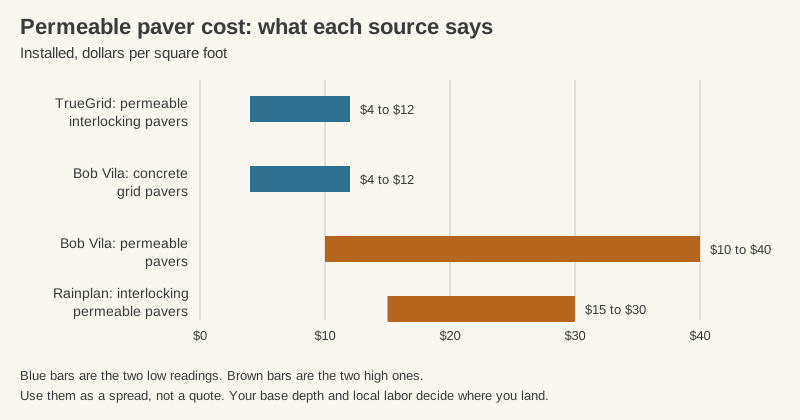
Here is what each page says for the interlocking concrete paver type, installed:
| Source | What it lists | Installed cost per sq ft |
|---|---|---|
| TrueGrid (a plastic grid manufacturer) | Permeable interlocking concrete pavers | $4 to $12 |
| Bob Vila (cites HomeAdvisor, Angi, HomeGuide) | Concrete grid pavers | $4 to $12 |
| Bob Vila | Permeable pavers | $10 to $40 |
| Rainplan (stormwater platform) | Permeable interlocking concrete pavers | $15 to $30 |
Do not average these. The $4 to $12 reading comes from a manufacturer of a competing product, on a page with no date and no cited sources. The $10 to $40 reading is a wide net of national averages. Rainplan's page states a headline range of $8 to $30 and a material table that puts the paver type at $15 to $30. It also contradicts itself in its own quick answer. Bob Vila's body text and table disagree on pervious asphalt too ($6 to $12 against $6 to $15).
Where the numbers overlap is $10 to $30. That is where I would plan, and it is a planning range and not a quote. If a contractor quote lands well outside it, ask what is in it before you argue about the paver.
Cost by type: start with the cheaper ones
Before you price interlocking permeable pavers, price the alternatives. They are cheaper, and for some jobs they are fine.
| Type | TrueGrid | Bob Vila | Rainplan |
|---|---|---|---|
| Plastic or grass grid pavers | $3 to $9 | $5 to $10 | $5 to $12 |
| Pervious concrete | $8 to $16 | $6 to $15 | $8 to $18 |
| Porous or pervious asphalt | $7 to $13 | $6 to $15 | $7 to $15 |
| Interlocking permeable pavers | $4 to $12 | $10 to $40 | $15 to $30 |
| Natural stone pavers | $10 to $30 | not listed | $15 to $25 |
All figures are installed, per square foot, as each page states them. Rainplan's stone figure is from its quick answer, and its own table puts concrete options lower, so treat it as soft.
The cheapest permeable surface is a plastic grid filled with gravel or grass. It also looks like a plastic grid. Pervious concrete and asphalt are poured, need special equipment and are a professional job, which Bob Vila says outright. Interlocking pavers cost more because the stone, the labor and the finish all go up, and they are the only option here that you can lift, fix and relay by hand. Worth a read next: pervious concrete vs permeable pavers.
If you only need a driveway that does not flood the street and you are not fussed about looks, price the grid and the porous asphalt first. If you want a patio that looks like pavers, keep reading.
The stone under the pavers is the line item most guides skip
The paver is the part you see. Under it is open-graded stone, with no sand anywhere. CMHA's permeable guide specification builds it from 2 inches of No. 8 stone bedding over 4 inches of No. 57 base over a No. 2 subbase, with the subbase thickness set by how much water the site has to hold (CMHA PAV-GSP-016-21). That makes the stone at least 6 inches deep before the subbase is added, against a 4 inch compacted base for an ordinary patio.
Bob Vila prices crushed rock at $40 to $86 per cubic yard, about 1.5 tons per yard, installed 6 to 18 inches deep. Here is the arithmetic, which is mine and covers stone only (no delivery, no waste, no excavation, no labor):
| Stone depth | Square feet per cubic yard | Stone cost per sq ft |
|---|---|---|
| 6 in | 54 | about $0.74 to $1.59 |
| 12 in | 27 | about $1.48 to $3.19 |
| 18 in | 18 | about $2.22 to $4.78 |
One cubic yard is 27 cubic feet, so it covers 54 square feet at 6 inches. The stone itself is a small slice of $10 to $30. The real cost is the digging and hauling of 12 to 18 inches of soil out and the same volume of stone in. Rainplan puts driveway excavation at 12 to 24 inches and demolition of an old slab at $2 to $5 per square foot. In my reading, that is where a quote moves.
The CMHA spec also says the base and subbase are compacted with a vibratory roller of at least 10 tons, with the subbase placed in lifts no thicker than 8 inches. A rental plate compactor does not match that. This is one reason a permeable driveway is not a casual weekend job, and the pavers are almost beside the point.
Project totals: a patio and a two-car driveway
Using the published ranges, here are the totals. The first column is each guide's own figure where it gives one, and the rest is my multiplication, labelled.
| Project | Source figure | My multiplication |
|---|---|---|
| 200 sq ft patio | Rainplan: $1,600 to $6,000 | At $10 to $30 per sq ft: $2,000 to $6,000 |
| 640 sq ft two-car driveway | Bob Vila: $6,400 to $25,000 for permeable pavers | At $10 to $30 per sq ft: $6,400 to $19,200 |
| Permeable driveway, whole project | HomeAdvisor via Bob Vila: $5,000 to $12,000, average $7,500 | Not comparable: the size is not stated in the guide |
A permeable paver patio is a small job, and small jobs cost more per square foot. Rainplan says a 100 square foot walkway can run $12 to $30 per square foot against $8 to $20 for a 500 square foot driveway from the same contractor. That is one company's statement and not a measured study, but it matches how contractors price mobilization.
For ordinary concrete pavers on a driveway, see the ranges in our paver driveway cost guide. That guide's numbers come from a different source, so compare the logic and not the decimals.
Rebates and credits can erase the premium
Some cities and sewer utilities pay for permeable surfaces, or cut the stormwater fee for them. Rainplan claims rebates can cover $10 to $20 per square foot and utility credits $5 to $25 per month. Treat that as a pitch, since Rainplan's business is finding those programs, and the page names no sources. The one program I could confirm is described in our permeable concrete pavers guide: the District of Columbia's rebate of $15 per square foot, with conditions about size, water source and installer certification.
Before you price anything, call your stormwater utility and ask three things: is there a rebate or fee credit, does it require a certified installer or inspection, and does a permeable driveway still count against your impervious-coverage limit. A $15 rebate on a $20 job changes the math completely. A rebate that needs pre-approval and you installed first changes it back.
Where DIY saves money and where it costs you
Bob Vila says DIY can cut labor costs only for experienced people with the right tools, and it puts driveway labor at $5 to $11 per square foot. So labor is a real slice of the price, and it is the slice a DIYer can actually remove.
Here is the cheaper-option opinion. On a patio, you can do the paver laying yourself and hire out the heavy part, the excavation and stone delivery. On a driveway, the load, the base depth and the roller requirement mean the base is where hiring pays. A mistake in the stone is buried under the pavers, and the only way to find it is a puddle.
Our DIY vs contractor paver patio cost guide covers the general split. The permeable twist is that you cannot use sand in the bedding or the joints. If your supplier hands you a bag labeled paver sand, send it back.
Buy permeable for a reason, and pay for the stone first
Permeable pavers cost more than standard pavers because of the stone, the dig and the haul, not because of the paver. Choose them when something is paying you to: a rebate, a stormwater fee, a lot-coverage limit or a drainage problem. Otherwise a standard paver patio on a well-built base is the cheaper way to get the same look. The pavers get the glamour. The stone gets the invoice.
FAQ
How much do permeable pavers cost per square foot?
Published ranges run from $4 to $40 per square foot installed. The three guides I read overlap at roughly $10 to $30 for interlocking permeable concrete pavers. Base depth, excavation and project size decide where your quote lands.
Are permeable pavers more expensive than regular pavers?
Usually, yes, because of the deeper open-graded stone base and the extra digging. The paver is not the main difference. Standard pavers use a 4 inch compacted base and a sand bed, while permeable pavers use at least 6 inches of clean stone and no sand.
How much does a permeable paver driveway cost?
Bob Vila's example is $6,400 to $25,000 for a 640 square foot two-car driveway with permeable pavers. Rainplan gives $4,000 to $15,000 for a 400 to 500 square foot driveway. Get at least three local quotes.
Are permeable pavers worth the cost?
They are worth it when a rebate, a stormwater fee credit, a lot-coverage limit or poor drainage makes them pay back. If none of those apply, a standard paver surface gives the same look for less.
Can I install permeable pavers myself?
The paver laying is doable for an experienced DIYer, but the base is the hard part. CMHA's spec calls for a roller of at least 10 tons on the subbase and base, and mistakes are buried under the surface. Many people hire out the excavation and base and lay the pavers themselves.


