

Last Updated on October 20, 2026 by Umar Farooq
The pinwheel paver pattern is built from a block of four identical rectangles turning around one small square, like the blades of a pinwheel. With 4 x 8 inch rectangles and 4 x 4 inch squares, the block measures 12 x 12 inches. It looks busier and more custom than running bond, needs a precise mix of two paver sizes, and works best as a focal point rather than a whole driveway.
Most pattern pages give it one sentence and a photo. Here is the geometry, so you can order the right pavers and avoid a pile of mismatched leftovers.
The 12 inch block behind the pinwheel paver pattern
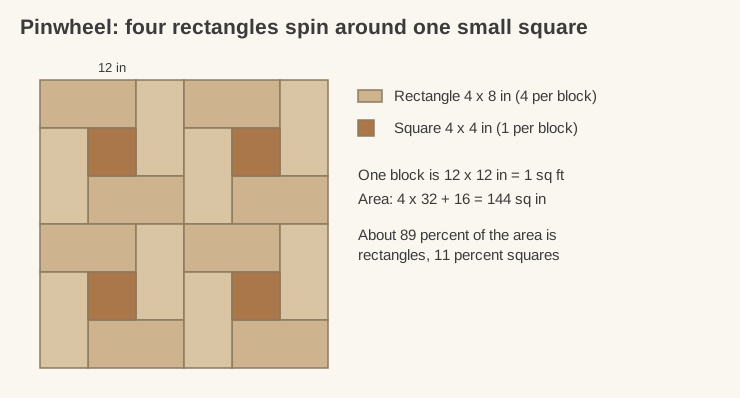
Unilock describes the pattern as pavers placed in a circular arrangement, each at 90 degrees to its neighbor, with the direction rotating in alternating sections to suggest a spinning pinwheel. The dimensioned two-tile version on Dimensions.com gives the same idea in numbers: four rectangles meet, and the gap left in the middle is a square half the rectangle's size.
Using 4 x 8 inch pavers:
- Rectangle one runs along the top, rectangle two down the right side, rectangle three along the bottom, rectangle four up the left side.
- Each one overlaps the next by a paver width, which is what makes the spin.
- The hole in the middle is 4 x 4 inches, filled by a square paver.
Block size: 8 + 4 = 12 inches each way. Area: four rectangles at 32 square inches plus one square at 16 equals 144 square inches, exactly one square foot. That tidy fact is the whole planning method.
The pavers to buy: a 4 to 1 ratio
One block uses four rectangles and one square, so every square foot of pinwheel needs the same four-to-one mix. Rectangles cover about 89% of the surface and squares about 11%.
A worked example for a 12 x 12 ft patio:
- 144 blocks, since each block is one square foot
- 576 rectangles (4 x 8 inch)
- 144 squares (4 x 4 inch)
- Plus 5 to 10% for cuts and breakage
Do not try to mix two products to get there. Colors and thickness differ between lines, and a pinwheel shows the mismatch because the small squares sit in the center of every block. Buy the manufacturer's pinwheel set, which comes pre-mixed in the right ratio on the pallet, and follow its layout sheet. The method for counting is in how many pavers do I need.
Where a pinwheel earns its place
A pinwheel has more going on than any other pattern in this family, so use it where you want the eye to stop.
- A rug inside a running bond field. A square pinwheel panel, surrounded by a running bond paver pattern, creates a focal point under a table.
- A courtyard or entry landing. The block repeats in all four directions, so it looks the same from any side.
- Not a long walkway. A narrow path cuts the blocks into fragments at both edges, and you lose the pattern.
Unilock suggests exactly this: use it to create a central focal point or accentuate one part of a patio. I agree, with one extra reason. It is easier to lay one 6 x 6 ft panel perfectly than a whole 600 sq ft driveway, and the contrast with plainer paving makes the panel look deliberate.
Setting out a pinwheel from the center
Start where the pattern will be seen, not in a corner.
- Find the center of the panel and mark it with two crossing string lines.
- Place the center square, then wrap four rectangles around it, each one turned 90 degrees from the last.
- Add the next ring of blocks outward. Each new block lines up with the square and rectangles beside it.
- Check the 12 inch grid with a string every row. An error here shows as blocks that no longer meet at the corners.
- Install the edge restraint and cut the edge pieces last, then compact. Paver installation covers the sequence.
The base is the usual one: at least 4 inches compacted on well-drained soil and 1 inch of loose, screeded sand (ICPI Tech Spec 2).
Cuts, edges and sizing in whole feet
A 12 inch block means a patio sized in whole feet lands on whole blocks. A 10 x 14 ft patio is 140 blocks with no edge cuts. A 10 ft 6 in width ends on a half block, so every edge paver is cut.
Because pinwheel blocks have rectangles pointing in all four directions, an edge that cuts through a block leaves different shaped scraps along each side. Keep every piece at least a third of a paver, and expect more cutting than running bond. The how to cut pavers guide covers the tools and dust control.
Pinwheel against its neighbors
| Running bond | Basketweave | Pinwheel | |
|---|---|---|---|
| Paver sizes | 1 | 1 | 2 (4:1) |
| Skill | low | low to medium | medium to high |
| Cuts at edges | few | few if sized in 8 in steps | more |
| Best use | whole field | patios, courtyards | focal panel |
Use a pinwheel as the accent, not the whole field
The pinwheel paver pattern rewards care: one precise block, one fixed ratio of two sizes, and a layout that starts at the center. Lay it as a panel inside a plainer field and it looks custom. Lay it across a whole yard and every small error repeats.
FAQ
What pavers do you need for a pinwheel pattern?
Two sizes from one product line: rectangles twice as long as wide and a square the width of the rectangle. A common set is 4 x 8 inch rectangles with 4 x 4 inch squares.
How many squares go with the rectangles?
Four rectangles to one square. Every 12 x 12 inch block uses four rectangles and one square.
Is the pinwheel pattern good for a driveway?
It is a decorative pattern. For vehicle traffic, herringbone is the pattern installers trust, so confirm any other layout with the paver manufacturer before using it under cars.
Is the pinwheel pattern hard to lay?
It is harder than running bond because every block must turn correctly and the ratio of sizes must be exact. Starting at the center and checking the 12 inch grid keeps it manageable.
Can I use a pinwheel pattern for part of a patio?
Yes, and it is often the best way. A square pinwheel panel inside a running bond or soldier-course border makes a focal point without committing the whole patio.


