

Last Updated on October 20, 2026 by Umar Farooq
A running bond paver pattern lays rectangular pavers in straight rows, with every row shifted by half a paver so the cross joints never line up from one row to the next. It is the brick-wall layout. It needs few cuts, suits patios, walkways and light driveways, and forgives the small alignment slips that a stack bond grid would show.
If you only learn one pattern, learn this one. It is the layout I would give a first-time builder, and the rest of this page explains why, plus how to lay it.
What a running bond paver pattern looks like up close
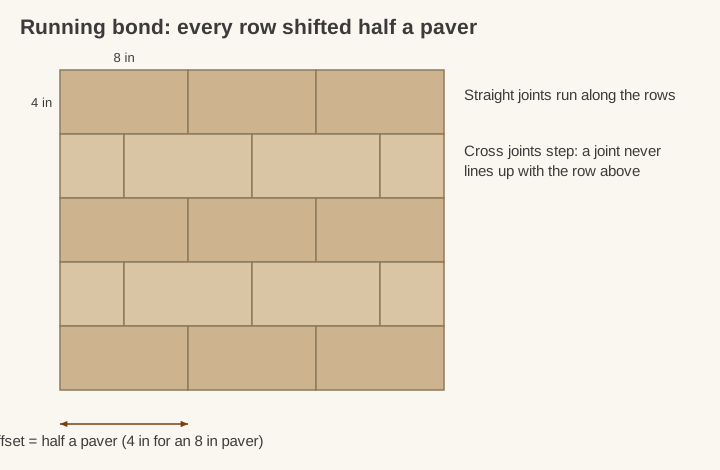
Take a 4 x 8 inch paver. Lay a row of them end to end. Start the next row half a paver (4 inches) over, so each paver sits across the joint below it. Repeat. That is the whole pattern, and it is also called stretcher bond when it comes from brickwork.
Two things follow from the geometry:
- Joints between rows run straight. Those long lines are the pattern's signature, and they give you an easy string line to check against.
- Cross joints step. No cross joint sits above another, so a load on one paver is shared with the two pavers underneath it.
Western Interlock's pattern guide calls running bond a structural pattern that suits heavy foot traffic and even vehicles. For cars, though, most installers still prefer herringbone, because the long joints give the pavers a line to creep along. If a driveway is the plan, read herringbone pattern paver patio next.
Which pavers work in a running bond layout
Almost anything rectangular does. Belgard's pattern guide pairs running bond with 6 x 9 pavers and plank pavers, and Western Interlock notes it works with any single rectangle or square, or a matched pair of sizes that avoids most cutting.
The shape matters less than the thickness. The CMHA's Tech Spec 10 says pavers with a length-to-thickness ratio of 4:1 or more should stay off vehicle areas, and 3:1 or less suits all vehicles. Run the numbers on common sizes:
| Paver | Thickness | Ratio | Where it fits |
|---|---|---|---|
| 4 x 8 in | 2 3/8 in | about 3.4:1 | patios, walks, light driveway use |
| 6 x 9 in | 2 3/8 in | about 3.8:1 | patios, walks, light driveway use |
| 4 x 8 in | 3 1/8 in | about 2.6:1 | any vehicle use |
| 6 x 24 plank | 2 3/8 in | about 10:1 | patios and walks only |
The last row is why plank pavers in running bond look sleek and stay off the driveway.
Rows along the walk or across it?

Direction is the only real design decision, and it changes how the space reads:
- Rows along a walkway lengthen it and draw the eye to the door.
- Rows across a walkway make it look wider, which helps on a tight side path.
- On a patio, rows parallel to the house look calm. Rows at 45 degrees add movement, but every edge paver then needs an angled cut.
- On a driveway, Western Interlock suggests laying the stones widthwise to the direction of travel.
Unilock also points out that visible joint lines can make a small patio feel more intimate. A pattern with strong lines is a quiet advantage in a small yard, and it is the reasoning I would use for any small patio.
How to lay a running bond paver pattern in 7 steps
The base and sand are the same as any paver job: at least 4 inches of compacted base on well-drained soil (6 inches for a driveway), and 1 inch of loose, screeded bedding sand (ICPI Tech Spec 2). The layout steps are what change:
- Set the edge restraint or a straight reference. Pick the longest straight edge and run a string line parallel to it.
- Lay the first row along the string. Use whole pavers, butted tight, and keep the joints even.
- Start row two half a paver over. A half paver at the start of every second row is the only cut you need if the width fits.
- Click each paver down into the sand from the laid surface. Never kneel on screeded sand.
- Check the long joints with a string every three rows. A drifting row looks like a small error now and a slope later.
- Leave the edge cuts for last. Lay every whole paver first, then cut the border pieces in one session.
- Compact, sweep in joint sand, compact again. See paver installation for the full sequence.
Skip the sand-as-leveler shortcut. If the base has a dip, fix the base; two inches of sand in one spot settles more than one inch everywhere else.
Cuts, waste and how many to order
Running bond wastes less than any pattern laid on a diagonal. Size the patio so each row ends on a whole or half paver and you cut almost nothing. Measure a dry row first and shift the width an inch or two if it saves a sliver.
A worked example: a 10 x 12 ft patio is 120 sq ft. At 4.5 pavers per square foot for a 4 x 8, that is about 540 pavers. Add 5 to 10% for cuts and breakage, which gives 570 to 600. The method is in how many pavers do I need, and the cutting itself is covered in how to cut pavers.
Where running bond falls short
Running bond has one weakness: its long joint lines. Under braking and turning tires, pavers can slide along them, which is why herringbone wins on driveways. On a patio the issue is smaller, but the lesson holds: without a solid edge restraint, the outer row rolls, the joints open, and the pattern drifts toward the grass.
Also be honest about the look. It is plain. It is the beige chinos of paver patterns, and for many yards that is exactly the point. If you want more visual interest, add a soldier-course border in a second color rather than changing the pattern.
Choose running bond first, switch only for a reason
Pick a running bond paver pattern when you want a good-looking, low-waste layout and you are laying it yourself. Switch to herringbone when cars will drive on it, and to basketweave or pinwheel only when the house style asks for it. A clean string line and a solid edge matter more than which pattern you choose.
FAQ
Is running bond the same as stretcher bond?
Yes. Stretcher bond is the brickwork name for the same offset-row layout. On pavers it is usually called running bond.
Is running bond strong enough for a driveway?
It works for light residential use if the base and edge restraint are right and the pavers are thick enough. Herringbone resists the turning and braking forces of tires better, so most installers choose it for driveways.
How much do I offset the rows in running bond?
Half a paver length. For a 4 x 8 inch paver that is 4 inches. Half is the standard, and it is what keeps every cross joint centered over a paver below.
Does running bond need a lot of cutting?
No. On a rectangle sized to the paver, you cut only the half pavers at row ends and any border pieces. It is one of the lowest-waste patterns.
Which way should the rows run on a patio?
Parallel to the house for a calm look, or at 45 degrees for movement at the cost of more cuts. Pick the direction before you order, because it changes the waste.


