


Last Updated on October 20, 2026 by Umar Farooq
Uneven paver step risers are a trip hazard first and a looks problem second. The residential code lets risers in one flight differ by no more than 3/8 inch, so measure each riser from tread top to tread top. Inside 3/8 inch, leave it alone. Outside it, lift the pavers on the step that is off, rebuild what is under them and relay. Do not add sand and hope.
Measure uneven paver step risers the same way every time
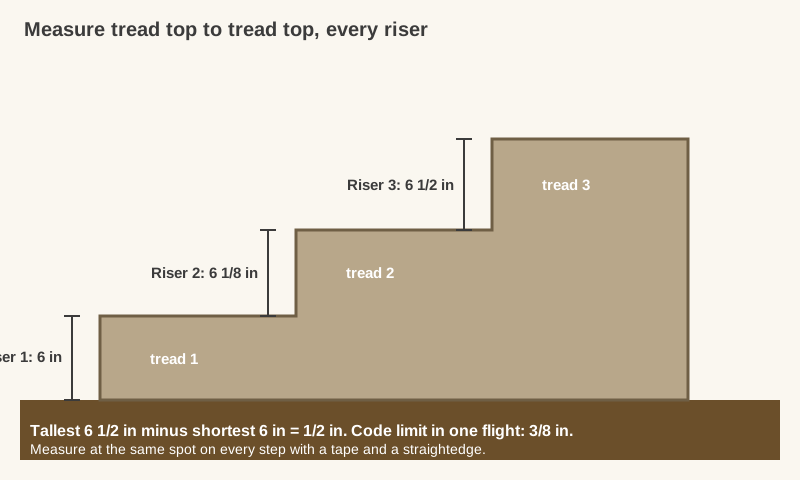
Lay a straightedge on each tread and measure straight down to the tread below, at the same spot on every step. Treat the ground at the bottom and the landing at the top as the first and last "treads". Subtract the shortest riser from the tallest.
The code is plain: "any variation of risers within a flight of stairs must not be more than 3/8 inch," and treads get the same tolerance (IRC R311.7.5.1 and R311.7.5.3, via Building Code Trainer). Freestanding garden steps are not always inspected, but an entry stoop usually is, so check local rules.
Why 3/8 inch is worth caring about
Your foot learns the first riser and assumes the rest match. In a study of 59 adults, one riser was made 10 mm taller than the rest. Going up, both groups lifted their foot about 9 mm less over it. Neither group changed their stride, so they apparently never noticed (TU Munich summary). My arithmetic: 10 mm is about 0.39 inch, close to the code limit. Nobody sees it. Everybody's toe finds it.
Find the step that moved
Was it ever right? Steps uneven on day one are a build error, usually because the riser was figured from the block and the cap added its own thickness (building steps with pavers covers that). Steps that were even and are not have moved. I found no study ranking the causes, so this table is my reading of the mechanics:
| What you see | Likely cause |
|---|---|
| One tread low, joints open around it | Bedding or base under that tread settled |
| Bottom riser taller than the rest | Ground or landing in front of it dropped |
| A riser block rocks or leans | Its base failed, or backfill behind it settled |
| Same error on every step | Caps or pavers of mixed thickness |
Water is the usual accomplice. A downspout beside the steps washes the base out from one corner, and the void returns unless you move the water first.
Reset one step, cheapest fix first
Pavers beat a poured step here: you can lift a piece, fix what is under it and put it back.
- Within 3/8 inch and stable. Leave it and re-measure after the next wet season.
- One tread low. Pull that step's pavers, add base stone, compact thin lifts with a hand tamper, screed a fresh 1 inch of loose bedding sand and relay. It is the job in how to fix sunken pavers, only smaller; This Old House lists the same order: lift, compact gravel, screed new sand, reset (This Old House).
- Riser block or cap off. Break the adhesive bond (paver adhesive), take the course down to the failed base, rebuild and compact behind it.
- Bottom step tall. Rebuild the landing in front, or reset the bottom course.
- Mixed thickness. Swap to units of one thickness.
I found no source with a cost per step, so I will not invent one.
Why extra sand will not rescue a low step
My one strong opinion: sand is not a leveling layer. CMHA specifies a nominal 1 inch of bedding sand and says "Do not disturb screeded sand" (PAV-GSP-011-21). Thick sand in a low spot compresses more than sand elsewhere, so the dip comes back. Scrap shims under a paver rock loose. I found no source recommending grinding a tall tread, and it ruins the finish. Fix the base, not the paver.
When to stop and call someone
- The steps serve an entry door and an inspector, buyer or insurer has flagged them.
- Four or more risers and no handrail; the model code wants one 34 to 38 inches high (IRC R311.7.8).
- The side walls or riser blocks are moving, or the steps hold back soil (paver retaining walls).
Photograph each riser with the tape in frame first. If a contractor built them, that is warranty evidence.
Keep the next riser from drifting
Send downspouts away from the steps, compact behind every riser as it goes up, and measure each finished riser, cap included, before the next course goes on.
Past 3/8 inch, rebuild that step and skip the sand
The fix is local: one step, one base, one afternoon. If your tape says 6 1/8 inches next to 6, that is fine. Put the tape away.
FAQ
How much variation is allowed between stair risers?
The model code (IRC R311.7.5.1) allows no more than 3/8 inch between the tallest and shortest riser in a flight. Local codes differ.
Can I fix one uneven paver step without redoing the whole flight?
Usually yes. Lift that step's pavers, rebuild the base and relay, then measure the whole flight again.
Why is my bottom step taller than the rest?
Often the ground or landing in front of it dropped. Look for a gap under the first block and for pooling water.
Are uneven risers really a trip hazard?
A study of 59 adults found they lifted their feet about 9 mm less over a riser 10 mm too tall and did not adjust.
Can I put extra sand under a low paver step?
No. Bedding sand is a nominal 1 inch, screeded and undisturbed. Fix the base, then screed 1 inch.


