


Last Updated on October 20, 2026 by Umar Farooq
Laying pavers in the rain works in a drizzle as long as the stone base underneath is firm and not water-logged, and you do not let the screeded sand bed turn to soup. Stop in heavy rain, cover the sand and the base when a downpour is coming, and keep joint sand out of the wet entirely. Rain damages a paver job in two places, the bedding sand and the joint sand, and everything else mostly shrugs it off. The hot-weather short version is at the end.
Nobody publishes a manufacturer rule for "how much rain is too much", and I looked. What exists is a handful of installer opinions and the product data sheets for joint sand. The advice below sorts the two apart so you can see which is which.
Laying pavers in the rain: where drizzle ends and a downpour begins
A paving forum thread I read puts it plainly: carry on as long as the sub-base and the sand are not "soggy and water logged", and stop when they are. That is one installer's rule of thumb, not a standard, but it matches what the mechanism says. Compacted stone that is damp is fine. Stone that is saturated will not stay compacted under a plate, and sand that is saturated will not screed flat.
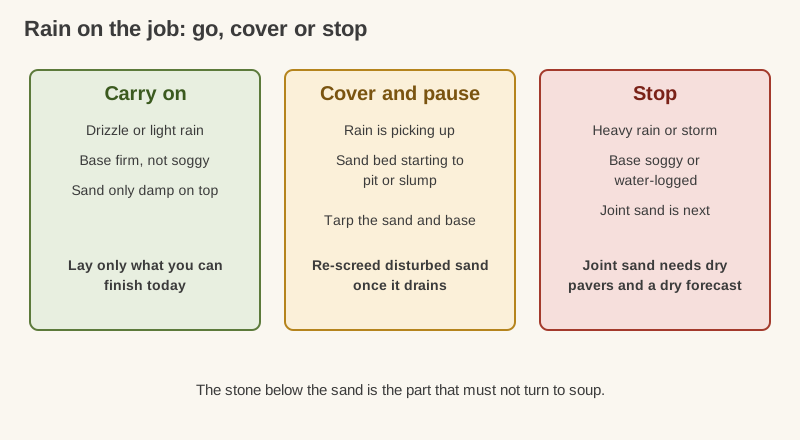
Use three signals, not the weather app:
- Does your boot sink into the base? If it leaves a print, stop.
- Is the screeded sand pitting or running? If rain is pocking the surface or carrying sand toward the low edge, cover it.
- Is water standing on the base? That is a drainage problem to fix before the sand goes on. See patio drainage for how to deal with it.
Protect the sand bed first
The bedding sand is the vulnerable layer. CMHA's rule for it is "Do not disturb screeded sand", and rain disturbs it better than any boot. My advice, not a cited standard:
- Screed only as much as you will cover today. Never leave a long strip of bare sand overnight.
- Tarp the sand and the open base at the end of every day, and weigh the edges down so it does not become a sail.
- If rain hits fresh sand, wait for it to drain, then re-rake and re-screed the top inch. For a handful of wet pavers, lift them and relay rather than patching around them.
- Keep your own footprints off it. Roger Cook's line in the This Old House paver guide is worth repeating: "The trick to pavers is not to drag them in the sand."
Screeding sand for pavers covers how thick and how flat the sand should be before you cover it.
Joint sand is the real casualty
Plain sand in the joints can be put down damp. Polymeric sand cannot. This Old House says polymeric sand must go on a completely dry surface and suggests checking for "two to three rain-free days before application". Western Interlock goes further: pavers and bedding should be "bone dry" before the final compaction, or moisture is pushed into the joints and leaves hardened residue.
The after-the-fact rain windows on the data sheets are short. Techniseal's HP NextGel data sheet says the sand withstands rain 60 minutes after install, but needs 24 to 48 hours to dry fully. Alliance Gator's SuperSand G2 says rain safe 15 minutes after water activation. Those are minimums, not invitations to push your luck, and different products give different numbers, so the bag in your hands wins. See how long polymeric sand takes to dry for the full picture, and polymeric sand washed out if you are reading this after the rain has already arrived.
If you cannot wait: slurry jointing
One UK paving forum thread describes a workaround for a driveway job that kept getting rained on. The method, endorsed by other posters: compact the pavers, spread ordinary sand (not polymeric), soak it with a hose until it flows, brush it into the joints from the high point to the low, rinse off the excess, and leave it about 24 hours so water drains from the bedding. Another poster warned not to compact straight after, but to wait 24 to 48 hours.
That is a forum technique on British block paving, not a US spec, and I would not use it with polymeric sand. If your polymeric sand deadline cannot move, move the deadline.
A short note on hot weather
I looked for a maximum laying temperature for pavers and could not find one. What the data sheets do give is temperature windows for the products you add afterwards. Techniseal's natural-look sealer says to apply at 50 to 85 degrees F with no rain forecast for 24 hours, and Alliance Gator's wet-look sealer says 60 to 85 degrees F, after 48 hours of dry conditions. Neither is a laying limit, but both show 85 degrees F as the ceiling for the finishing work. Practically, hot days mean the sand dries fast and the compactor shakes harder at lunchtime than at 8 am, so start early. That last part is common sense, not a sourced figure.
Cold is a different rule set: joint sand needs temperatures above 32 degrees F, covered in laying pavers in winter.
Lay what you can finish before the sky changes its mind
A drizzle is an inconvenience. A saturated base and a washed-out sand bed are a re-do. Keep the stone firm, cover the sand every evening, keep polymeric sand for a dry week, and let the rain have the rest of the day. The pavers will still be there tomorrow. They are, famously, not going anywhere. (Unlike the sand, if you leave it uncovered.)
FAQ
Can you lay pavers when it is raining?
In light rain, yes, if the base is firm and the screeded sand is not saturated. In heavy rain, stop and cover the sand and open base. Keep polymeric sand out of any wet conditions.
Can you lay pavers on wet sand?
Damp sand is workable, but sand that is saturated or running will not screed flat or compact properly. Let it drain, then re-rake and re-screed the top layer. If the whole bed is soggy, wait.
Can you compact pavers when it is wet?
Compacting wet bedding sand pushes moisture up into the joints, which matters most when you plan to use polymeric sand. Western Interlock says the pavers and bedding should be bone dry before the final compaction.
How long after rain can you lay pavers?
There is no single rule. The base should be firm underfoot and the sand bed should have drained. For polymeric sand, This Old House suggests two to three rain-free days before application, and your product's data sheet sets the real minimum.
What happens if it rains on polymeric sand?
Rain before it has set can wash polymers onto the paver surface or out of the joints. Techniseal's HP NextGel withstands rain after 60 minutes and Alliance Gator's G2 after 15 minutes from activation, so timing and product both matter.


